Monday, July 17, 2017

What's on the Council agenda for 7/18/2017: $26 million from the 4% fund.

The Metro Council will meet Tuesday, July 18, 2017 at 6:30 PM in the Council chamber at the Metro Courthouse. There is not much of interest on the agenda.  There is nothing that I would expect to generate debate or passion. There is a large spending bill but it probably will not generate controversy and it probably shouldn't.  It is routine except it is for a lot money but it is a lot of request from different departments, all rolled into one bill. There is an anti-home sharing bill on the agenda but it is most likely going to be deferred.

To watch the Council meeting, you can go to the courthouse and watch the meeting in person, or you can watch the broadcast live at Metro Nashville Network's Government TV on Nashville's Comcast Channel 3 and AT&T's U-verse 99 and it is streamed live at the Metro Nashville Network's livestream site. You can catch the meeting the next day (or the day after the next) on the Metro YouTube channel. If can stand the suspense and just wait, I will post the video on this blog the day after or the day after that and provide commentary.

If you are going to watch the Council meeting, you need a copy of the Council agenda and the Council staff analysis or you really will not know what is going on. You can get the agenda and analysis at the highlighted links.

There are six appointment to Boards and Commissions on the agenda and you can expect all to be approved unanimously. One of the appointees is to the Hospital Authority. If the Council would do so, the approval of an appointee to this money pit would be an occasion for the Council to influence policy but the Council does not take advantage of this opportunity and will simply rubber stamp the mayors appointee.

There are two bills on public hearing, one revises and sets the tax levy rates for the central business improvement districts in the Gulch area and the central business improvement district for downtown. Properties in these two district pay an addition tax levy to support additional services provided in those districts. Following the recent reappraisal of property within Davidson County, including the property within the DCBID and GCBID, the special assessment rate for each district must now be lowered. This is routine and should not generate controversy. There are no resolutions on public hearing. There are only 5 bills on First Reading, and they are all lumped together and pass by a single vote. First Reading is a formality that gets a bill on the agenda. Bill are not scrutinized or considered by committee until after First Reading.

Resolutions
There are 18 resolutions all of which are on the consent agenda. A resolution stays on the consent agenda if it passed the committees to which it was assigned unanimously. Since the committees have not met yet, some resolutions which are listed as on the consent agenda may not be on the consent agenda when the council meets. Bills on the consent agenda are usually not controversial and tend to be routine matters, such as accepting grants from the Federal or State Government or authorizing the Department of Law to settle claims against the city or appropriating money from the 4% fund. Resolutions on the consent agenda are passed by a single vote of the Council rather than being considered individually. Any member of the body may have a bill pulled off of the consent agenda or have there "no" vote or abstention recorded. None on the resolutions on this agenda appear controversial.

RESOLUTION NO. RS2017-785  appropriates a whopping $26 million from the General Fund Reserve Fund, also called the 4% fund, for the purchase of equipment and building repairs for various departments of the government. I think this is one of the largest request ever made from this fund in a single bill. I hope the Council Budget and Finance Committee very carefully evaluates each of these request. The largest request are $1 million for General Hospital, $4 million for Police for mobile vehicle laptop computers and printers and a start on equipping police with body cameras, $1 million for Libraries and $1 million for Parks.

RESOLUTION NO. RS2017-786  and RESOLUTION NO. RS2017-787 appropriates money to subsidize the development of what is called "workforce housing." This is housing for those who make between 60% and 120% of the area median income.

Bills on Second Reading. These are the ones of interest.
BILL NO. BL2017-801  and BILL NO. BL2017-802  both deal with obstruction or closure of public right of ways.  801 says that says that if a right of way is going to be obstructed for six months or more that the applicant must also get approval from the Director of the Mayor's Office of Neighborhoods and Community Engagement and the Director of Transportation and Sustainability. Currently, the applicant must simply get the approval of the Public Works Department.  802 would impose a fine for obstructing or closing a right of way without a permit or exceeding the scope of what is authorized by the permit.  While I hate to make it even more cumbersome  for companies to do business, construction closing or blocking of a street can be an inconvenience to the public. I do not know how serious of a problem this is however, but these requirements seem reasonable.
Bills of Third Reading of interest. 
BILL NO. BL2017-608 would restrict all home sharing (Short Term Rental Property, AirBnB), in which the owner does not live on the property to areas zoned for multi-family.  This is likely to be deferred. An  ad hoc committee is still working on other proposals to take away property rights of those sharing their home and this will be considered by that committee to come up with a more comprehensive set of ordinances or one big ordinance that address the issue of home sharing.

BILL NO. BL2017-701  by Karen Johnson is a bill disapproved by the Planning Commission.  It would apply an Urban Design Overlay District on 11.25 acres on Moss Springs Rd and Bluewater Trace. An Urban Design Overlay is a tool to insure that future development or redevelopment is in character with what already exist in the neighborhood and addresses such things as height  of buildings and construction material and orientation of the front door and location of the garage. The Planning Commission says this would impose standards that are more stringent than what constitutes the current character of the neighborhood. A disapproved bill requires 27 affirmative votes to pass.

BILL NO. BL2017-719 by Scott Davis  is a rezoning bill disapproved by the Planning Commission. It will require 27 votes to pass.  I am only pointing out this bill because it is disapproved. Some council members will not vote contrary to a Planning Commission recommendation and doing so is often frowned upon as "councilmanic courtesy." I do not think the Planning Commission should never be overruled, otherwise why not just make the Planning Commission the final authority. On the other hand, I do not think the local council member should have any property he wants rezoned, rezoned without question.  Ideally when voting to override the Planning Commission, council members should carefully evaluate the rezoning on its merits.
 
BILL NO. BL2017-741 would require that private parking lots or garages post a sign listing the amount of any fines or penalties that may be charged by the parking facility and to post such information not only at entrances but also at each automatic pre-payment station for those with that type arrangement. Parking facilities must already post their parking fees at the entrance of the facility. This seem reasonable.

BILL NO. BL2017-782 by Councilman Roberts is another rezoning bill disapproved by the Planning Commission. 

Stumble Upon Toolbar
My Zimbio
Top Stories

Sunday, July 16, 2017

What is “Fake News”?

by Bill Bernstein
The term “Fake news” or inevitably on social media "#FakeNews," became current largely with last year's presidential election and its coverage.  Famously Pres Trump dismissed a CNN reporter's repeated questions at a press conference with the comment “You're fake news.”

But what is fake news?  And why is this so popular now?  For starters fake news is not new, although the variations we are seeing are.  In the past, propaganda, deliberate misinformation, and “yellow journalism” were all common occurrences where governments, politicians or newspaper publishers all wanted something more than to report news. 

But fake news is not simply “facts or opinions I disagree with.”  Truth can be challenging sometimes.
There are many variations of fake news.  Some are obviously fake: stories about Prince Harry having a secret wedding in Las Vegas are simply fiction.  These are easy to spot, as are most “conspiracy” stories. So here are some tips to recognize FakeNews stories:

1).  Any story with “might have” or “could have” is speculation, and very likely #FakeNews. 

Here's a howler from CNNMoney online: The headline reads: Ethics watchdog says White House lawyer might have broken rules.

That sounds like a member of the Trump staff broke ethics rules or committed some kind of crime.  But you have to read in to the story to discover that 1) the “rules” of the headline were ones the administration itself created, 2) even those rules don't apply to people who don't actually work for the administration in any official capacity, in this case Carl Icahn, who was merely an unofficial advisor.  The entire case comes down to an interview the attorney alleged to have violated the rules gave where he stated Icahn was not an official advisor to the President.  And by the way, the “Ethics Watchdog”, Walter Schaub resigned about three weeks later.  Probably for getting into trouble pushing a fake sensationalized story like this.

2) Any story where the headline or lead is not supported by facts given in the body of the story is #FakeNews.

Sensational headlines that oversell the story in the article are by definition #FakeNews. Here's an excellent example of the genre from the Tennessee Star: The headline reads: Mayor Megan Barry Says The Constitution Does Not Apply Here in Nashville: ‘I Am Committed to Meeting the Goals of the Paris Agreement – Even if the President Is Not’

Now, if Megan Barry says The Constitution does not apply in Nashville then there should be a quotation or statement from Mayor Barry that says exactly that, or substantively that.  Read in the story and there is no such thing.  President. Trump decided to withdraw from the Paris Accord on climate change.  Mayor Barry condemned the decision, unsurprisingly, and affirmed her commitment to instituting policies that would follow the principles in the Paris Accord.  A mayor instituting policies in her own city is not a violation of the Constitution, however poor the policies are.  The only proof offered to support the headline is this statement in the story: Constitutional law experts around the country have stated that such declarations are in direct violation of Article 1, Section 10 of the Constitution of the United States.

The article cites no Constitutional law experts saying any such thing.  And the assertion is prima facie absurd.

3) Any story with George Soros in it that is not about George Soros is very likely #FakeNews.

Soros is a billionaire hedge fund manager who has a charitable foundation and gives heavily to left wing causes.  But in the conservative world Soros takes the position of “International Banker” (or “International Jew Banker” to hold up an old stereotype) and is always a mysterious shadowy figure intent on harming America and its way of life. In this, Soros replaces “the Rothschilds” (the prototypical International Jew Bankers) and “the Rockefellers” (often identified erroneously as Jewish by anti Semites) in the role of conspirator against American values. Here's a particularly egregious example: Vartan Gregorian: Islamic Trojan Horse.

Side note: Any article signed with a pseudonym (here “Politically Incorrect”) is almost certainly fake news as real journalists want their names known. Now Vartan Gregorian is a well known academic and while he was born in Iran he comes from an Armenian Christian family and is not, as the article alleges “an unassimilated Muslim.”  The article starts with an unflattering description of George Soros and then asserts an association between Soros and Gregorian.  Unfortunately there is no evidence, in the real world, much less in the article, that the two men even have met each other, much less have some kind of evil relationship.  Soros is trotted out simply because he is a known “bad guy” so guilt by association helps paint Gregorian as a threat.

4) Any story pushing an affiliation not directly relevant to the story is likely #FakeNews.

Speaking of guilt by association, use of the term “affiliate” is always suspicious.  Anyone active in public life who belongs to organizations and/or donates to them could be said to be “affiliated” with anyone else belonging to or donating to the same organization.  It is meaningless in judging a person's intent or character to assert an association, especially with a known bad guy.
An especially egregious example again comes from the Tennessee Star: La Raza Affiliate That Randy Boyd Gave $250,000 Is Holding Another Anti-Trump Event in Nashville.

You'd be hard pressed to recognize from this headline the article is about an upcoming “Biscuits and Tacos” event put on for Independence Day by Conexion Americas, an organization that helps and advocates for Hispanics in Nashville.  But that is the topic. Sort of.  Note the dog whistles here: La Raza (a national organization often tied to Hispanic nationalism), Randy Boyd (a bad guy in the Tennessee Star's world), and “anti Trump” which connotes disloyalty or being on the wrong side of issues. The article of course has nothing to do with Boyd, La Raza or even “anti Trump”.  Their presence is simply meant to create an association among them that amounts to a smear.

Finally,
5) Any story relying on anonymous sources is likely #FakeNews.

While “Deep Throat” helped break open the Watergate scandal and anonymous sources do often break stories, more often they are cover for fake news.  An especially amusing example is the continuing story that Reince Preibus, the White House Chief of Staff, is getting fired.  That story was reported in the “Palmer Report” on March 30 2017, citing an unlinked Politico story.  CNBC on April 7th relied on a story on Axios, citing “a top aide” to Trump to state Preibus would be fired shortly. On May 27th the Washington Post, relying on “some Trump associates”, reported Priebus would be named ambassador to Greece to remove him from Chief of Staff.  The Post's story concerned an upcoming shake up in the administration and establishing a “war room” to deal with the Russia crisis.  Of course no such thing happened. On May 31st NBC news, citing “multiple sources close to the administration” reported Priebus would be fired and likely replaced with Gary Cohn. And on June 11th Politico, relying on “two administration officials and three outside advisors familiar with the matter,” reported Trump had given Priebus until July 4th to “clean up the White House”.  Of course Priebus is still there.  I should note that all of these stories contain flat denials by the White House itself that there was any truth to them.  People should remember that not every staffer is loyal to his immediate or ultimate boss and many have their own agendas to push.  They do so by providing anonymous “tips” to further one narrative or another.  When these tips confirm a narrative the particular news organization wants to believe, like the Trump White House is chaotic and disorganized, then they are likely to be aired as news.

In all fake news is so not because the facts reported are incorrect.  In almost every case what is reported is “true”.  They are fake because the writers and editors stack fact and opinion, editing to create a false impression by leaving out key pieces of information, or substituting opinion for fact.  To recognize fake news requires asking questions, whether the facts given are relevant, whether there are key pieces of information not being reported, whether the source of the information is reliable or not, and whether the story is really a disguised attempt to push an opinion rather than report news.

Bill Bernstein first came to Nashville in 1980 as a freshman at Vanderbilt. After finishing he spent time in graduate schools in Classics. He returned to Nashville in 1992 and has been a firearms dealer and Second Amendment advocate for over a decade.

Stumble Upon Toolbar
My Zimbio
Top Stories

Beth Harwell enters 2018 governor's race


The Tennessean: Beth Harwell enters 2018 governor's race touting experience and leadership

Stumble Upon Toolbar
My Zimbio
Top Stories

Saturday, July 15, 2017

Bill Lee wins Williamson GOP Gubernatorial Straw Poll

Williamson County GOP press release,THOMPSON'S STATION, TN - The Williamson County Republican Party held its annual summer BBQ tonight at Little Creek Farms in Thompson's Station. A record sold-out crowd of 400+ guests attended, and 243 voted in the straw poll, making this the largest gubernatorial straw poll in recent Tennessee political history. 

While straw polls are not always necessarily reflective of the electorate, tonight's straw poll provides a good early pulse check of who influential Republicans in Williamson County and other mid-state counties are supporting in the gubernatorial race. Tonight's attendees included influential conservative activists, prominent donors, party leaders, and over two dozen elected officials. Attendees cast their straw poll ballots with gumballs. The results are as follows: 
Sen. Mae Beavers: 63 
Congressman Diane Black: 16 
Randy Boyd: 4 
Speaker Beth Harwell: 8 
Bill Lee: 153 
Williamson County Republican Party Chairman Debbie Deaver issued the following statement."Congratulations to Bill Lee for winning the first major straw poll of the 2018 gubernatorial cycle. We are thrilled to have so many fine choices for Governor and plan on hosting many more events for Republicans in Williamson County to get to know each of the gubernatorial candidates." 

Addressing the crowd were U.S. Congressman Marsha Blackburn, Sen. Jack Johnson, Sen. Mark Green, and gubernatorial candidates Sen. Mae Beavers and businessman Bill Lee. All announced and likely gubernatorial candidates who appeared on the straw poll were invited to address the crowd and host a booth. Co-hosts include the Davidson County Republican Party, the Tennessee College Republican Committee, the Republican Women of Williamson County, the Williamson County Republican Career Women, and the Williamson County Young Republicans.

Stumble Upon Toolbar
My Zimbio
Top Stories

These are the eight council members who voted against the sanctuary city bill.

Robert Swope
Doug Pardue
On July 6th the Metro Council met in regular session and among the items on the agenda was BILL NO. BL2017-739, the sanctuary bill. It was withdrawn by the sponsor. On June 20th the bill had passed second reading by a vote of 25 in favor, eight opposed and four abstentions.  Between second reading and third reading, the mayor had come out against the bill, the sheriff  had come out against it and said if it passed he would not enforce it, the Metro legal department had issued an opinion that the bill was not enforceable and the Council could not compel the sheriff to abide by the bills requirements, the state legislature let it be know they were considering going into special session to nullify the Council's action should the bill pass, and there had been a howl of pubic protest opposing the bill.

Steve Glover
Sheri Weiner
On July 20th when on second reading Councilman Robert Swope led the opposition and gave a powerful speech arguing against it.  When it came to a vote, only eight council members voted against it. The eight "no" votes were Robert Swope, Doug Pardue, Steve Glover, Sheri Weiner, Russ Pulley, Davette Blalock, Tanaka Vercher, and Jacobia Dowell. These council members who had the courage to vote against this bill should be applauded.  If you see them, please thank they for their vote.

The members of the Council voting for the sanctuary city bill were John Cooper, Erica Gilmore, Bob Mendes, Sharon Hurt, Jim Shulman, DeCosta Hastings, Brenda Haywood, Scott Davis, Brett Withers, Anthony Davis, Nancy VanReece, Bill Pridemore, Jeff Syracuse, Mike Freeman, Colby Sledge, Burkley Allen, Freddie O’Connell, Mary Carolyn Roberts, Ed Kindall, Mina Johnson, Kathleen Murphy, Jeremy Elrod, Karen Johnson, Fabian Bedne, and Dave Rosenberg. 
Russ Pulley

Davette Blalock
Four council members, Nike Leonardo, Larry Hagar, Keven Rhoten, and Angie Henderson abstained.

To place a face and council district number with the names, follow this link.

Tanaka Vercher
Jacobia Dowell


Stumble Upon Toolbar
My Zimbio
Top Stories

Friday, July 14, 2017

The 20 Council members who voted against even more money for General Hospital.

On June the 20th Council met and adopted the annual operating budget for the city of Nashville.  Several amendments were offered one of which was Amendment number 4 sponsored by Councilman Robert Mendez, which would increase the metro subsidy to General Hospital by $5 million, from $35 million to $40 million..  Any time a proposal is made to increase funding for one part of the budget, the money must come from somewhere else in the budget. This amendment would have taken the $5 million from the reserve fund for new debt.

Metro General Hospital is a money pit that is constantly needing more and more money.  There is no state law or charter requirement that the city even operate a charity hospital.  Metro gives metro employees an incentive to use General and when Metro jail inmates need care they are taken to General, yet General cannot fill its beds. People simply do not want to go to General.  Ever since the advent of medicaid poor people have been able to use the hospital of their choice.  There is little need for a charity hospital, yet we continue to operate General and General constantly needs more and more money. To read a whole lot more about General Hospital, follow this link.

The amendment of add an additional $5 million dollars in subsidy to Metro General failed by a vote of 15 Yes, 20 No, 2 Abstain and 2 Not voting.

These are the 20 councilmen who voted "no," voting against the additional $5 million subsidy for General Hospital:

John Cooper, Bill Pridemore, Keven Rhoten. Freddie O'Connell, Davette Blalock, Jim Shulman, Dough Pardue, Jeff Syracuse, Mary Carolyn Roberts, Tenaka Vercher, Robert Swope, Larry Hagar, Mike Freeman, Mina Johnson, Jacobia Dowell, Bret Withers, Steve Glover, Burkley Allen, Jeremy Elrod, and Angie Henderson.

Those 15 who voted for the additional subsidy are Erica Gilmore, DeCosta Hastings, Nancy VanReece, Karen Johnson, Bob Mendes, Brenda Haywood, Ed Kindall, Fabian Bedne, Sharon Hurt, Scott Davis, Kathleen Murphy, Dave Rosenberg, Nick Leonardo, Anthony Davis, and Russ Pulley.

Abstaining was Colby Sledge and Sheri Weiner.  While an abstention is better than a "yes" vote, I am especially disappointing that Sheir Weiner, who is a Republican, failed to vote "no." Absent from this meeting and not voting were Huezo and Potts.

I do not know why those who voted, voted the way they did.  Some may have voted "no" because they are fiscally responsible or some may have voted "no" because they are Mayor Barry loyalist and since the extra $5 million was not in the mayor's budget, they were not going to vote against the mayor.  In any event, 20 council members voted the right way. If you see them, commend them for their vote.

To view the source material, follow this link. To put a face and district number with the names, follow this link.

Stumble Upon Toolbar
My Zimbio
Top Stories

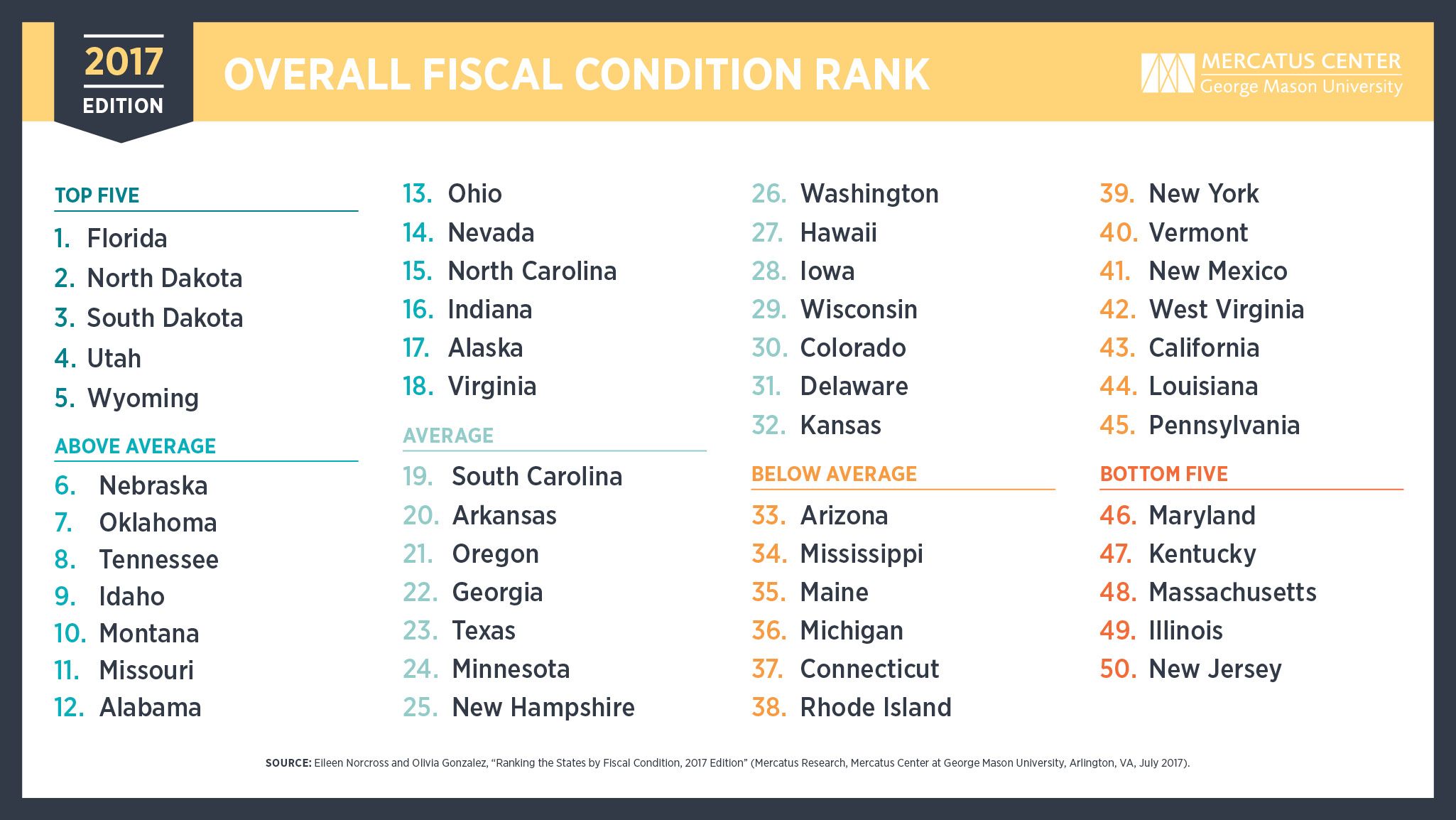
Tennessee ranks as the eighth most fiscally healthy state

The Mercatus Center at George Mason University has ranked Tennessee as the eighth most fiscally healthy state in the nation up from tenth place in 2016.  The rankings are based on the following five categories:

  • Cash solvency.  Does a state have enough cash on hand to cover its short-term bills?
  • Budget solvency. Can a state cover its fiscal year spending with current revenues, or does it have a budget shortfall?
  • Long-run solvency. Can a state meet its long-term spending commitments? Will there be enough money to cushion it from economic shocks or other long-term fiscal risks?
  • Service-level solvency. How much “fiscal slack” does a state have to increase spending if citizens demand more services?
  • Trust fund solvency. How large are each state’s unfunded pension and healthcare liabilities?
Florida, North Dakota, South Dakota, Utah, and Wyoming  rank as the top five states. Oil and gas revenue account for the high ranking of some of the states, but declining revenue from these sources has seen some states, such as Alaska, drop out of the top five.

The bottom five ranked states are Maryland, Kentucky, Massachusetts, Illinois, and New Jersey. Each of the bottom five have urge debt obligations and unfunded pensions and healthcare liabilities play a major roll in low rankings.

Last night at a meeting of the Bastiat Society, the guest speaker was Justin Wilson, Comptroller of the Treasurer for Tennessee. He spoke of Tennessee's sound financial standing and pointed out that Tennessee is almost alone as a state with no debt for road construction.  He also said Tennessee's pension obligations are actuarialy sound and that Tennessee is transitioning from a defined benefit pension system to a defined contribution pension system for new hires. Tennessee is not using one-time monies to fund on-going expenditures. By any measure, Tennessee is fiscally responsible.

As Tennessee's fiscal health has been improving, Tennessee has reduced the State workforce by about 5,000 people and services have not suffered. Our ranking for the quality of our public education has increased from among the worse three or four in the nation to a ranking in the mid-twenties.  Also, the number of college educated adults has been increasing.  We can rightly be proud of the job Governor Haslam and our Republican dominated legislature are doing.


To read the full article or delve deep into the details of the data that supports the rankings, follow this link.

Stumble Upon Toolbar
My Zimbio
Top Stories

Thursday, July 13, 2017

Nashville's Metro Council kills latest attempt to cut lifetime health benefits

Nashville's Metro Council kills latest attempt to cut lifetime health benefits

Stumble Upon Toolbar
My Zimbio
Top Stories

Trump nominates Senate Leader Mark Norris for federal judgeship in Tennessee

Trump nominates Senate Leader Mark Norris, three others as federal judges in Tennessee

Stumble Upon Toolbar
My Zimbio
Top Stories

Liberty on the Rocks meets tonight, July 20th

Who: A group of people, numbering anywhere between 8 and 25, who love liberty and who range in age from 18 to 80, and who vary in occupation from students to laborers to attorney's and businessmen, who are generally labeled "right of center" and may call themselves, libertarian, tea party, Republican, conservative, constitutionalists, Objectivist, and  an occasional anarcho-capitalist.

What: Liberty on the Rocks is a get-together that involves eating and drinking and talking and respectfully disagreeing and exchanging of ideas usually about some political topic (but not always) which could be the news of the day, or foreign policy, or the monetary system, or the roll of the family and gay marriage, or legalization of drugs or prostitution, or privacy and the NSA, or the welfare state, or education reform, or criminal justice and prison reform, or the death penalty, or immigration policy, or morality, or  just whatever topic one brings up. There is no program.

When: Thursday, July 20th 5:30 until everyone leaves which usually people start leaving about 9:00, but sometime later but you can come as late or leave as early as you please.  

Where: Smoking Thighs, 611 Wedgewood Ave, Nashville, Tennessee 37203

Why: For the enjoyment of good conversation with like-minded people. 

To RSVP follow this link

Stumble Upon Toolbar
My Zimbio
Top Stories

Eat Drink and be Republican

From the Davidson County Republican Party.


Stumble Upon Toolbar
My Zimbio
Top Stories

Tuesday, July 11, 2017

THE HEALTH CARE OPTIONS ACT OF 2017

The Health Care Options Act of 2017 is sponsored by Senator Lamar Alexander. While this is not a repeal and replacement for Obamacare, this sounds like a reasonable proposal to help those who are being left without any insurance coverage as Obamacare collapses. The summary is provided by Senator Alexander' office.

Action is needed now to help Americans who may soon have zero health insurance options on the Affordable Care Act (ACA) exchanges. The Health Care Options Act will allow these Americans—who would otherwise be unable to use their ACA subsidy to purchase health insurance—to use their subsidy to buy any insurance plan approved by their state.

PROBLEM: MILLIONS MAY HAVE ZERO OPTIONS FOR HEALTH INSURANCE
ON ACA EXCHANGES NEXT YEAR

Individuals who receive an ACA subsidy can only use that subsidy to purchase health insurance through an ACA exchange. They are locked in a failing system.

These Americans had fewer health insurance options on the ACA exchanges for the 2017 plan year than the year before, and next year, millions face an even worse reality: having zero health insurance options to purchase on their ACA exchange.

While Congress needs to enact long-term structural health reforms, it must take immediate action to provide relief for Americans trapped in collapsing exchanges.

• In 2016, 7 percent of counties in the United States had just one insurer offering plans on their ACA exchange. This year, that number jumped to 32 percent.

• Five states have only one insurer offering ACA plans in their entire state this year: Alabama, Alaska, Oklahoma, South Carolina, and Wyoming.

• Nine states have only one insurer offering ACA plans in a majority of the counties in the state: Tennessee, North Carolina, West Virginia, Utah, Nevada, Arizona, Mississippi, Missouri, and Florida.

• Next year, we know the problem will be much worse. There are 34,000 Americans who rely on an ACA subsidy to buy health insurance on the exchange in Knoxville, Tennessee. All of the insurers who have offered plans on that exchange have announced that they are leaving for 2018, leaving no options.

• As more insurance companies announce their plans for the 2018 plan year, it is very likely that more counties across the nation will face challenges similar to Knoxville.

ACTION NEEDED: MORE HEALTH CARE OPTIONS

• Americans with an ACA subsidy but no health insurance on their ACA exchange would be allowed to use their ACA subsidy to purchase health insurance outside of an ACA exchange, as long as the insurance is approved by the state for sale in the individual market.

• Available to individuals who live in a county where the Secretary of Health and Human Services certifies there are no options on the ACA exchange.

• The individual mandate penalty would not apply for these individuals.

• This temporary authority would be in place through the end of the 2019 plan year.

Stumble Upon Toolbar
My Zimbio
Top Stories