Friday, November 07, 2025

Harwood Salon Presents Daniel Smith, "The Road to Serfdom in the 21st Century."

From Harwood Salon, Nov. 7, 2025-Join us in Nashville for an event with Daniel Smith, Director of the Political Economy Research Institute at MTSU. 

There is growing interest, especially among American youth, in socialism. Daniel J. Smith revives Friedrich Hayek’s 1944 warning in The Road to Serfdom that socialism—defined as state ownership of the economy—inevitably erodes democracy and leads to authoritarianism. Drawing on historical insights, modern critiques, and empirical evidence from Venezuela’s collapse to Nordic prosperity, Smith demonstrates how capitalism fosters civil liberties, academic freedom, and social capital. Countering claims that Hayek was “wrong,” he debunks common myths about socialism and calls for robust economic education to safeguard freedom.

Harwood Salons – Nashville is made possible through the generosity of supporters like you. We encourage you to become a member or make a donation to support the American Institute for Economic Research and ensure the continuation of these important events. All donations are tax-deductible and directly contribute to sustaining Harwood Salons – Nashville.

Registration Required.

Agenda 

6:00 PM – 6:30 PM – Networking
6:30 PM – 7:15 PM – Presentation by Dr. Daniel Smith
7:15 PM – 7:30 PM – Q&A

About the Speaker

Daniel J. Smith is the Director of the Political Economy Research Institute and Professor of Economics at the Jones College of Business at Middle Tennessee State University. Dan is the North American Co-Editor of The Review of Austrian Economics and the Senior Fellow for Fiscal and Regulatory Policy at the Beacon Center of Tennessee. Smith has published over one hundred popular publications in national and regional outlets, including the Wall Street Journal, The Hill, and the Tennessean.

Stumble Upon Toolbar
My Zimbio
Top Stories

Trump Pardons Former Tennessee Speaker Glen Casada, Ex-chief of Staff. Robin Smith Seeks Pardon.

Glen Casada, Cade Cothren
by Sam Stockard, Tennessee Lookout, November 6, 2025 - Former Tennessee House Speaker Glen Casada and his ex-chief of staff reportedly received presidential pardons Thursday, just weeks after being sentenced to prison for government corruption convictions, according to news reports.

Casada’s attorney, Jonathan Farmer of Nashville, could not confirm the pardon Thursday evening.

But Casada told Channel 4 News via text message and the Tennessee Journal that President Donald Trump called him Thursday and granted him a full pardon.

Casada and his former chief of staff, Cade Cothren, did not respond to text messages or calls Thursday night to confirm the pardons.

In late September, Casada was sentenced to 36 months in prison for his role in a kickback scheme after a jury convicted him on multiple counts of fraud, bribery, theft, conspiracy and money laundering in connection with a shell company called Phoenix Solutions run by Cothren, who was sentenced to 30 months the previous week.

Defense attorneys were appealing the case to a higher court.

Attorneys for Casada and Cothren requested a mistrial after prosecutors inadvertently played an unredacted recording of an FBI interview with Casada that incriminated Cothren during their four-week trial that stretched from mid-April into May. They also sought a new trial just before sentencing, but U.S. District Court Judge Eli Richardson denied the request.

Casada and Cothren were convicted of setting up the secret company that tapped into the state’s postage and printing program that provides House members $3,000 a year for constituent mailers. Casada and former Rep. Robin Smith, who pleaded guilty and testified against the pair, steered lawmakers’ business to Phoenix Solutions, which was secretly run by Cothren with the front name of “Matthew Phoenix.”

Smith was recently sentenced to eight months for her role in the scheme. She is seeking a presidential pardon according to the Chattanooga Times Free Press.

Stumble Upon Toolbar
My Zimbio
Top Stories

Gov. Lee invites New York Businesses to Relocate to Tennessee Following Mamdani’s Mayoral Win

Stumble Upon Toolbar
My Zimbio
Top Stories

Tennessee Best in Nation in Per Capita Government Debt

By David Beasley, The Center Square contributor,  Nov 7, 2025 - Tennessee is among the states with the lowest amount of state and local government debt in the nation, according to a new study.

Tennessee is the best on the Reason Foundation’s ranking of per capita state government debt at $1,952. Government debts in Connecticut and New Jersey equate to $26,187 and $22,968 per resident, respectively, the two highest in the country.

In total debt, Tennessee's $13.49 billion is lower than 31 other states.

“State and local government debt includes both short- and long-term obligations – from salaries due at the end of this month to bonds maturing decades from now,” the Reason Foundation said. “The $6.1 trillion in liabilities includes $1.5 trillion in public pension obligations, and $958 billion for retiree health care obligations.”

With 7.3 million people, Tennessee is the 15th most populous state in the nation. It has no state income tax.

Earlier this month S&P confirmed Tennessee’s AAA rating for general obligation bonds, the best ranking available.

“Tennessee is leading the nation because of our longstanding bipartisan commitment to responsible fiscal management,” Gov. Bill Lee said in his budget proposal to the Legislature last February.

The state has invested in economic opportunities, reduced debt and increased cash reserves, the governor said.

The state has more than $2 billion in a “rainy day” fund for financial emergencies or economic downturns.

Tennessee is only one of nine U.S. states with no state income tax. The others are Florida, Texas, Washington, Alaska, Nevada, Wyoming, South Dakota and New Hampshire.

Tennessee’s state sales tax is 7%, which is in addition to some local government sales taxes.

Stumble Upon Toolbar
My Zimbio
Top Stories

Poll: Majority of Tennessee Democrats View Socialism Favorably

A Beacon Center poll graphic shows that 54% of respondents
who identify as Democrats have a favorable view of socialism,
while 31% view it unfavorably, according to data from November
 2025. Graphic: Beacon Center of Tennessee

By Kim Jarrett, The Center Square,  Nov 5, 2025 - A new poll by the Beacon Center shows 54% of Tennessee Democratic respondents have a favorable view of socialism, while 31% held a negative view, according to results released Wednesday morning.

“As politicians like Zohran Mamdani and Alexandria Ocasio-Cortez gain national recognition as the future leaders of the Democratic Party, one of the most notable findings from the poll is the substantial support for socialism among Democratic voters in Tennessee," Beacon's Senior Fellow for Public Opinion Mark Cunningham said. "The favorability of socialism among Democrats is notable, and it will likely influence how Democratic candidates run to the left in contested primaries, but also could spell doom for the party in general elections if the public’s view on socialism stays the same.”

Mamdani won the New York City mayoral race Tuesday with more than 50% of the vote over former Gov. Andrew Cuomo, who ran as an independent, and Republican Curtis Sliwa.

The Beacon Poll of 1,200 Tennessee residents included 336 Democrats, according to information provided by Beacon Center.

Respondents had a favorable view of Gov. Bill Lee. Fifty-four percent said they approved of the governor, with 38% saying they didn't approve of his performance.

Lee is term-limited and cannot run again. U.S. Sen. Marsha Blackburn is the favored Republican candidate, garnering 58% of positive responses. U.S. Rep. John Rose received 9% of positive responses while state Rep. Monty Fritts, R-Kingston, received 5%.

The survey shows that 63% support President Donald Trump's decision to send National Guard troops to Memphis, while 33% disapprove of the move. Republicans backed the deployment the most at 82% while 49% of Democrats opposed it.

The majority of those polled said they approved of the job Trump is doing, with 57% giving the president a thumbs up. Forty-one percent gave him a thumbs down, with 2% saying they had no opinion.

Republicans and Democrats agreed that political violence is a serious problem today, according to the poll. As to who is to blame, 38% said it is the left and right, but the left received most of the criticism at 32%. Eighteen percent of respondents placed political violence on the shoulders of the right.

Those surveyed also had a dim view of whether things would improve, with 64% saying they expected political violence to worsen. Just 11% said they thought it would get better.

Stumble Upon Toolbar
My Zimbio
Top Stories

In Defense of the Electoral College

Rod Williams: If this becomes the platform
 of the Democratic Party, I may vote for Trump's
anointed successor.
by Michael Dioguardi, Nov. 7, 2025- Regarding the direct election of presidents, few ideas are worse for liberty.

 Most presidential systems outside the U.S. lack the federalist counterweight built into our design. In Africa and South America, presidentialism often combines:

• Direct popular election of the president, granting an immediate “national mandate.”

• Weak or centralized legislatures, often subordinated to the executive.

• Unitary states, where regional governments have little independent standing.

This creates the classic pattern: a directly elected president becomes the singular embodiment of the people’s will, while regional or legislative bodies cannot resist. From there, authoritarian drift is inevitable.

By contrast, the U.S. avoided this trap, at least historically, because:

1. Electoral College Federalism – The president is not elected by a national plebiscite but through the states. This means he governs by consent of the states as political communities, not just an atomized mass of voters.

2. State Sovereignty – The states retain constitutional standing and power, acting as rivals and checks on the central government.

3. Senate (originally) – Chosen by state legislatures, it reinforced the role of states as guardians of federal balance.

4. Fragmented Power – Separation of powers and staggered elections made it very difficult for one faction to control all levers of government at once.

So yes, the Electoral College is not just an “antiquated system” or “undemocratic” (as some critics charge) but a structural safeguard unique to American presidentialism, tempering the dangers of direct mandate.

In a way, this makes the U.S. a hybrid: presidential in form, but with federalist brakes that blunt the concentration of power. That is probably why, unlike so many other presidential systems, the U.S. has not already collapsed into caudillismo or outright dictatorship.

No amount of rhetoric about “majoritarian fairness” or “true democracy” changes the fact that liberty becomes contingent on the whims of electoral outcomes.

Advocates of direct national election are not merely proposing a procedural change. They are actively proposing a structural weakening of liberty. Their claims of “democracy” are rhetorical cover for what is essentially a power grab, and history shows that the concentration of power under the guise of popular mandate inevitably backfires, often against those who initially supported it.

In short: democracy without counterweights is not liberty. It is majority rule that can quickly become coercive.

Stumble Upon Toolbar
My Zimbio
Top Stories

Thursday, November 06, 2025

Democrats Need to Win the Center

by Rod Williams, Nov. 6, 2025- I feel it is imperative to stop Donald Trump's march toward authoritarianism. There is no point in listing his many sins against ordered liberty, Constitutional governance, and norms of behavior. Those who are not in the MAGA cult can clearly see them. Many Republicans can also see them, but can find justifications to ignore them.

While the judiciary may curtail some of Donald Trump's worst abuses, the courts are limited in their ability to restrain Trump. Their job is not to set policy. They are not to settle political questions. Additionally, although Trump has not yet disobeyed a Supreme Court ruling, he may do so in the future. The Supreme Court has no means to carry out an order. 

Congress has proven unable to restrain Trump due to the Republican Congress marching in lockstep with Trump, except in a very few instances. If Trump is going to be restrained, it must happen at the ballot box. Democrats must win the midterms. They do not need to barely squeak out a win, but win by a significantly large number so Trump cannot steal the election. 

It is not paranoia to think Trump may try to steal the mid-term election. On January 6, 2021 he tried to stop Congress from certifying the 2020 election results. I fully expect efforts by Donald Trump to try and subvert the midterms. I am not going to be surprised if we do not have ICE agents patrolling the streets near polling places, suppressing voter turnout. I am not going to be surprised if Congress refuses to seat some Democrats who win their election. There may be instances where there were minor irregularities and that is used as an excuse not to seat the winner of the election.  As an example, assume that due to an extreme weather event, polls are kept open longer than normal. That may be used as an excuse to not seat the elected Democrat.  There are other situations which could be used as a justification to challenge the winner of an election. If Democrats only win the midterms by four or five seats, Republicans may succeed in stealing the election; if they win by 30 seats, it is much harder. A Democrat victory needs to be "too big to rig."

I contend the way for Democrats to win is to try to capture the center of the political spectrum. By pandering to the social justice, identity politics, and woke faction of the electorate, Democrats' path to victory is much narrower. Many disaffected Republicans and independents may vote for a moderately liberal Democrat but not a Democratic Socialist. They may vote for a normal person who wants to give people more free stuff, but not a progressive who speaks Woke. The disaffected may vote for the Republican, or stay home unless they have someone running who does not offend them. 

There is a tug of war going on in the Democratic Party between the center-left and the progressives. Believing the Democrats have a much better chance of winning if they are the party of the center-left. I want to see the center-left win the battle. 

I used to be a contributor to the Republican Party. I am a person of modest means but made annual contributions to the RNC, the State Party, the local Party, the House Republican organization, the Senate Republican organization and the Republican Governors Association, and some individual candidates and organizations that supported Republican causes. A few years ago, I stopped all contributions to Republican organizations and pro-Trump organizations.

Believing it is imperative that Trump be stopped and believing that winning at the ballot box is the only way to do it, I am looking to do my part. If I can find sane Democrats with a chance of winning, I will send money to those candidates.  The Win the Center PAC is looking for those candidates. I am sending them some money.  Below is their appeal. Please consider contributing.

Rod, 

I've learned a lot in the last few years, but one lesson stands out above all the rest: elections are won by running and supporting candidates who are unafraid to take on the fights that voters care about—even when it means bucking their own party.

I saw it firsthand in my race against Lauren Boebert. We came just 546 votes short of flipping a solid Republican district, and we did it by focusing on the issues that matter to everyday people and building a broad coalition—not by chasing the loudest, most extreme voices.

That's the approach we need to take if we want to build a real majority. We have to compete and win in the places where it's toughest to be a Democrat. We need to back pragmatic candidates who can earn trust in the broad middle, beat extremists, and deliver for their communities.

That’s why we started the Win the Center.

Let me be clear about something: I’m not taking a salary or single dime myself. Our mission is to strategically raise and distribute money to the Democratic fighters who are running in these tough races and the ones who are willing to put their communities over Washington politics.

We are taking the lessons we learned from my campaign and applying them on a national scale because we believe this is what it will take to get Democrats back to winning again. We’re identifying the most vulnerable incumbents and the most promising challengers—the ones who can actually win—and giving them the resources they need to get across the finish line.

If you’re tired of seeing extremists win races they shouldn't, and if you believe that the path to a Democratic majority runs through the center, then please, join us.

Your donation will go directly to the candidates who can win. Can you make a donation today to help us get started?

 Thank you for being on this journey with me.

With gratitude,

Adam Frisch

For more information or to contribute, follow this link

Stumble Upon Toolbar
My Zimbio
Top Stories

A Defense of Citizen's United

Rod Williams: If this becomes the platform
 of the Democratic Party, I may vote for Trump's
anointed successor.


by Michael Dioguardi, Nov. 6, 2025- Few cases are more clearly misunderstood and more clearly blamed for outcomes whose blame rests squarely with the concentration of power in DC rather than corporate lobbying or campaign donations.

Citizens United correctly recognized that political spending is a form of speech and limiting it undermines fundamental liberties. At the same time, the distortions critics associate with the decision, entrenched interests, policy gridlock, and the outsized influence of large organizations, are the natural consequences of centralized federal authority. 

Blaming Citizens United conflates cause and effect: the problem is not free speech, but the concentration of power that makes any speech appear disproportionately impactful.


Stumble Upon Toolbar
My Zimbio
Top Stories

Tuesday, November 04, 2025

Public Hearing on New Major Metro Zoning Changes

by Rod Williams, Nov.4, 2025 - I am relatively informed about the zoning proposals before the Council and I am not opposed. I don't have a lot of passion around this issue, but generally support what is before the Council. I think we need greater density. For decades, I watched as little by little Metro Council approved the rezoning of large swaths of the county from a zoning allowing duplexes to a zoning that was single-family only. This reduced the number of homes that could be built in Davidson County. Opening back up to new housing development, those areas now zoned single-family only should have a modest downward effect on the prices of new homes. 
I doubt the proposals, if passed, will increase by very much homeownership affordability, but will have a greater impact on renter affordability. As Nashville has grown, we have attracted high-paying jobs to Nashville, and people without a lot of money have been priced out of the market by those with a lot of money. That just happens. Prices have risen, and you can not build cheap single-family housing on expensive land. Even with the proposal to rezone areas from single-family to duplex will not drastically reduce the price of new single-family housing. When it comes to rental however, the addition of more DADU's, allowing greater heights of apartment buildings, and more places where apartments can be built should make rental housing more affordable.
I understand the desire to protect the character of one's community. However, with growth, if we protect our community character, we destroy someone else's community character. The character of many small towns and rural communities has changed as people have chosen to move to the suburbs and rural communities because they could not afford to live in Nashville. 
I also think long commutes and urban sprawl is bad for the environment and the quality of life for many. We should make it possible for those who want to live in Nashville rather than Watertown to do so.
The arguments against the proposals based on capacity of water, stormwater, sewer, schools, and roadways, I do not find persuasive. We adjust capacity as growth occurs, not in advance of growth occurring.
For more on the issue, see the below from The Pamphleteer and follow the links.
Zoning Wars
By The Pamphleteer, Nov.4, 2025
Tonight, the council will hold public hearings for a slew of
proposed zoning bills on second reading. During the final community presentation last week, Nashvillians questioned whether the changes actually benefit residents and those seeking home ownership in Davidson County. 
Over the last two weeks, community meeting attendees were given an overview of the four pieces of legislation by the Nashville Planning Department. The bills include:“A [Detached Accessory Dwelling Unit], by definition, is going to increase the value of the property making it less likely for people to be able to buy it,” said a District 11 resident during last Thursday's meeting. He explained that mortgage companies won’t credit the potential income of renting out the extra detached dwelling until it’s occupied, so the benefit of that income doesn’t help with affordability when initially pursuing the purchase of a home.
“My taxes went up $250 a month,” he continued. “I went from less than $3,000 to $6,200 a year. If you want to make things more affordable, let's look at that.”
Hundreds of people have turned up to community meetings over the last two weeks, and high attendance is expected during tonight’s meeting. Citizens are allowed two minutes to speak in favor or in opposition of BL2025-10051006, and/or 1007 during separate public hearings.
Want to know more? Check out our previous overview of the legislation and reporting on the RN zoning proposal, issues with DADUs, concerns over neighborhood infighting, and more.

Stumble Upon Toolbar
My Zimbio
Top Stories

Lee Beaman Credits Kid Rock for Trump Administration Appointment to Tennessee Valley Authority


Lee Beaman Credits Kid Rock for Trump Administration Appointment to Tennessee Valley Authority

Is Kid Rock the Most Powerful Person in Tennessee?

Stumble Upon Toolbar
My Zimbio
Top Stories

Former State Rep. Robin Smith Seeks Presidential Pardon

 Former State Rep. Robin Smith Seeks Presidential Pardon, Citing Cooperation with Prosecutors

Stumble Upon Toolbar
My Zimbio
Top Stories

America Needs a Free-Trade Party

by Jeremiah Johnson, The Dispatch, Nov. 4, 2025- For decades, the working consensus in American politics was that free trade was good. Every Republican presidential nominee from Gerald Ford to Mitt Romney supported agreements to expand and liberalize international trade. Democrats have historically been a bit more reluctant, but their most successful presidents of the last 50 years—Bill Clinton and Barack Obama—both championed free trade and pursued large, multilateral trade agreements. Both the vote to create NAFTA in 1993 and the vote to grant China permanent normal trade relations passed on a bipartisan basis.

That changed in 2016. Hillary Clinton broke with the Obama administration to oppose the Trans Pacific Partnership, and Donald Trump tore up the GOP’s traditional views on trade to promote heavily protectionist, anti-trade policies. Trump withdrew from the TPP on his first day in office, and he was the first president in generations to significantly raise America’s tariff level. ... 

Economists say Trump’s tariffs are causing economic chaos—higher prices, slower growth, and increased uncertainty with Trump’s frequent changes. And yet, Democrats haven’t come out forcefully for the idea of free trade. Why?

Democrats have long had a complicated relationship with trade. Despite Clinton and Obama championing international trade, significant parts of the Democratic coalition have opposed new trade agreements. Major unions fiercely opposed TPP, a free trade agreement among 12 Pacific Rim nations including Japan, Australia, Vietnam, Peru, and Chile, with AFL-CIO President Richard Trumka calling it “a new low.” And the populist, anti-capitalist left has always been skeptical of globalization and free trade, from the 1999 WTO protests in Seattle to Elizabeth Warren and Bernie Sanders opposing TPP. 

.... If Republicans are now the party of high tariffs and trade skepticism, Democrats can’t just be the party of “tariffs, but smarter.” America needs at least one of our major parties to stand up, loudly and clearly, for free trade.

The situation is ripe for Democrats to unapologetically champion trade because the damage being done by Trump’s tariffs is real and hitting so many sectors of the economy simultaneously.

... China bought more than $12 billion of American soybeans in 2024, our single largest export to China—but that number has now dropped to zero. .. The U.S. manufacturing industry has contracted for seven straight months under Trump. This is exactly the opposite of what trade skeptics promised. High tariffs were supposed to usher in a new golden age of manufacturing, but they’re killing American manufacturers instead. ... The U.S. has lost tens of thousands of jobs in the manufacturing sector since April, and that slide is likely to continue as long as tariff chaos does. Tariffs haven’t saved American manufacturing; they’ve weakened it further.

The economic case for free trade is clear. Tariffs increase prices for consumers, they lower GDP growth and kill jobs, they hit low-income families hardest, and they’re causing economic uncertainty and instability. Economists almost universally oppose tariffs, and the long-run gains from trade dwarf any localized pain. But there’s another reason Democrats should come out aggressively against protectionism—it’s a threat to the rule of law.

Trump is attempting to build an “imperial presidency” in his second term, where he can bypass Congress and rule via executive orders and decrees straight from the White House. ... Article I, Section 8 of the Constitution gives Congress the sole power to “collect Taxes, Duties, Imposts and Excises” on foreign countries. Over the years, Congress has passed laws delegating this power to the president in certain circumstances. But Trump has taken a tool meant for emergency measures and illegally used it to pass sweeping tariffs on every country in the world. 

An appeals court has already found that most of Trump’s tariffs are illegal. The logic is simple—and the Supreme Court will be hearing arguments in the matter on Wednesday. The International Emergency Economic Powers Act (IEEPA) shifts authority from Congress to the president to regulate economic transactions in the case of “unusual and extraordinary” threats or national emergencies. It would be preposterous to say that our trade partnerships with every country in the world (even those with which we have a surplus) are an unusual and extraordinary emergency, especially since most of those partnerships have been steady over time. And Trump often doesn’t even try to pretend that the “emergency” is real—he recently increased tariffs on Canada simply because they hurt his feelings in an advertisement.

... Democrats should loudly demand that Congress reassert control over trade policy, and they should do it in the context of taking power away from the President. ... Democrats should loudly proclaim what’s obvious—tariffs are bad policy, and Trump’s tariffs in particular are wrecking the economy. ... Democrats should loudly, publicly, repeatedly make the case that tariffs are taxes on the middle class. They should demand an end to Trump’s tariffs, promise to reverse them as soon as they regain power, and demand that trade policy return to its constitutionally appointed place with Congress. (read it all)


Stumble Upon Toolbar
My Zimbio
Top Stories

Monday, November 03, 2025

This is What Democrats Need to do to Win

by Rod Williams, Nov. 3, 2025- I recently posted about a new study produced by a center-left think tank.  The study, called Deciding to Win, examines why, in the face of Donald Trump's chaos and authoritarianism, the Democratic Party remains so unpopular and what the party must do to win. As I said in that post, if these were normal times, I would hope this study stayed buried and no one read it, because if these were normal times, I would want the party to keep doing what they are doing. However, I think Democrats need to retake the House in order to check Donald Trump, so I hope Democrats will read the study and take its message to heart. 

The study is heavy on charts and data.  It draws on thousands of election results, hundreds of public polls and academic papers, dozens of case studies, and surveys of more than 500,000 voters conducted since the 2024 election. Like most such studies, it is kind of dry reading.  However, if you are a wonkinsh poli sci type, you will find it interesting. 

Here is the bottom line. The study says, to give Democrats the best chance to win, they need to make the following changes: 

1. Focus our policy agenda and our messaging on an economic program centered on 
lowering costs, growing the economy, creating jobs, and expanding the social safety net.  

2. Advocate for popular economic policies (e.g., expanding prescription drug price 
negotiation, making the wealthy pay their fair share in taxes, raising the minimum wage to $15 an hour) rather than unpopular economic policies (e.g., student loan forgiveness, electric vehicle subsidies, Medicare for All). 

3. Convince voters that we share their priorities by focusing more on issues voters do not think our party prioritizes highly enough (the economy, the cost of living, health care, border security, public safety), and focusing less on issues voters think we place too 
much emphasis on (climate change, democracy, abortion, identity and cultural issues). 

4. Moderate our positions where our agenda is unpopular, including on issues like immigration, public safety, energy production, and some identity and cultural issues. 

5. Embrace a substantive and rhetorical critique of the outsized political and economic influence of lobbyists, corporations, and the ultra-wealthy, while keeping two considerations in mind: First, voters’ frustrations with the status quo are not the same as a desire for socialism. And second, criticizing the status quo is a complement to advocating for popular policies on the issues that matter most to the American people, not a substitute.
Let me be clear, I do not endorse the policy proposals listed above; I endorse the strategy of focusing on the above policy proposals.  I do not want an expanded safety net, Medicare for all, to raise the minimum wage, nor student loan forgiveness. I do think it is a winning message, however. People like free stuff. I think a focus on more traditional Democratic issues is more likely to make Democrats more likable rather than a focus on climate change, abortion, identity politics and cultural issues. 


Stumble Upon Toolbar
My Zimbio
Top Stories

Bill Gates: Climate change is a serious problem, but it will not be the end of civilization.

by Rod Williams, Nov. 11, 2025- Six days ago, Bill Gates, co-founder of the software company Microsoft, one of the world's wealthiest men, and a leading philanthropist, published an essay, Three tough truths about climate. In the essay, he makes these points:

  • Climate change is serious, but we’ve made great progress. We need to keep backing the breakthroughs that will help the world reach zero emissions.
  • But we can’t cut funding for health and development—programs that help people stay resilient in the face of climate change—to do it.
  • It’s time to put human welfare at the center of our climate strategies, which includes reducing the Green Premium to zero and improving agriculture and health in poor countries.
I am pleased to see someone of Bill Gates stature speak common sense about the topic of climate change. Like Gates, I believe climate change is a serious problem. I think it is undeniable that the planet is warming. I also think it is a problem that can be addressed and adapted to without sacrificing economic progress, condemning the poor of the world to perpetual and worsening poverty, adopting punitive authoritarian models of governance, or denouncing modernity.  I also think climate hysteria is not helpful and in fact, can be counterproductive. 

Below is a portion of Bill Gates essay. Yesterday, I posted the introductory portion of the essay, which you can read at this link, or read the full essay at Gates Notes.
 
Truth #1: Climate change is a serious problem, but it will not be the end of civilization.

by Bill Gates - Even if the world takes only moderate action to curb climate change, the current consensus is that by 2100 the Earth’s average temperature will probably be between 2°C and 3°C higher than it was in 1850.

That’s well above the 1.5°C goal that countries committed to at the Paris COP in 2015. In fact, between now and 2040, we are going to fall far short of the world’s climate goals. One reason is that the world’s demand for energy is going up—more than doubling by 2050.

From the standpoint of improving lives, using more energy is a good thing, because it’s so closely correlated with economic growth. This chart shows countries’ energy use and their income. More energy use is a key part of prosperity.Gates notes image
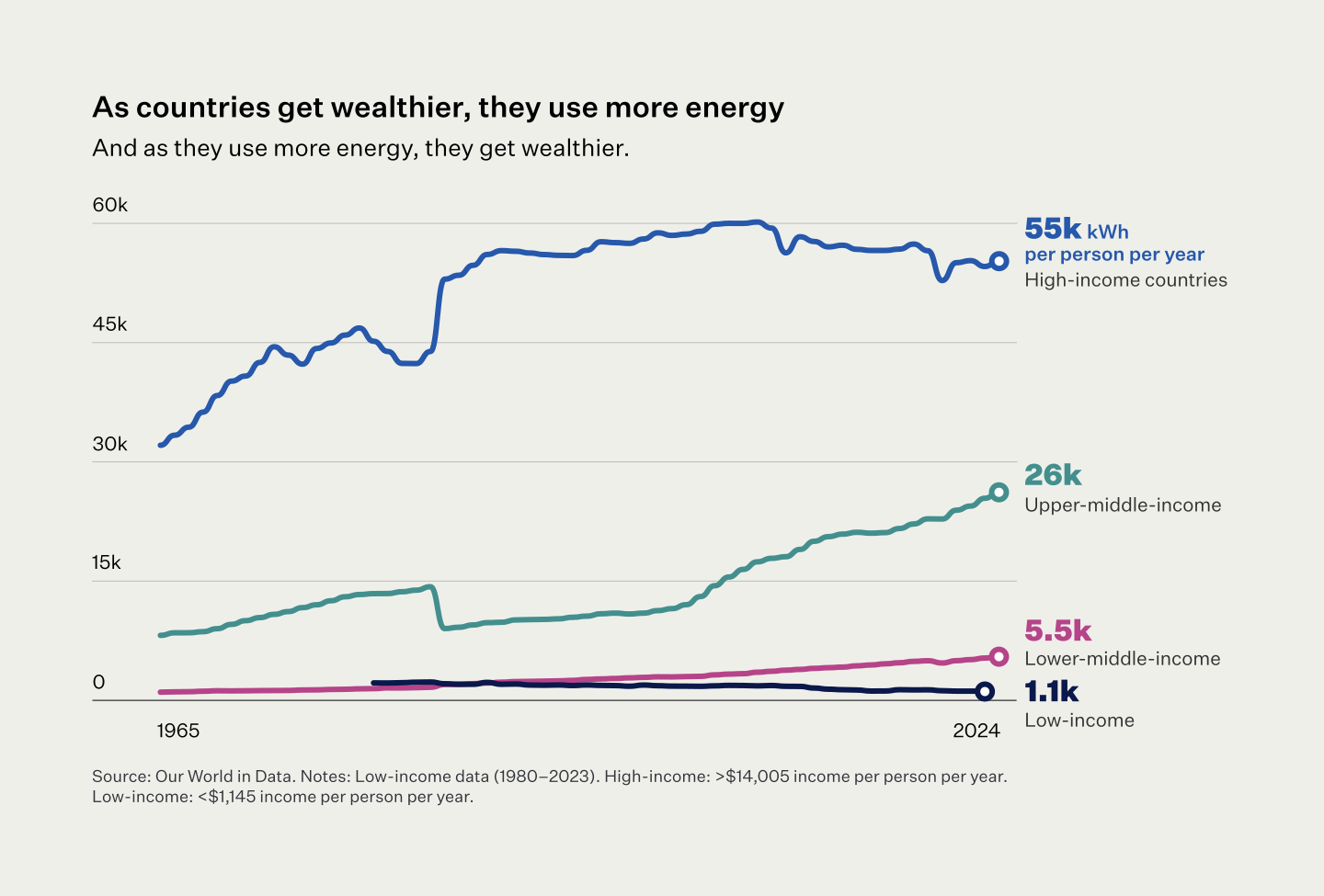
Unfortunately, in this case, what’s good for prosperity is bad for the environment. Although wind and solar have gotten cheaper and better, we don’t yet have all the tools we need to meet the growing demand for energy without increasing carbon emissions.

But we will have the tools we need if we focus on innovation. With the right investments and policies in place, over the next ten years we will have new affordable zero-carbon technologies ready to roll out at scale. Add in the impact of the tools we already have, and by the middle of this century emissions will be lower and the gap between poor countries and rich countries will be greatly reduced.

I wasn’t sure this would be possible when Breakthrough Energy was started in 2015 after the Paris agreement. Since then, the progress of Breakthrough companies and others and the acceleration now being provided by the use of artificial intelligence have made me confident that these advances will be ready to scale.

All countries will be able to construct buildings with low-carbon cement and steel. Almost all new cars will be electric. Farms will be more productive and less destructive, using fertilizer created without generating any emissions. Power grids will deliver clean electricity reliably, and energy costs will go down.

Even with these innovations, though, the cumulative emissions will cause warming and many people will be affected. We’ll see what you might call latitude creep: In North America, for instance, Iowa will start to feel more like Texas. Texas will start to feel more like northern Mexico. Although there will be climate migration, most people in countries near the equator won’t be able to relocate—they will experience more heat waves, stronger storms, and bigger fires. Some outdoor work will need to pause during the hottest hours of the day, and governments will have to invest in cooling centers and better early warning systems for extreme heat and weather events.

Every time governments rebuild, whether it’s homes in Los Angeles or highways in Delhi, they’ll have to build smarter: fire-resistant materials, rooftop sprinklers, better land management to keep flames from spreading, and infrastructure designed to withstand harsh winds and heavy rainfall. It won’t be cheap, but it will be possible in most cases. Unfortunately, this capacity to adapt is not evenly distributed, a subject I will return to below.

So why am I optimistic that innovation will curb climate change? For one thing, because it already has.

You probably know about improvements like better electric vehicles, dramatically cheaper solar and wind power, and batteries to store electricity from renewables. What you may not be aware of is the large impact these advances are having on emissions.Gates notes image
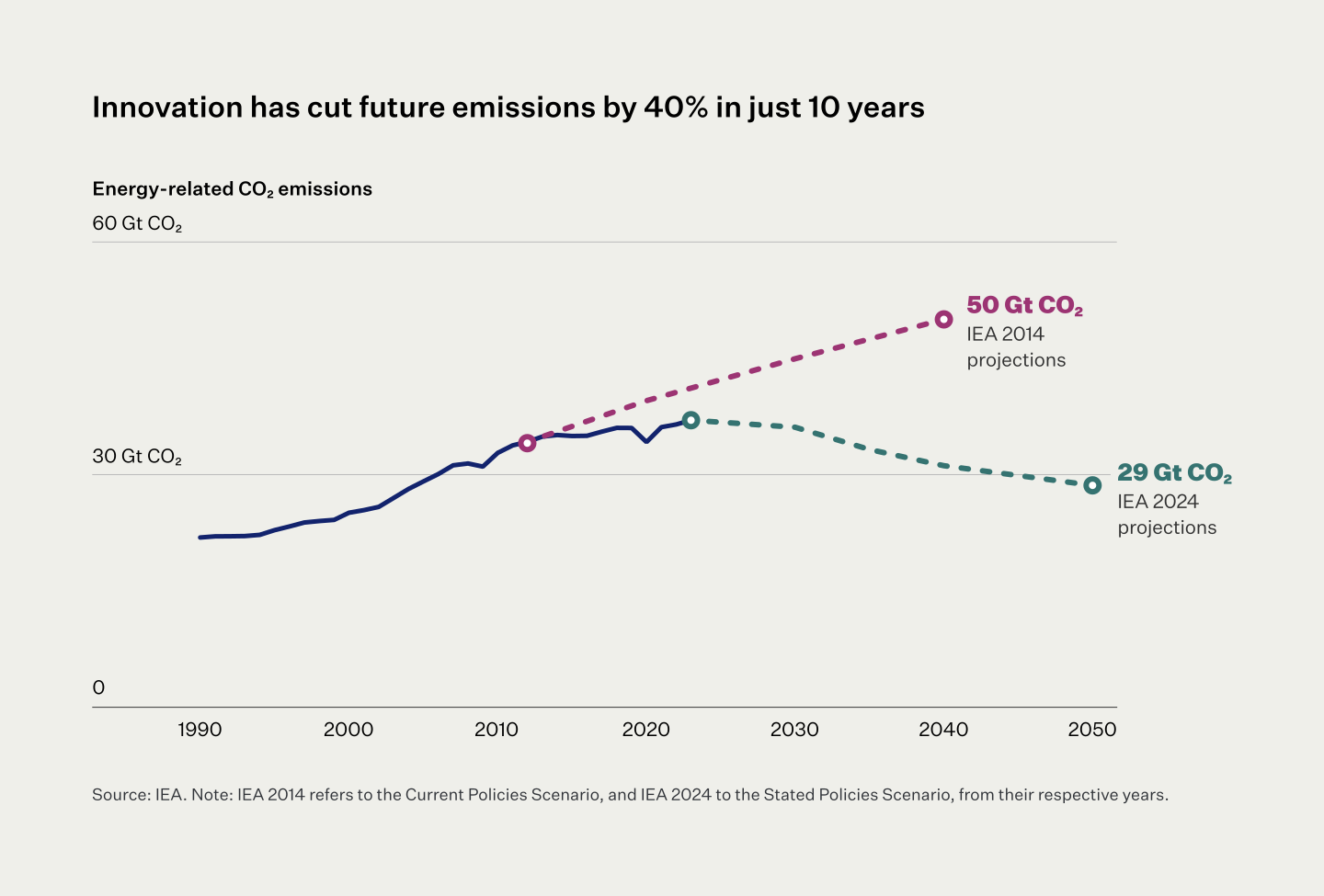
Ten years ago, the International Energy Agency predicted that by 2040, the world would be emitting 50 billion tons of carbon dioxide every year. Now, just a decade later, the IEA’s forecast has dropped to 30 billion, and it’s projecting that 2050 emissions will be even lower.

Read that again: In the past 10 years, we’ve cut projected emissions by more than 40 percent.

This progress is not part of the prevailing view of climate change, but it should be. What made it possible is that the Green Premium—the cost difference between clean and dirty ways of doing something—reached zero or became negative for solar, wind, power storage, and electric vehicles. By and large, they are just as cheap as, or even cheaper than, their fossil fuel counterparts.

Of course, to get to net zero, we need more breakthroughs. This will become even more important if new evidence shows that climate change will be much worse than what the current generation of climate models predicts, because we will need to lower the Green Premium faster and accelerate the transition to a zero-emission economy.

Luckily, humans’ ability to invent is better than it has ever been.

Breakthrough Energy focuses its new investment on the areas of innovation that still have large positive Green Premiums. Below I write about the state of play in the five sectors of the economy that are responsible for all carbon emissions. I’ll cover highlights and challenges—one common theme will be the difficulty of scaling rapidly—and I’ll include some of the companies Breakthrough Energy works with so you can see how much activity there is in each sector.Gates notes image
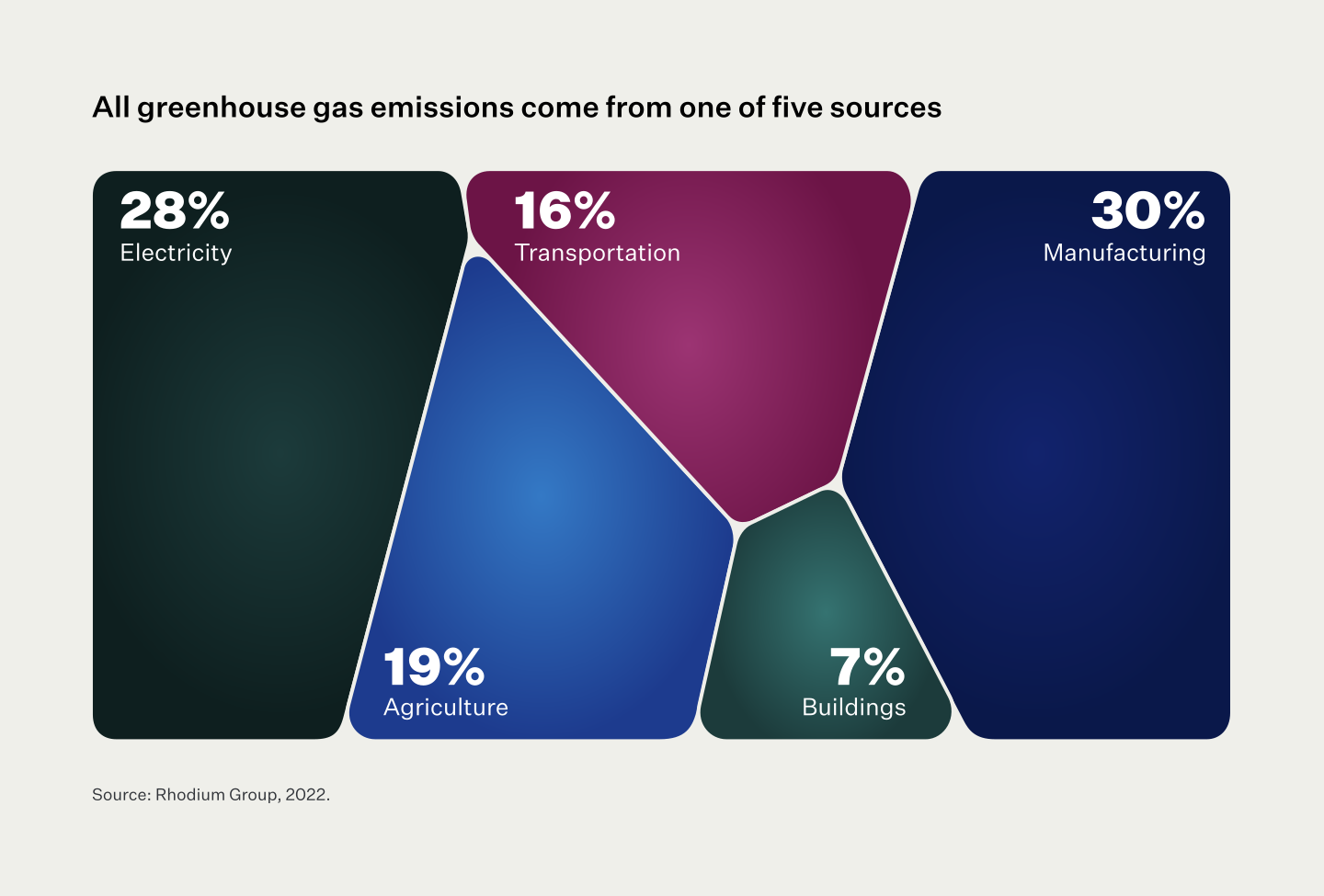
Electricity (28 percent of global emissions)

Making electricity is the second biggest source of emissions, but it’s arguably the most important: To decarbonize the other sectors, we’ll have to electrify a lot of things that currently use fossil fuels. We need more innovation in renewables, transmission, and other ways to generate and store electricity.

  • New approaches to wind power can generate more energy using less land, and advances in geothermal mean it’s being tapped in more places around the world. (Examples: Fervo, Baseload Capital, Airloom)
  • Companies are pilot-testing highly efficient power lines that can transmit much more electricity than the previous generation of cables.  (TS Conductor, VEIR)
  • We need to keep reducing the cost of clean energy that’s available around the clock, including new nuclear fission and fusion facilities. More than half of today’s emissions from electricity could only be eliminated using these so-called “firm” sources, but they have a Green Premium of well over 50 percent. I’m hopeful that we can get rid of the Green Premium with fission; a next-generation nuclear power plant is under construction in Wyoming. And fusion, which promises to give us an inexhaustible supply of cheap clean electricity, has moved from science fiction to near-commercial. (TerraPower, Commonwealth Fusion Systems, Type One Energy)

Manufacturing (30 percent of global emissions)

When someone tells you they know how to curb emissions, the first question you should ask is: What’s your plan for cement and steel? They’re key to modern life, and they’re hard to decarbonize on a global scale because it’s so cheap to make them with fossil fuels.

  • Zero-emissions steel exists today. It’s made using electricity, so if you can get clean electricity that’s cheap enough, you end up with clean steel that’s cheaper than the conventional type. The technology still needs to get into more markets, and companies that make clean steel need to expand their capacity. (Boston Metal, Electra)
  • Clean cement faces similar hurdles. Several companies have found ways to make it with no Green Premium, but it takes years to get a foothold in the global market and ramp up manufacturing capacity. (Brimstone, Ecocem, CarbonCure, Terra CO2, Fortera)
  • One of the biggest energy surprises of the past decade is the discovery of geologic hydrogen. Eventually, hydrogen will be widely used to make clean fuels and will help with clean steel and cement. Today we make it from fossil fuels or by running electricity through water, but geologic hydrogen is generated by the Earth itself. Companies have already proven that they can find it underground; now the challenge is to extract it efficiently. There’s also been a lot of progress on making hydrogen with electricity much more cheaply than current technology does it. (Koloma, Mantle8, Electric Hydrogen)
    New techniques have made clean steel a reality.
  • Companies are beginning to roll out ways to either capture carbon from facilities that currently emit it, such as cement and steel plants, or to remove it directly from the air and store it permanently. If captured carbon becomes cheap enough, we could even use it to make things like sustainable aviation fuel. (Heirloom, Graphyte, MissionZero, Deep Sky)


Agriculture (19 percent of global emissions)

Much of the emissions from agriculture comes from just two sources: the production and use of fertilizer, and grazing livestock that release methane.

  • Farmers can already buy one replacement for synthetic fertilizer that’s made without any emissions, and another that turns the methane in manure into organic fertilizer. Both are selling at a negative Green Premium. Now the challenge is to produce them in large quantities and persuade farmers to use them. (Pivot Bio, Windfall Bio)
  • Additives to cattle feed that keep livestock from producing methane are nearly cheap enough to be economical for farmers, and a vaccine that does the same thing has been shown to work. It’s now moving into the next stage of development. (Rumin8, ArkeaBio)
  • Another source of methane is the cultivation of rice, one of the world’s most important staple foods. Companies are helping rice farmers around the world adopt new methods that both reduce methane emissions and increase crop yields. (Rize)
  • One stubborn problem is that some of the nitrogen in fertilizer seeps into the atmosphere as nitrous oxide, a potent greenhouse gas. It’s very dilute, which makes it hard to capture.

Transportation (16 percent of global emissions)

Nearly one in four cars sold in 2024 was an EV, and more than 10 percent of all vehicles in the world are electric. In some countries including the U.S., they still have disadvantages, such as long charging times and too few public charging stations, that keep them from being as practical as gas-powered cars. In addition, cars and trucks are just one part of this sector, which also includes tough-to-decarbonize activities like shipping and aviation.

  • Airplane emissions are projected to double by 2050, and clean jet fuel still comes with a Green Premium of over 100 percent. Today we know of only two cost-effective ways to make it: produce it with algae, or make synthetic fuel using very cheap hydrogen. Companies are in the early stages of work on both approaches.
  • As more transportation goes electric, the demand for batteries is going to increase, which is why companies have developed ways to make them cheaper and more efficient. (KoBold Metals, GeologicAI, Redwood, Stratus Materials)

Buildings (7 percent of global emissions)

Heating and cooling buildings is the smallest slice of global emissions today, but it’s going to skyrocket with urbanization and the growing need for air conditioning.

  • Electric heat pumps are widely available, up to five times more efficient than boilers and furnaces, and often the cheaper option. But there aren’t enough skilled workers around the world to install them. Next-generation, extra-efficient heat pumps are already on the market, and ones that are easier to install are in the works. (Dandelion, Blue Frontier, Conduit Tech)
  • Other zero Green Premium products are available, including building sealants and super-efficient windows. But as with so many clean technologies, reaching scale takes time. (Aeroseal, Luxwall)

Stumble Upon Toolbar
My Zimbio
Top Stories

Sunday, November 02, 2025

Bill Gates: Three tough truths about climate

Bill Gates
By Bill Gates, Gates Notes, Oct 28, 2025- There’s a doomsday view of climate change that goes like this:

In a few decades, cataclysmic climate change will decimate civilization. The evidence is all around us—just look at all the heat waves and storms caused by rising global temperatures. Nothing matters more than limiting the rise in temperature.

Fortunately for all of us, this view is wrong. Although climate change will have serious consequences—particularly for people in the poorest countries—it will not lead to humanity’s demise. People will be able to live and thrive in most places on Earth for the foreseeable future. Emissions projections have gone down, and with the right policies and investments, innovation will allow us to drive emissions down much further.

Unfortunately, the doomsday outlook is causing much of the climate community to focus too much on near-term emissions goals, and it’s diverting resources from the most effective things we should be doing to improve life in a warming world.

It’s not too late to adopt a different view and adjust our strategies for dealing with climate change. Next month’s global climate summit in Brazil, known as COP30, is an excellent place to begin, especially because the summit’s Brazilian leadership is putting climate adaptation and human development high on the agenda.

This is a chance to refocus on the metric that should count even more than emissions and temperature change: improving lives. Our chief goal should be to prevent suffering, particularly for those in the toughest conditions who live in the world’s poorest countries.

Although climate change will hurt poor people more than anyone else, for the vast majority of them it will not be the only or even the biggest threat to their lives and welfare. The biggest problems are poverty and disease, just as they always have been. Understanding this will let us focus our limited resources on interventions that will have the greatest impact for the most vulnerable people.

I know that some climate advocates will disagree with me, call me a hypocrite because of my own carbon footprint (which I fully offset with legitimate carbon credits), or see this as a sneaky way of arguing that we shouldn’t take climate change seriously.

To be clear: Climate change is a very important problem. It needs to be solved, along with other problems like malaria and malnutrition. Every tenth of a degree of heating that we prevent is hugely beneficial because a stable climate makes it easier to improve people’s lives.

I’ve been learning about warming—and investing billions in innovations to reduce it—for over 20 years. I work with scientists and innovators who are committed to preventing a climate disaster and making cheap, reliable clean energy available to everyone. Ten years ago, some of them joined me in creating Breakthrough Energy, an investment platform whose sole purpose is to accelerate clean energy innovation and deployment. We’ve supported more than 150 companies so far, many of which have blossomed into major businesses. We’re helping build a growing ecosystem of thousands of innovators working on every aspect of the problem.

My views on climate change are also informed by my work at the Gates Foundation over the past 25 years. The foundation’s top priority is health and development in poor countries, and we approach climate largely through that lens. This has led us to fund a lot of climate-smart innovations, especially in agriculture, in places where extreme weather is taking the worst toll.

COP30 is taking place at a time when it’s especially important to get the most value out of every dollar spent on helping the poorest. The pool of money available to help them—which was already less than 1 percent of rich countries’ budgets at its highest level—is shrinking as rich countries cut their aid budgets and low-income countries are burdened by debt. Even proven efforts like providing lifesaving vaccines for all the world’s children are not being fully funded. Gavi (the vaccine-buying fund) will have 25 percent less money for the next five years compared to the past five years. We have to think rigorously and numerically about how to put the time and money we do have to the best use.

So I urge everyone at COP30 to ask: How do we make sure aid spending is delivering the greatest possible impact for the most vulnerable people? Is the money designated for climate being spent on the right things?

I believe the answer is no.

Sometimes the world acts as if any effort to fight climate change is as worthwhile as any other. As a result, less-effective projects are diverting money and attention from efforts that will have more impact on the human condition: namely, making it affordable to eliminate all greenhouse gas emissions and reducing extreme poverty with improvements in agriculture and health.

In short, climate change, disease, and poverty are all major problems. We should deal with them in proportion to the suffering they cause. And we should use data to maximize the impact of every action we take.

 I believe that embracing the following three truths will help us do that. (Continue Reading)

Rod's Comment: I am pleased to see someone of Bill Gates' stature speak common sense about climate change and push back against climate alarmism. I have accepted the science of climate change for about fifteen years. I accept that the climate is changing; it has always been changing, either cooling or warming. I accept that it is warming and that humans burning fossil fuels contribute to that warming. I do not think it is the only problem we face, nor the most pressing problem, and I often think the approach we are using to combat it is the wrong approach. I also simply do not trust the climate alarmist and their evaluation. As an example, if not for the anti-nuclear energy position of the most ardent climate alarmist, we would be further along the path of replacing dirty carbon fuels with clean nuclear. I will be posting the other parts of this essay by Bill Gates soon, or you may follow the above link to read it now. 


Stumble Upon Toolbar
My Zimbio
Top Stories

TRUMP HINTS OF ATTENDANCE AT SCOTUS ARGUMENTS ON TARIFFS

Ralph Bristol
by Ralph Bristol, Facebook, Nov. 2 ,2025- On Wednesday this week, the Supreme Court hears arguments on whether President Trump has overstepped federal law with many of his tariffs. He and I consider it one of the most important cases the court has heard in years.

Earlier this year, two lower courts and a 7-4 majority on the U.S. Court of Appeals for the Federal Circuit found that Trump did not have power under the International Emergency Economic Powers Act, or IEEPA, to set tariffs — a power the Constitution grants to Congress. 

Dissenting judges said the law allows the president to regulate imports during emergencies “without specific limitations.”  Everyone agrees that’s a loophole, but the loophole is vague and untested. “How big and how vague” is the question before the court.

The Supreme Court is wading into uncharted waters, and thus has wide latitude in deciding whether (a) the national emergency cited by Trump is of the sort Congress had in mind when it passed the law in 1977 (b) whether he is using it as a response to that emergency – or for something else entirely and (c) whether imposing taxes falls under the definition of “regulating imports.” 

One might have expected Congress to have answered those questions in advance, but one would not know Congress to have those expectations. Congress has been consistent over my lifetime in turning over more decisions about the specific use of legislation to an executive branch and 20 different federal departments and agencies who are drafting millions of pages of rules, interpretations and new executive powers that a Congress, accurately representing the U.S. population, never imagined for the president and has neither the intellectual capacity nor the courage to challenge.

The Supreme Court has given President Trump some latitude in its many rulings regarding his actions, but not all. Reuters reports Trump's administration has made 19 emergency applications to the court in less than five months. The court has acted in 13 of these cases, ruling in Trump's favor nine times, partially in his favor once, against him twice and postponed action in one case that ultimately was declared moot.

HOW IMPORTANT IS THIS?

The AP reports, “Trump increasingly has expressed agitation and anxiety about the looming decision in a case he says is one of the most important in U.S. history. Trump has suggested he may attend the arguments in person.” Trump is correct that this case is one of the most important in U.S. history.  It could alter the balance of power between the executive and legislative branch more than any other I can recall. 

THE CASE (Learning Resources, Inc. v. Trump, consolidated with V.O.S. Selections, Inc. v. Trump.)

• On April 2, 2025, President Trump declared a national emergency and announced that he would be impose tariffs on most imports to the United States and additional duties on certain trading partners. He argued that the International Emergency Economic Powers Act of 1977 (IEEPA) may be used "to deal with any unusual and extraordinary threat, which has its source in whole or substantial part outside the United States, to the national security, foreign policy, or economy of the United States," if the President declares a national emergency under the National Emergencies Act (NEA) with respect to that threat. 

• Plaintiffs argue the IEEPA was never intended to authorize tariffs. It lets presidents block or regulate specific economic transactions with hostile nations during emergencies — not impose broad, peacetime import taxes. IEEPA authorizes the President to "regulate" a variety of international economic transactions, including imports. 

• Whether "regulate" includes the power to impose a tariff, and the scale and scope of what tariffs might be authorized under the statute, are open questions as no President has previously used IEEPA to impose tariffs.  

Since tariffs are a tax, and Congress has the sole power to impose taxes, the court would have to decide that Trump’s arguments are compelling enough to trump one of the most important powers the Constitution reserves for Congress.  It may or may not inform the court that three Senate votes were held recently, challenging Trump’s use of tariffs/emergency declarations, and Republicans crossed party lines to join Democrats in each: 4 Republicans in two of the votes, 5 Republicans in one of them.

If I were handicapping the Supreme Court decision, I would give 5/4 odds in favor of a ruling against the president.  Although the Roberts court is more protective of its own power than that of Congress, I predict both Roberts and at least one Trump appointee will vote against the administration’s arguments.  And, I think they should.  I also believe Trump will respect the court’s decision and pivot to a new plan, one that involves a new justification for most of the tariffs. All presidents test the limits of their powers. They don’t expect to win all the time, and I don’t think Trump expects to win this time. I admit that’s pure speculation, but it’s informed speculation. 

WHAT WOULD THAT MEAN?

Business Insider reports, “Whatever the Supreme Court decides, it would apply only to the "reciprocal" tariffs announced on "liberation day" and the "trafficking" tariffs Trump issued earlier on imports from China, Canada, and Mexico, which he said were meant to stem what the White House described as a tide of foreign-made fentanyl into the United States.”

If the Supreme Court knocks down the IEEPA tariffs, Trump could still accomplish his trade policies, but it would be "a lot messier and more difficult," said Alan Wolf, a former deputy director of the World Trade Organization, who has negotiated trade deals in both Republican and Democratic administrations, now a fellow at the Peterson Institute for International Economics.

There are laws that explicitly grant the president the ability to issue tariffs without Congress's permission, but those laws are much less flexible than the powers Trump claimed under IEEPA. Those tariffs can only be imposed against specific countries or particular industries and they typically have built-in expiration dates and caps on how high the tariff can be.  "For IEEPA, we need none of that," said Rachel Brewster, a professor of international trade at Duke Law School. "We don't need any investigation. We don't need any substantive limits. You just have this completely unbound power in IEEPA, which is why the president is now so fond of IEEPA."

It’s also why Trump may attend Wednesday’s open arguments in person.  The court will let us all know, by way of its questions, how it’s likely to rule.  I’ll be watching. 

Ralph Bristol is the former long-time morning talk radio host broadcasting on Supertalk 99.7 WTN. He was one of the less provocative and bombastic of conservative radio personalities, more thoughtful and grounded in conservative ideas. He left talk radio in 2018 and retired. He lives in Nashville. 


Stumble Upon Toolbar
My Zimbio
Top Stories