Showing posts with label Metro Budget. Show all posts

Wednesday, May 10, 2023

What's in the Mayor's proposed FY24, $3.2 billion budget

Metro Press Release, May 1, 2023- Today, Mayor John Cooper files his proposed FY24 budget to Metro Council for their consideration. Mayor Cooper previewed some of the budget's key priorities at last week's 60th State of Metro Address.

This year's proposal reflects $3,218,202,300 in total revenue, which is a 6.2% increase, or $188M, from the FY23 operating budget. It also fully achieves the new fund balance policy passed by Metro Council, which holds 2 months of operating expenditures and 50% of annual budgeted debt service in reserves.

In addition, Mayor Cooper is proposing an additional $125.7 million in one-time capital spending and additional reserves as a result of surplus funds available after meeting Metro's fund balance policy threshold. The Metro Council ordinance establishing the new policy directs that any surplus be used for one-time, capital expenses, debt reduction or the establishment of additional reserves.

"In the past four years, we have course corrected on years of underinvestment and made generational improvements in our most important priorities – education, public safety, housing, infrastructure and other core government services," said Mayor John Cooper. "This year's budget builds on those efforts, investing in what works and innovating to meet the challenges of tomorrow. Nashville's future is bright, and this budget helps create a platform for a successful city for decades to come."

Mayor Cooper's FY24 budget includes $99,970,300 in new operating spending for Metro Nashville Public Schools; nearly $50 million in new spending to increase wages for Metro employees; significant funding increases for affordable housing, including the Barnes Fund at $30 million; new investments to combat homelessness, including establishing a new Office of Homeless Services; fully funding all staffing requests for sworn officers, EMS and firefighters; and an emphasis on continued stability of waste management and furthering our capacity to address litter.

MNPS Investments

This year's budget reflects Mayor Cooper's consistent priority of ensuring our students have the top-quality resources and facilities they need, while our teachers are receiving the pay they deserve. In addition to the nearly $100m in new operating spending for our public schools, this budget fully funds continuity of service and 4% COLA and steps for Metro Nashville Public School Employees. Additionally, it calls for:

  • a pay increase for principals and associate principals;
  • $10.8M to fully expand a national best practice pilot program called Classroom Associates to fix a broken substitute teacher system; and
  • $8M for no-cost meals to ensure every single student receives a free school lunch.
  • A one-time capital allocation of $66 million to MNPS from the surplus will allow for Pre-K space additions to 15 locations across our public schools; a building addition for our most overcrowded school Alex Green Elementary; 5th grade transition expenses in the Antioch, Cane Ridge and Glencliff schools; and other capital improvement projects district wide. A portion of this investment will be held as additional reserves for capital needs.

Public Safety

It is essential that Metro continues to support its first responders. This commitment continues in the FY24 budget: which includes:

  • $15M for increasing police pay
  • $10.7M for increasing fire pay
  • 49 new EMS positions and 39 more firefighters
  • Additional police officers to fully staff 9th Police Precinct in Southeast Nashville
  • Recurring funding for MNPS's SRO program
  • 21 new positions to fund a fleet overnight service program so vehicle maintenance and repairs will be faster
  • Increase juror pay from $10 to $20 a day (and continued free parking program)
  • Expanding Partners-in-Care to additional police precincts
  • $50k for a mail-in gun lock program to provide free gun locks to residents
  • $700k for new investments in the Office of Family Safety

Homelessness

One year ago, Mayor Cooper declared Nashville a "housing first" city and announced an ambitious $50 million homelessness response plan using federal funds that finally matched the magnitude of the problem. This year, he is furthering that commitment by creating and funding a New Office of Homelessness-- a department focusing on getting our unhoused neighbors in permanent homes. This year's budget funds 29 employee positions, equips them with a $750K Community Partnership Fund and a $500k Housing and Support Services Fund.

Neighborhood Services

It is critical that as Nashville continues to grow, Metro equips its neighborhoods with the resources so all its residents can thrive. That's why the FY24 budget:

  • Fully funds operation for all Parks Community Centers to be open on Saturdays
  • Increases funding for library staffing in our branches
  • Continues Metro's tree canopy restoration and development projects
  • Increases the Financial Empowerment Center's staffing
  • Continues the Nashville GRAD Program
  • Provides Community Court navigators and program support
  • Bolsters Social Service program focus and staffing on vulnerable elderly
  • Increases operational and provides $7.3M of capital funding for the Nashville General Hospital

Affordable Housing

Ensuring every family has access to affordable housing is a challenge Metro Nashville is facing head-on. This year's budget continued funding for the low-income tax credit housing tax abatement, Housing Incentive pilot program, VASH voucher support program, and development of a Unified Housing Strategy. For the second year in a row (using federal funds last year), the Barnes Fund will be funded at $30m, meeting the recommendation of the 2021 Affordable Housing Task Force.

Transportation and Infrastructure

A safe, clean, and thriving neighborhood also needs proper upkeep. Budget funds have been set aside to focus on neighborhood safety infrastructural improvements, including projects like litter and street sweeping, right-of-way striping, streetscape, right-of-way enforcement and capacity-building in transportation capital project management. Additionally, a one-time capital investment will be made in projects like Vision Zero, traffic calming, sidewalks, and construction planning for the Murfreesboro Bus Rapid Transit corridor to BNA.

In a city on the move, it's important Nashvillians and visitors alike can move efficiently through our streets. Mayor Cooper's dedication to this cause is visible in the operating budgets almost $10M increase to the Metro and Regional Transit Authorities to fund continuity of service, pay plan, and $2.6M of Better Bus Enhancements.

Government Improvements

The FY24 budget also makes significant government improvements. It includes investment in language access in Metro council meetings and Metro court proceedings, as well as the Office of Family Safety, libraries, and public health facilities. Additionally, it calls for a $1M comprehensive compensation study for all Metro employees, and an increased parking validation budget for Metro public meetings. Finally, it ensures the Metro government meets all contractual increase and requirements, as well as provides funding for FY24 Metro Elections.

Stumble Upon Toolbar
My Zimbio
Top Stories

Wednesday, June 08, 2022

Metro Council meeting on new schools budget highlighted by emotional employee testimonies

 By Rebecca Cardenas, Jun. 8, 2022, NASHVILLE, Tenn. (WSMV) - The Nashville mayor’s budget proposal will face another vote before it receives final approval and dozens of Nashvillians voiced their input on Tuesday night.

The nearly 5-hour Metro Council meeting adjourned after 11 p.m. on Tuesday, with nearly two hours taken up by public comment. Story after story of Metro employees struggling to make ends meet in an increasingly expensive city were told.

As it stands, the nearly $3 billion budget includes a fully funded school budget, affordable housing, cost-of-living increases for Metro employees and additional funding for the Department of Transportation. (link)

Stumble Upon Toolbar
My Zimbio
Top Stories

06/07/22 Council Announcements and Meeting including Budget Public Hearing.

by Rod Williams- Budget hearings start at timestap1:05.  First, is the Capital Improvement Budget which is actually not a budget and appropriates no money but is a prioritized wish list with sources of funding identified. Nevertheless, it is an important piece of legislation. If the public or a Council member wants a project developed, it must first be in the Capital Improvements Budget. 

Following the CIB there is the hearing on the operating budget. The budget proposal for $2.97 billion is a no-tax-increase budget but is an increase of 12.1% in spending over the current year's budget. The budget reflects $319.6 million in new revenue. 

Surprise, surprise, a lot of people want Metro to spend more money. Having served in the Council and observed the Council for decades, I have observed that liberals are always active and speak out for more funding and support higher taxes while conservatives only attend the public hearings and call for austerity and cutting waste when there is a large tax increase on the table. 

No wonder local government grows bigger and bigger all of the time and at a rate of growth bigger than the population growth.  I wish there was a local equivalent of the Beacon Center, which operates at the State level, to monitor Metro government and advocate for common-sense reforms, privatization, improved efficiency, and lowering of taxes.  

All of the interest and firepower are on the liberal side of the equation. The advocates of more taxes and spending have a build-in constituency consisting of Metro employees and their families. This general constituency for bigger government then has its pressure groups such as the teachers union, the Firefighters Union, and the Fraternal Oder of Police. Then, each interest has its advocacy groups such as Friends of the Library or Friends or the Parks or a particular park, or parents groups. Also, often the Better Business Bureau and the League of Women Voters can be advocates of greater spending. Now, we have a bunch of progressive local organizations, many with ties to national organizations, pushing for more government. There is no advocacy group for cutting taxes, greater government efficiency, and cutting waste.

While conservatives often mouth platitudes quoting Thomas Jefferson, "The government closest to the people serves the people best," they don't act like they believe it. Liberals make things happen at the local level and ensure that we continue to waste local money and always ask for more;conservatives stay home.

Stumble Upon Toolbar
My Zimbio
Top Stories

Tuesday, December 28, 2021

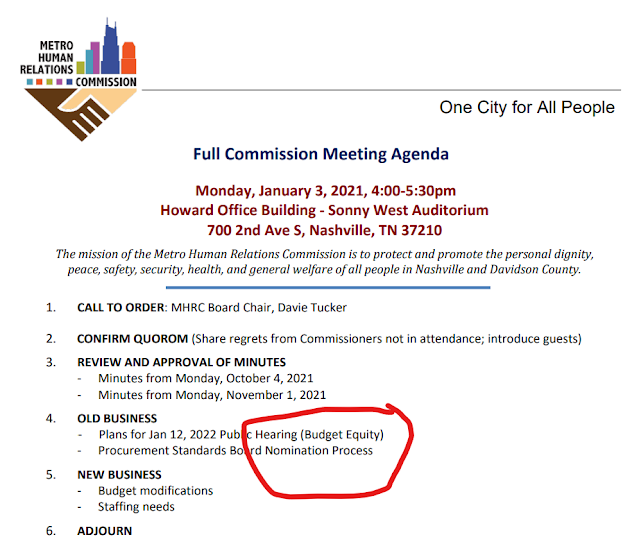
Expect to hear the term "budget equity" a lot this year when Metro develops a budget. What is it?

by Rod Williams, Dec. 28, 2021 - Progressives have a new tool to use at the local level to redistribute income, slip in Critical Race Theory indoctrination, and impose more progressive policies on their citizens.  This new term and tool are being adopted by progressive cities across America.  

It appears that Budgeting for Equity was a project of Bloomberg Philanthropies and was launched in 2020.  Initially, 30 cities participated in a training session to learn the concept and use of the tool.  "The 30 cities that have been selected to participate in the program, which will run through December 2021, are: Akron (OH), Austin (TX), Birmingham (AL), Chattanooga (TN), Chula Vista (CA), Columbia (SC), Columbus (OH), Denver (CO), Durham (NC), Fort Collins (CO), Knoxville (TN), Lincoln (NE), Madison (WI), New Orleans (LA), Oakland (CA), Peoria (IL), Philadelphia (PA), Providence (RI), Pueblo (CO), Rochester (NY), Salt Lake City (UT), Savannah (GA), Seattle (WA), Springfield (IL), Stockton (CA), Syracuse (NY), Tacoma (WA), Tampa (FL), Toledo (OH), West Palm Beach (FL)." (link)

Note that Nashville was not one of the original 30, but since the launch of "Budgeting for Equity," by Bloomberg, this concept has spread rapidly beyond the original thirty participating cities. Numerous cities are now incorporating "budget equity" in their budgeting process.

Here is some of what I gleaned about the "budget equity" movement from reading various sources and included are some snippets of the rhetoric. One can expect this to be repeated in Nashville.
  • A BUDGET IS A MORAL DOCUMENT AS WELL AS A FINANCIAL ONE
  • BE SPECIFIC. “Equity” can sound like a broad term. Identify the inequity or disparity you wish to address and how you will address it.  'Our department will create a performance goal for each employee to attend at least 2 equity, diversity, and inclusion related training per year." 
  • Budget Equity Tool (BET) is designed to integrate explicit considerations of racial and economic equity into decisions, including policies, practices, programs and ultimately, the  Departmental budgets.
  • Systemic inequities are entrenched in local governments. And the sheer pervasiveness can make it hard for city leaders to know where to start when making structural changes to how services are delivered or programs are designed. Many local leaders are now looking at their budgets—a city’s most important annual statement about its values and priorities—to address long-standing issues of racial injustice.

For more on the topic see these link, link, link, and link.

Stumble Upon Toolbar
My Zimbio
Top Stories

Wednesday, December 22, 2021

Metro Budget 101 Series: How Does the City Spend Money? Schools

 Metro Budget 101 Series: How Does the City Spend Money? Schools

Stumble Upon Toolbar
My Zimbio
Top Stories

Sunday, June 21, 2020

Councilman Brett A. Withers explains the budget process, his votes and defends himself against his leftist critics.

In the below essay Councilman Brett Withers provides valuable insight into the Metro government budgeting process and defends himself against attacks by his fellow progressive social justice warrior distractors.  At over 3500 words long, this is probably one of the longest blog post I have ever posted.  However, it does not contain wasted words.  Withers uses the number of words necessary to make his points. I encourage you to read it all.  The highlighting in the below essay is mine.
Brett Withers is not one of my favorite Council members.  I have often disagreed with legislation he has sponsored and the way he has voted.  One does not have to always agree with someone however, to recognize that they work hard and that they are knowledgeable and know what they are talking about.  I can respect someone for their ability, work ethic and knowledge and still not agree with their conclusions.  The budget process is complicated and a lot of people who are opinionated are not very informed. This essay by Withers is informative for anyone wanting a better understanding of the budget process.
In the most recent budget battle, the leftist activist have turned on Withers for not supporting their attempt to defund the police.  Because he is an employee of a subsidiary of TransCor America, the left has taken the tactic of claiming Withers voted for the interest of his employer rather than standing with the people for racial justice.  TransCor is the company formerly know as CoreLogic that provides incarceration services to governments.  They own prisons, among other things. In this essay,  Withers counters that charge that he put the interest of his employer above that of his constituents. Rod Williams


Brett Withers
by Councilman Brett A Withers, reposted from Facebook - I hope that everyone is enjoying the sunny weather today. I finally got a chance to sleep in this morning and go for a drive in the country to clear my head, which I highly recommend. I also joined Council Member Zulfat Suara’s FaceBook Live meeting providing a budget vote recap at 3:00 PM. I indicated earlier that I would send out a communication as well, and so here goes.

The Metro Government budget process is always like a marathon - it lasts several months - and this year’s was the most harrowing of the five that I have been through so far. The Metro Charter is a strong-mayor/weak-council system, and the Metro Departments are part of the executive branch, not the legislative branch of government.

Metro’s operating budget is a maintenance-of-effort system which means that each Department leadership team makes a presentation to the Mayor about what staffing or other operating budgets they need to continue providing services to constituents. This could mean that some efficiencies have been found (“targeted savings”) or that new situations have emerged or new efforts are underway or are being asked that would require additional employees or recurring operating budget resources. The mayor then goes through all of these department presentations and submits a recommended budget. Then the Metro Council goes back through that process with each of the Departments and then the Budget & Finance Committee chair submits a substitute operating budget that tweaks those recommendations a little bit, and there are amendment proposals to that substitute that the Metro Council votes up or down. Then if the Budget & Finance Committee chair’s substitute does not pass with whatever amendments were approved, then by law the Mayor’s recommended operating budget goes into effect. That happened last year. This year was unusual in that there were multiple substitute budget options that came out really late in the timeline. But Budget & Finance Committee Chair Bob Mendes’s Fiscal Year 2021 Operating Budget passed with 32 votes.

I think that it is fair to say that this budget doesn’t make anyone happy. Truly. But I have always voted to fund our school system and I did support Council Member Zulfat Suara’s Amendment 8 that moves up to $8,158,500 out of the MNPS Cash & Fund Balance (savings) toward teacher compensation. I also voted for Council Member Colby Sledge’s Amendment 5 that would have moved $2.5M from the Public Health & Safety Contingency fund toward the Barnes Fund for Affordable Housing, but that vote count failed.

I did not vote for Council Member Sean Parker’s Amendment 7 that would have diverted about $2.9M from the Sheriff, District Attorney and Police Departments for a contingency account for a social and emotional learning contingency fund. While the minutes have not yet posted, the Council Office’s notes appear to show that in addition to me, 24 other Council Members voted no on this amendment: Council Members Allen, Glover, Hall, Swope, VanReece, Hancock, Young, Hagar, Evans, Bradford, Rhoten, Syracuse, Cash, O’Connell, Roberts, Druffel, Murphy, Pulley, Johnston, Nash, Vercher, Rutherford, Styles and Henderson. This vote count captures a broad spectrum of Council Members. I have in the past supported efforts by NOAH and other groups by voting to fund social and emotional learning in MNPS budgets and to urge for the passage of School Board actions to address this needed instruction. But a great many of my Metro Council colleagues and I felt that this particular Amendment was well intentioned but not the appropriate way to fund this contingency fund at this time.

Council Member Welsch’s Amendment 26 that would have decreased the police department and sheriff’s office funding by about $110M and moved those funds into a number of other departments failed in a voice vote and a roll call vote was not taken. I have seen social media posts that listed perhaps ten out of forty Council Members who voted for it. There was a larger number of no votes - including mine - and a large number of abstentions. The African American Council Member vote was spread in yes/no/abstain votes.

Here are some thoughts on that.

Let’s go back to my previous indication that Metro’s operating budget is based upon departmental needs to maintain essential services to constituents. It is not clear to me that the sponsor or advocates for this amendment have thought through and accounted for how such a significant budget cut would impact services to the entire county.

Davidson County’s police staffing per capita is already lower than some other large cities, and our city is spread out over 500 square miles. The number one thing that constituents contact Council Members about is speeding cars and requesting traffic enforcement, which is mostly a police function. Noise complaints which are high in District 6 are also a police function.

Council Members also receive complaints about slow response times to police calls, and in the Southeast region which has the most traffic and some of the highest population growth, the former District 32 Council Member commented several times during our service together last term that her constituents wanted more police patrols. District 28 Council Member Tanaka Vercher served with me last term and has shared similar constituent feedback and this year has continued to advocate for opening a new Antioch police precinct on Murfreesboro Road. And so while I understand that in the last few weeks a national movement has erupted to defund police departments in large cities, and that defund movement means different things to different people, it is not clear to me that this amendment matches up with longstanding constituent calls throughout the county for additional police patrols and to create a new police precinct in Antioch led by an African American Council Member.

I would also share that I have been involved in this community for more than a dozen years and have experienced how our East Nashville neighborhood associations have worked closely with the East Precinct to address problems and make our community much safer for everyone. That effort to make our neighborhoods safer has taken a lot of working together among our neighborhood associations and with the East Precinct over the years. This longstanding positive working relationship includes neighborhood associations that have been led by African American East Nashville community members.

Several years ago as a community member I worked with the McFerrin Park neighborhood association on an event with the East Precinct to address crime concerns on North Second Street that were making residents there fearful in their homes. That community work with the East Precinct appears to have improved the quality of life and safety for neighbors in McFerrin Park over what it used to be ten or more years ago. And that event working with the East Precinct and the McFerrin Park Neighborhood Association was where I met a longtime neighbor who currently serves on the Community Oversight Board. It is good to have community members who have longstanding ties to neighborhoods that have worked on problem-solving efforts with the police department serving on the Community Oversight Board.

My own street is much safer now than when I first moved here and my family feared for my safety due to drug dealing and aggravated assaults. Later on East Nashville was experiencing rashes of home breakins and around 2010 the Eastwood neighborhood association created a yard sign that said “See Suspicious Activity? Call 862-8600.” Lots of neighbors across East Nashville bought those signs to encourage neighbors to contact the police nonemergency number to report suspicious activity, and the effort worked and the number of breakins decreased significantly, but of course there still are some.

Most if not all East Nashville neighborhood association meetings before COVID-19 continued to include police reports where an officer attends, goes over recent statistics for each neighborhood, and answers any questions or concerns that neighbors have. I have attended hundreds of those neighborhood meetings in District 6 including in Cayce Place and I have never heard neighbors say that they wanted less police officers responding to calls.

In Cayce we had a series of tragic shootings all in one year and the last one was a high school student who was caught in crossfire and tragically killed. I was present that night when Cayce neighbors gathered to mourn her death and speakers urged neighbors to communicate with the police to help bring the shootings to and end.

I was also serving as the District 6 Council Member when Jocques Clemmons was shot by a police officer. I spent a lot of time at Cayce over those days and weeks following that shooting. The Cayce residents themselves expressed to me that they wanted the matter investigated but they also remained calm. There were some social justice advocates who wanted to hold protests on the campus. But the Cayce Residents Assiciation president at the time who was also a NAACP member asked them not to do that. Some groups later held a protest and came to the Metro Council.

The Cayce residents themselves indicated to me that they wanted police protection but wanted policing to be done differently. Ultimately MDHA added more security cameras on the campus and the East Precinct worked with me, MDHA and the Cayce residents to set up foot and bike patrols that have fostered close relationships in Cayce Place. We actually pay police officers to walk children to school in the morning and play basketball in the afternoon and build positive relationships with residents in order to address potential problems before they place the community in danger.

There is a community advisory group for this team that includes Cayce residents, other neighbors and local faith leaders, and the advisory group meets monthly to talk with the East Precinct about what is working well or could be approached better or differently. This community policing model requires more personnel in the Cayce neighborhood than typical cruiser patrol ratios and it has made the Cayce community safer. But if we cut the police budget in half overnight that will go away, and instead whatever police officer staffing the county has remaining will go back to cruisers to respond to calls all across the county when they can get to the call.

So that is an example of how in some cases, having more police officers on foot or bike actually does make communities safer. It depends on the relationships that can be built. The sort of one-size-fits-all truisms of many of the calls to slash police department funding and personnel are not necessarily always true in Nashville. Nor do they necessarily reflect the views of the constituents for whom some well-meaning groups and neighbors are trying to speak. The way that I know what Cayce residents want is by asking them and listening to them.

I would also encourage folks to look more closely at how African American Council Members voted on this amendment. A couple of them voted yes, others abstained and at least two voted no. Council Member Porterfield stated on the floor that she empathized with the concerns but would be voting no. I cannot and will not speak for my colleagues but I do encourage folks to watch the video footage to discern the nuance of the deliberations.

I agree with several colleagues that I understand and appreciate the concerns raised but do not feel that simply cutting the Nashville police department’s budget by a large number and then sprinkling those funds over to other Departments is a well-thought-out plan to provide services to communities who truly need support. It is conceivable to me that Nashville can come up with a thoughtful and intentional, stakeholder-led plan to reimagine how several interrelated community support services are funded and provided in Nashville. Taking a dramatic budget cut action simply “to make a point” as one constituent wrote to me is not a thoughtful plan.

I appreciate the passion and enthusiasm of the many young people who wrote or spoke to the Metro Council on this topic.Sometimes I can agree with someone on a goal but not on the strategy for attaining that goal.

When I was in college and about 20 years old I was part of a Left-aligned group and read up on a lot of the Marxist-Leninist literature. I still have some of those books on my personal library shelf today as pictured. I had to work two jobs for a while to put myself through college but I did spend a fair amount of time traveling around the Midwest to counter-demonstrate against KuKluxKlan rallies. And while my appreciation of the Left critique of Capitalism remains, my beliefs about how to address those problems and how change occurs through government has continued to evolve with my own life experience and observation. In my zeal I did and said things to people whom I was trying to help or persuade that were not helpful, compassionate or even constructive. I am still working to make the world a better place and I continue to listen, observe and learn every day.

Sometimes individuals with Left-aligned views have a tendency to decide that a person who agrees with them on many things and actually votes with them a lot of the time is suddenly the enemy, and some of that phenomenon appears to be targeted toward me right now. That activity is understandable but unfortunate and I believe that it is misplaced.

I am the first person in my family to go to college in the traditional sense and I put myself through school, earned an undergraduate degree in liberal arts (English, with a minor in Comparative Literature and a minor in Philosophy) and then decided against incurring more student loan debt for graduate school but rather decided instead to get a “day job” to pay off those undergrad student loans.

My first job out of college was as an entry-level employee in the commercial real estate appraisal department at Price Waterhouse (now PwC). I loved that job and was working toward my commercial real estate appraise certifications. That’s how I learned so much about land use policy and zoning.

Then 9/11 happened and almost all commercial real estate transactions stopped for a while and that division was eliminated in Chicago. So I went to work as a support staff for executives at PwC. I worked for the president of a department that did business process best practices analysis and publishing and then that division was relocated to Tampa, Florida. I then went to work as the assistant to the head of PwC’s mergers and acquisitions division for the Midwest region. I left that job and moved to Nashville to help take care of my grandparents and to spend time with my family here. So when I moved to Nashville PwC did not have an office in Nashville and I worked with a staffing company on a job search and that is how I ended up at TransCor America, which is government contractor that provides transportation services. Yes, it is a company that is owned by CoreCivic. I had never even heard of that then. But at any rate, my job is as the support staff for the president and VP of TransCor America. They are both Marines (TransCor strives to hire veterans).

I am an hourly worker. I do meeting and event planning, I work on documents, reports and communications, and I work on employee relations stuff. I produce the employee newsletter. I send birthday cards. I spend a lot of time ordering flowers for funerals when an employee loses a loved one. I put a lot of work into quarterly or annual employee recognition awards events and communications. I work with a team of volunteers who send gifts to employees at the non-Nashville locations to let them know that we are thinking of them. Most TransCor employees are CDL drivers and are diverse. In 2016 TransCor was named a Top Workplace based upon external employee engagement survey responses. Right now I am also covering a switchboard.

I have held this same support staff position at TransCor for 13 years. That information has always been available. I know that a lot of people don’t like CoreCivic. I don’t make decisions for or speak for CoreCivic, or even TransCor. I punch a clock and go home at the end of the day.

While working my day job at TransCor over the years I have taken off work countless times to support our community at Planning Commission or other Metro Government meetings. I was elected the president of Eastwood Neighbors five years in a row from 2010-2014 and worked with our neighborhood on an extensive Conservation Overlay expansion and helped negotiate an adaptive reuse plan for Hobson Church at Greenwood/Chapel that is finally coming to fruition. I worked with then-Council Member Walter Hunt in 2013 and 2014 to build community support to pass the DADU bill allowing detached garage apartments, the Duplex Bill regulating the “tall-skinny” proportions of duplexes, and the Contextual Overlay enabling legislation. I was honored by the Historic East Nashville Merchants Association as their East Nashvillian of the Year for 2014. All while working this same administrative support job.

In 2015 I ran for Metro Council to represent District 6 with a campaign team of neighborhood volunteers and with support from District 6 residents and small businesses. My employer was definitely a topic of conversation at that time. I won 62% of the vote. I think that most District 6 voters at that time were able to weigh my long record of community involvement higher than their feelings about the parent company of the employer who pays me an hourly wage for a support staff position. I ran unopposed in 2019.

I know that some people are once again resorting to putting up signs and using ad-hominem attacks, but the identity of my employer has been public information for a long time and has been known to most people who have been around and paying attention. I hope that those who have been around the neighborhood and paying attention have also noticed my work to serve and support this community as best as I can.

That leads me to the concern that some have expressed that my reason for not voting for Amendment 26 is due to my employer.

No.

My voting record shows that I have always voted to fund Metro Schools as much as I can, even if it requires raising taxes to do so. Every year.

On the law enforcement and immigration topic, I even cosponsored legislation introduced by Council Member Bob Mendes that would have ended Metro funding for immigration enforcement at the jail https://www.nashville.gov/…/o…/term_2015_2019/bl2017_739.htm and ended Metro’s contract with the US Marshals Service https://www.nashville.gov/…/o…/term_2015_2019/bl2017_743.htm. My views do not reflect those of my employer.

I also introduced and passed a Resolution making Nashville one of the first cities in the Southeast to recognize Indigenous Peoples’ Day https://www.nashville.gov/…/r…/term_2015_2019/rs2017_907.htm. I have taken numerous other steps to support racial justice efforts in Nashville, not to mention LGBTQ equality. In terms of funding affordable housing and services, the Envision Cayce Master Plan is a $600M affordable and workforce housing plan that has also brought an additional school to the Cayce neighborhood at no cost to Metro. I did work with Mayor David Briley to fund some additional affordable housing units on top of the one-for-one affordable housing replacement units. So I support funding education and affordable housing.

I simply do not believe that the proposed Amendment 26 represented a well thought-out strategic plan to address some of the valid concerns that have been raised about policing and to provide comprehensive solutions that would be needed in order to reduce the number of police officer positions in Nashville. That is an aspirational goal. And some of my African American Metro Council colleagues appear to agree and voted similarly.

I appreciate the many kind emails or communications from District 6 neighbors that I have received over the last few days. I will continue doing what I can to support practical measures that further the Black Lives Matter movement in Nashville where I believe that our city can again lead the nation in thoughtful dialogue and positive change to make our city safer for everyone.

Thank you for reading.

Stumble Upon Toolbar
My Zimbio
Top Stories

Thursday, December 12, 2019

Nashville gets state approval for budget after officials outline financial fixes

The Tennessean-..... To fill the gap, the city will use:

  • $12.6 million from a PILOT with Music City Center; 
  • $10 million from a PILOT with Metro Water Services; 
  • $7.2 million from refinancing of Metro Development and Housing Agency payments; 
  • $3.6 million from debt reimbursement from the Convention & Visitors Corp;
  • and $500,000 from program reimbursement from the Davidson County Sheriff's Office and the U.S. Marshals Service. 
The remaining will be filled with an estimated $2.6 million in targeted savings and deferrals in spending from Metro departments and the $5 million cut to the Barnes Fund for Affordable Housing, which the administration announced last week.

"I have very good news to report," Crumbo said Wednesday, telling council members that state Comptroller Justin Wilson approved the plan he submitted earlier in the day. (Read More)

Stumble Upon Toolbar
My Zimbio
Top Stories

Wednesday, June 19, 2019

No TAX Hike! Metro Council fails to pass substitute budget with a property tax hike


I am surprised. I was almost certain one of the three proposed tax increase budgets would pass. I was favoring the Glover substitute, because it raised taxes the least. My support was simply a pragmatic calculating. I prefer a no tax increase budget but did not think one could pass. Looking at the make up of the Council, knowing of Metro's dire financial situation, perceiving the mayor to be weak, and looking at the number of Council members in either safe seats or not seeking reelection, I thought  the Council was almost certain to pass a tax increase of some amount. That shows you how much I know. I miscalculated. I was wrong, but I am not disappointed. I am pleased the no tax increase budget passed.

Going into tonight meeting there was three proposed substitute budget proposals, so the council had four options to consider, the three substitute options each of which raised taxes and then the mayors budget which did not. The process involved considering the budget presented by Council member Vercher. Her budget proposal was the recommendation of the Budget and Finance Committee and would have raised taxes the most. After her budget was introduced, then there were attempts to amend her proposal with first one and then the other alternatives. Both attempts failed, so then the Council was faced choosing Vercher's bill, which would raise taxes more than the two rejected alternatives, or the mayor's no-tax-increase budget. Vercher's proposal failed by only one vote.

Metro's new budget is $2.33 billion with revenue increases of $101 million but about $44 million will go to rising debt obligations. Debt obligations have to be paid. Not paying our debts in not an option. It provides a $28.2 million increase for Metro Schools and a 3% pay increase for school employees.

I am posting this with some still unanswered questions.  Budget's are required to balance; revenues have to equal expenditure.  Briley calculated  income from the proposed parking privatization deal as the source of  $17 million for this year's budget. With the parking deal put on hold, I do not know how they filled that hole. Most likely reserves were permitted to dip, but I don't know that.

For more on Metro's budget here are some resources.

Stumble Upon Toolbar
My Zimbio
Top Stories

Saturday, March 16, 2019

Metro budget "discussions" begin March 28th.

by Rod Williams - Metro will start the formal budget "discussions" March 28th. They were always called budget "hearings" prior to Mayor Megan Barry rebranding them as "discussions."  "Discussions" sounds so much more "collaborative" and all  touchy-freely. I prefer "hearings."  I hope the next mayor goes back to having budget "hearings."

What happens at these "discussions" is that each department appears before the mayor and presents their budget request. What really happens is that prior to the discussions the mayor's office has already told each department head that there is not going to be a tax increase this year so most department heads will present a budget request that only calls for a modest increase. In years in which the mayor is going to ask for a tax increase, Department heads say houses will burn, police will not be able to stop a crime wave and libraries will close if they do not get a big budget increase. It is somewhat a sham. Some department heads really will plead for more money but they will not go overboard, they kind of already know what to expect. Never does a department head say they need less money than previously.

At the conclusion of the budget discussions, the Mayor and the Finance Director draw up a budget.  On May 1, the Mayor and/or the Finance Director present the Recommended Budget to the Metro Council. The Chairman of the Budget and Finance Committee files the budget and tax levy ordinances. The Office of Management and Budget (OMB) then prepares the Recommended Budget Book for Council's review. This is known as the "mayor's budget."

During April to June, the Council and the Budget and Finance Committee conduct public hearings as well as hearings with each individual department. The budget is approved on three readings, and may be amended or substituted on the third reading. OMB prepares a substitute budget ordinances for the Budget and Finance Committee as required. This is called the "substitute budget," or the "council's budget." Even if taxes are not going to be increased, the Council always shifts some money around and changes the mayors budget.

On June 30, the Council passes the budget ordinances, and the Mayor signs the budget ordinances into law. If the Council fails to pass a balanced budget by June 30, the Recommended Budget and tax rates take effect by default. In other words, if the Council does not pass their substitute budget the mayor's budget become the budget even if Council does not vote on it.

As anyone who had read my blog for any time knows, I am a conservative. I would like to see Metro cut non-essential services and not raise taxes.  I would like for the city to stop the massive fraud and waste and corporate welfare. I would like to see the city close General Hospital and abolish the Human Relations Commission and make other cuts. Unfortunately, that is not going to happen.  Without  Metro being willing to make cuts to services we need a tax increase. We probably should have had a tax increase last year. I could support a modest tax increase. This being an election year Mayor Briley is not going to propose a tax increase. The cooperative press is not going to write stories about how we are on the brink of disaster. We are not, but be sure that that is what we would be reading if the mayor was proposing a tax increase.  While we are not facing a disaster, employees deserve a pay increase and fire and police are under staffed. Also, we need to budget more money to debt service to pay down Metro's debt.

Look out next year! If Briley is reelected, in 2020 he will propose a whopping tax increase.  No matter who is elected, I expect a proposal for a substantial tax increase in 2020.

The budget "discussion" will be on line for viewing if anyone is interested. They each only last a few minutes and are pretty shallow affairs. They are also open to the public if one wants to go and observe in person.  Below is the City's press release and budget discussion schedule.

#

Metro Nashville press release - Mayor David Briley and Metro Finance Director Talia Lomax-O’dneal have released the schedule for upcoming meetings related to the 2019-20 budget.
The Mayor's Budget Discussions will be aired live on Metro Nashville Network and Nashville.gov. All budget discussion videos will be archived and available on YouTube and shown throughout the following weeks on Metro Nashville Network.

Schedule for Thursday, March 28, 2019

Conservation and Historical

  • 9:30 a.m. – Codes
  • 10:00 a.m. – Planning Commission
  • 10:15 a.m. – Beer Permit Board
  • 10:30 a.m. – Historical Commission

Health and Social Services

  • 10:45 a.m. – Community Education Commission
  • 11:00 a.m. – Human Relations Commission
  • 1:45 p.m. – Social Services
  • 2:00 p.m. – Health Department
  • 2:30 p.m. – Hospital Authority
  • 3:00 p.m. – Metro Action Commission
  • 3:15 p.m. – Justice Integration Services

Location

Historic Metro Courthouse
1 Public Square
Mayor's Media Room
Nashville, TN 37201

Stumble Upon Toolbar
My Zimbio
Top Stories

Saturday, June 23, 2018

These council members voted NOT to raise your taxes.

Below are the council members who voted against raising your taxes.  They voted against the Mendez substitute budget which would have increased the property tax rate by 50 cents or 16%.

A tax increase would have not only been paid by homeowners but renters would have likely been impacted to a greater extend since multi-family properties are assessed at a higher rate and higher taxes on these properties would have been passed on to renters in the form of higher rents.

You may want to thank your councilman for his vote.  You may contact any of these members by clicking on their name and it will take you to a page with a link to their email address and other contact information.

If you are unsure who your council member is follow this link and to the right of the page see, "Council District Lookup."


Stumble Upon Toolbar
My Zimbio
Top Stories

What happended at the Council meeting of 6/19/18: No tax hike budget passes, most other important bills deferred. (final update)


By now everyone who cares knows the council passed a budget that does not raise taxes. This meeting however is worth watching because it is one of the best meeting I have ever seen.  I thought the arguments were well made even when I didn't agree with the position of the speakers. Also, the Council was attempting to do something never done before and that is to raise taxes when the mayor's office did not propose raising taxes, so that made it interesting.

 If you are actually going to watch the whole meeting, you better get a drink and a snack and be prepared to take a bathroom break.  At six and half hours long, this is one of the longest meeting I ever remember. I watched part of it in real time as it occurred and then watched most of the video. I skipped ahead in the parts where I knew nothing important was happening and watched parts of it in double speed. Most of the meeting is devoted to the budget. Below is a summary of the meeting.
To access the agenda, the Council staff agenda analysis and my commentary on the agenda, follow this link and this link.

Following the prayer and pledge is a ceremonial presentation honoring Franklin Road Academy's wrestling program coach. The Council gets down to business at timestamp 16 in the video. The first item is election of a person to the Industrial Development Board.  There are two candidates and a nominating speech for each and then the council votes, electing Quin E. Segall. I don't know anything about either candidate and had no preference. 

Following that election, the Council votes to confirm mayoral appointments to boards and commissions. There is no discussion or surprises. This is concluded at timestamp 32. The next item is public hearings  on three resolutions all asking for an exemption from the minimum distance requirements for obtaining a beer permit. No one speaks on any of them and they pass.

Resolutions of interest

Resolution RS2018-1253  extends the duration of the water and sewer extendable commercial paper program. I do not know if this is prudent or not but it sounds suspect. It is deferred one meeting.

Resolution RS2018-1262  appropriates $3.5 million from the undesignated fund balances of the MNPS General Purpose Fund to Metro Schools. This was necessary to
finish the current budget year, which ends on June 30. It is unusual. It means the School system spend more money than was appropriated. Director of Schools Shawn Joseph explained this was due to unexpected administrative expenses. To read The Tennessean's coverage of this issue, follow this link. This resolution passes on a voice vote.

Resolution RS2018-1263 is a resolution requesting the Tennessee General Assembly to introduce and enact legislation to allow for online publication, instead of newspaper publication, when public notices are required. Now, these public notices are published in publications that no one reads, that is just full of notices. The committee voted against it 8 to zero and the sponsor deferred it indefinitely. I do not know the argument against it as I did not watch the committee meeting but on its face this seemed like a good idea. 
All bills on first reading are lumped together and pass by a single vote without discussion as is the norm. 

Bills on Second Reading.
Bill BL2018-1189  would require Metro to make an even greater effort to make sure some Metro business goes to minority contractors when Metro has projects to put out for bid. The staff analysis says Metro legal has expressed concern that the bill may contain unconstitutional race and gender based preferences and is inconsistent with the current framework of the Procurement Non-Discrimination Program. It is deferred one meeting.

Bill BL2018-1200 would require that if a  hotels or roominghouses accept cash payment, they must also accept at least one other form of payment such as check or credit cards. I seldom carry cash and would find it inconvenient if I tried to do business with an entity that was cash-only, but why not let the market work this out?  Why must the government try to micromanage every aspect of commerce and our lives? It is deferred one meeting.

Bill BL2018-1201  would tighten animal control regulations. Now, you are not supposed to leave your pooch out if the heat index will be above 95. This lowers it to 85. Animal Control says to enforce this will take more people, space, and equipment and cost $472,617. This is deferred one meeting.

Bill BL2018-1202 are proposed new rules for scooter prompted by the arrival of

Bird Scooter here in Nashville. It would require new fees including a fee of $40 per scooter. This is deferred one meeting.

Bill BL2018-1203  also deals with scooters, in-line skates, and roller skates by removing the requirement for wrist guards, elbow pads, and kneepads and updating audio device references.. This is deferred one meeting.
Bill BL2018-1207 would direct the Purchasing Agent to terminate Contract Purchase Agreement 338266, a project management services agreement between Commonwealth Development Group, Inc. and the Metropolitan Government. Commonwealth Development is the company that did work on the MLS stadium without a contract to do that work and without money appropriated to do that work. The work was authorized by Metro Chief Operating Officer Rich Riebeling. Commonwealth was paid out of a Bridgestone Arena fund. The Metro Sports Authority, which operates the arena, was unaware of the spending.  This  incident let to a deeper look the work of Commonwealth and some in the Council became dissatisfied.  The owner of Commonwealth and Rich Riebelng are close friends and questions were raised about that cozy relationship and how Commonwealth got Metro business and how much they are paid and the provision of free office space to the company. There is less than a year left on the current contract and this bill was withdrawn. Steve Glover says the trust factor has been eroded.
Bills on Third Reading:
Substitute BL2018-1139 (as amended)   approves the Donelson Transit-Oriented Redevelopment Plan. This is deferred two meetings.
The Operating Budget, Bill BL2018-1184 and related items. 
The lengthy deliberations on the operating budget starts at timestamp 1:22:17.  Speaker Pro Tem lays out the process and possible outcomes at the start of the discussion.

There were three possible budgets that could have passed; the mayor's budget, the Vercher substitute or the Mendes substitute. The mayor's budget did not raise taxes and did not fund the promised employee cost of living pay raise or give the schools their budget request. The Vercher substitute did not hike taxes but shifted money, giving $2 million more to schools. The Mendes substitute increased the tax rate 50 cents or 16%, would have generated $150 million, fully funded the COLA for metro employees and fully funded the schools request.

One should realized the budget process to know the limitations of what the Council could do.  We have a strong mayor form of local government. The deck is stacked against the Council. When it comes to the budget, if the Counciil fails to pass a budget the mayor's budget becomes law without council action. It takes 21 votes to pass a budget. If the mayor should veto the budget presented by the Council, then it takes 27 votes to override a veto. So, the Mendes budget had an uphill clime to be passed. Should the Mendes budget have passed, then been vetoed by the mayor, which we can assume he would do, and then the Council failed to override, then the mayor budget would have been the official budget.  There would not have been an opportunity to go back and pass the Vercher budget.

For those who won't to get in the tall weeds of the budget, see Citizens' Guide to the Metro Budget. If watching this lengthy budget debate does not satisfy your desire to understand the budget issues, you may want to watch the Budget and Finance Committee deliberations on the budget which you can watch at this link

Vercher is called on first. As chairman of the Budget and Finance Committee she is the sponsor of the mayor's budget. As chairman, she oversaw the work of the committee that created the substitute and the substitute that was the result of committee work becomes her bill and she moves to substitute the mayor's budget. The Vercher budget is substituted for the mayor's budget by a vote of 34 to 4. 

Next, various amendments are voted upon. Most of the amendments shifted some money from one department to another. All failed but three. One of the amendments shifted a little money.  Another, which I am pleased to see, created a Blue Ribbon Commission, "to identify government inefficiencies, practices, transfer payments, third party payments and subsidies with the targeted goal of achieving budgetary cost savings of $20 million in annual savings." I hope this is successful and am optimistic that some saving will be realized by this commission.

Another, was an amendment to substitute one piece of property for another as one of the properties that will be sold to generate money as part of the city's revenue to fund this budget.  A piece of property on Woodycrest used to park school buses was substituted for the Edgehill Community Memorial Park that was listed as a piece of property to be sold.  I am pleased by this amendment. We should not be selling off city parks. 

Next, Councilman Mendes was recognized and he moved to substitute the Vercher substitute with his substitute which raised taxes. After considerable debate his budget was rejected by a vote of 19 in favor to 20 opposed. The vote was 19 to 19 before the tie was broken by the Speaker Pro Tem Councilman Sheri Weiner. Back on the budget ordinance which is the Vercher substitute, that bill is adopted. There is some very good debate.

After the budget, Bill BL2018-1185 which is the tax levy which did not increase taxes is passed. Following that the Council acts on three resolutions that address the pay plan. If the pay plan had not been adjusted, then to fund the employees pay increases approved in a pay plan last year, a lot of other employees would have lost their job.

Stumble Upon Toolbar
My Zimbio
Top Stories

Wednesday, June 20, 2018

NO TAX INCREASE! Tax hike budget fails in a very close vote.

by Rod Williams, June 20, 1918 - After a lengthy discussion in which numerous Council members spoke for or against the Mendes amendment to the Vercher sponsored substitute budget, the Mendes amendment failed. That amendment would have hiked the tax rate by 5O cents or 16%. It would have generated $150 million which would have funded a cost-of-living pay increase for Metro employees and it would have fully funded the school board's funding request. The vote was taken at 12:33 AM. The vote was 19 to 19. President por tem Sheri Weiner who only votes in the event of a tie voted "no," killing the Mendes tax hike budget proposal making the final vote 19 in favor and 20 opposed


Back on the Vercher no tax hike substitute bill, the Council voted in favor 34 to 4.


For more details, and a list of how council members voted, see a future blog post.

Stumble Upon Toolbar
My Zimbio
Top Stories

Tuesday, June 19, 2018

Budget and Finance Committee recommends tax hike budget by 7 to 6 vote. However ...

In a surprise move the Budget and Finance Committee of the Metro Council voted to recommend a tax hike budget. The budget that was expected to be the Council budget that had been developed earlier by the committee shifted some funding but did not raise taxes. That no tax hike budget was sponsored by the Committee chairman Tanaka Vercher.   

The tax hike budget was sponsored by At-large Councilman Bob Mendes and barely won approval by the Committee by a vote of 7 to 6. Under the Mendes budget the tax rate for most property owners would increase by 50 cents which amounts to a 16% property tax hike. That tax hike would generate $150 million which would fund a cost-of-living pay increase for Metro employees and it would fully fund the school board's funding request.

Confusingly, the Council also recommended the no tax hike Vercher budget by a recommendation of 9 to 3.  So, the Committee is recommending both budgets which means the Committee is not making a clear recommendation. With no clear recommendation from the committee, we probably will see a floor fight on Tuesday night. For more details, see The Tennessean's coverage of this development at this link.


Stumble Upon Toolbar
My Zimbio
Top Stories

Monday, June 18, 2018

Metro's financial woes just got $23 milliion worse.

by Rod Williams - By the way city officials calculate the budget, there is a budget shortage of $34 million. That is to say the city will realize $34 million less in revenue than the city initially thought they would have. $26 million of that is due to successful challenges, mostly by large commercial interest, to the city's recent property appraisals. Another $8 million is due to the city getting less funding from the State for schools due to declining school enrollment.

Despite the city's population growth, there are fewer children being enrolled in Metro Schools. either because there is demographic shift and there are fewer school age children or because more parents are sending their kids to private schools or homeschooling.  It is probably some of both. One would think with fewer children to educate that would be a budget plus. One would think with fewer students to educate, that would save the city money.  The State does not cover the full cost of educating children so it is hard to understand why having fewer students is a hardship  rather than a benefit. If you think like that then you are thinking like a business man or someone who manages a household budget.  That is not the way bureaucrats or the school board or Mayor Bailey thinks about it.

In any event, these two factors constitute a $34 million shortage. In developing the budget, the
anticipated revenues and anticipated expenses have to match.  Most of the revenue comes from property tax and sales tax but there are also many other fees that contribute to the revenue side. Everything from parking tickets to fees for rezoning property and city auto stickers and dozens of other fees contribute to the city's revenue.  In the Mayor's $2.23 billion budget $23 million in revenue is anticipated to come from the sale of three city properties that have been declared surplus. This is one-time money and it is not wise to depend on one-time money for continuing expenses, but that is what the city is doing. This same revenue is also counted in the Council's substitute budget proposed by the Budget and Finance committee.

It is by no means a certainty that these property sales will take place. The three properties are in Edgehill, Green Hills and Charlotte Avenue near Sylvan Park. There are any number of things that could stop these sales. While I do not know the specifics of these three parcels, rezoning could be an obstacle. Often for a prime piece of property to get top dollar it must be rezoned. Often the completion of the sale is contingent upon the rezoning taking place. Rezoning is never a certainty.

There is already serious opposition to the sale of the Edgehill property. This property is a park that adjoins the Edgehill Apartments public housing project. It is the former site of the home of African-American folk artist William Edmondson. He was the son of slaves who became a self-taught artist and was the first African-American artist to be given his own show at the Museum of Modern Art in New York City. His art has been featured in the Smithsonian American Art Museum.

The Edgehill community has a long history of activism. The Rev. Bill Barnes who was an organizing force in the community pastured the Edgehill Methodist Church from 1966 until his retirement in 1996. He was liberal advocate for affordable housing and other issues affecting the Edgehill community.  The Edgehill community is accustomed to fighting city hall. A few years ago when the city entered into an agreement with Belmont University to share Rose Park with Belmont University in exchange for Belmont's investment in the park, the community unsuccessfully fought the deal. It did happen but it took a while and there were lots of protest and a lawsuit before Belmont won that battle. 

In the last year, the Edgehill community became a leading voice opposing the redevelopment of property that adjoins Fort Negley that was the former home of the Nashville Sounds' Greer Stadium. Fort Negley is near the Edgehill Community. Fort Negley was build by freed slaves forced into labor by the occupying Union army.  Many Blacks endured terrible hardship building the fort and many died. Many in the Black community found it offensive that this site of significance to African-Americans was to be redeveloped rather than incorporated into the Fort Negley Park. When Mayor Briley became mayor, the plan to redevelop the Greer stadium site was abandoned.

The point of the above discussion of the Edgehill community is to say that if the community wants to keep the city from selling off the  Edgehill Memorial Gardens Park, the community will fight. They will not just roll over and play dead. The community has already had at least one community meeting to organize for the purpose of saving the park (link). While I think Nashville does too many things, I like our park system. As Nashville grows, we need more green space not less.

In addition to the political activist of Edgehill, I am sure there are many people like me who will side with those who think selling off park property to balance the budget is not a good idea. I signed petitions and advocated saving Fort Negley and reincorporating the Greer site back into Fort Negley Park and I feel sure I will support saving Edgehill Memorial Gardens. Councilman Colby Sledge who represents the Edgehill area has already come out in opposition to selling off the park.

In stead of making the budget balance by counting one-time money from the sale of pubic lands when that sale looks very doubtful, the city should cut the budget. There is plenty of waste, corruption, and unnecessary spending to cut to make it balance. Also, using one-time money to balance the budget just sets us up for a certain tax increase next year. It is time to get serious about cutting expenses.

For additional source material for this story see the following links: here, here, here, here.

Stumble Upon Toolbar
My Zimbio
Top Stories