Showing posts with label Farm Bill. Show all posts

Saturday, February 01, 2014

How TN Congressman voted on the $1 trillion central planning food stamp farm bill

Reposted from The Foundry:

Congress is very fond of two things: throwing a bunch of stuff into one bill and rushing bills through while Americans are focused on other news. While people were talking about the State of the Union, they’ve done it again with the $1 trillion farm bill.

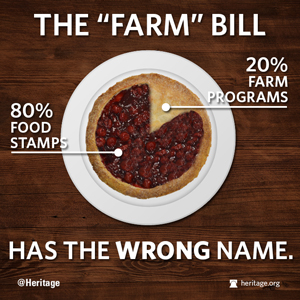
The “farm bill” passed by the House yesterday has projected costs that are even greater than those of the Obama stimulus, and about 80 percent of the bill is just food stamps.
The bill is filled with special handouts to agriculture special interests and is a model of central planning. When it comes to food stamps, the bill is just as bad.
farm-bill-pie
Food stamps should go to those truly in need. So it may surprise you to learn that you can qualify for food stamps even if you have millions in the bank. The new farm bill does nothing to address this absurd loophole.

A loophole like this undermines the legitimacy of the program and certainly does nothing to help people who really need help.

Food stamp recipients also aren’t required to work—a disservice to them and to the taxpayers who are assisting them. A work requirement empowers people, as we have seen with welfare reform.

So the food stamp program, with plenty of encouragement from the Obama Administration, has grown far beyond what it was supposed to be. Heritage expert Daren Bakst reports that “food stamp spending has quadrupled since [fiscal year] 2000 and doubled since 2008.”

The food stamp issue is not just about numbers. It’s about policy reform—developing policy that empowers Americans instead of creating a dependency that harms them.
Now this food stamp—er, farm—bill disaster goes to the Senate.
How they voted:

The bills passed the House 251 to 166 with 14 not voting. Republicans voted 162 in favor and 63 opposed. Democrats voted 89 in favor and 103 opposed. So, Republicans voted for the bill in greater number than Democrats. Democrats opposed the bill because of a modest decrease in food stamp funding. Below is how our Tennessee delegation voted. Tennessee Republican votes are in red text; Democrats in blue.
 
Here are the Tn Congressmen voting in favor: Phil Roe, Diane Black, Stephen Fincher,

Here are the Tn Congressmen who voted against the bill: Chuck Fleischmann, Jimmy Duncan,  Scott DesJarlais, Jim Cooper, Marsha  Blackburn, Steve Cohen.

One can assume Republicans voted against the bill because it is a terrible bill as explained above. I am proud of those Republicans who voted against the bill and if I were in Congress I would have voted against it. 

One of the things that always angered me about Republicans is their support of agriculture central planning and welfare for farmers. We should not pay rich Hollywood farmers and Wall Street farmers for not growing crops on their farms. We should embrace a free market in agriculture. Republicans who rail against government control of health care and advocate a market approach to health care turn around and support government central planning in agriculture and price-fixing. They rail against welfare queens and support welfare for farmers.

Because many farmers vote for Republicans, Republicans support the central planning status quo and welfare for farmers. Having said all of that however, sometimes voting in Congress is a strategic vote. One is not just voting on the merits of the bill, but voting between available options. Sometimes one may vote for a bad bill because if the bad bill does not pass, a more terrible bill will pass. I am sure some Republicans voted for this bad bill because the alternative was worse. At least, I hope that is why Republicans who voted in favor, did so.

I cannot find a searchable data base on this vote, but if one wants to see how a particular Congressman voted you can look them up at this link.

Stumble Upon Toolbar
My Zimbio
Top Stories

Tuesday, November 12, 2013

Meet Your Taxpayer-Subsidized Farm Bill Billionaires!

Jason Linkins -  When most people think about farm subsidies, chances are they do not immediately think "massive taxpayer money boondoggle that should be cut from the federal budget immediately." They've probably heard about how hard it is out there for small family farmers, doing honest work in the world, keeping everyone fed and maintaining our institutional repository of agricultural practices. Surely, these subsidies are helping to keep an important way of life alive for the True Sons of Soil and Toil ... like, say, multi-billionaire Microsoft co-founder Paul Allen.

Wait. What? He's a farmer? (link)
One of the things that continue to disgust me about Republicans is the hypocrisy of supporting agriculture central planning and welfare for farmers. Republican profess to believe in free markets and capitalism. Some in Congress are also feeding at the government trough, such as our own Congressman Stephen Fincher of the 8th Congressional District and tea party favorite Michelle Bachmann who has received a quarter million dollars in farm subsidies

Welfare for farmers is as much welfare as the inner city single mother of four living in public housing. The difference is, many of the welfare farmers are super rich. Here are a few "farmers" we are subsidizing. 

 Paul Allen, co-founder of Microsoft: Net worth: $15.8 billion, His Kona Residence Trust received $14,429 in barley subsidies from 1996 to 2006.

 Philip Anschutz, owner of Anschutz Entertainment Group and co-founder of Major League Soccer: Net worth: $10 billion, His Clm Company received $553,323 in cotton, wheat, sorghum, corn, oat, barley and other farm subsidies from 1995-2003. His Equus Farms received $53,291 in livestock subsidies in 2002.

S. Truett Cathy, founder of Chick-fil-A:  Net worth: $6 billion, His Rock Ranch LLC received $4,536 in livestock subsidies in 2003.

Charles Schwab, founder of brokerage firm Charles Schwab Corporation: Net worth: $5.1 billion, Schwab received $525,593 in rice and other farm subsidies from 1995 to 2003.

Stumble Upon Toolbar
My Zimbio
Top Stories

Thursday, July 11, 2013

John Duncan is lone House GOP Tennessee vote against the new central planning farm welfare bill.

The House passed a farm bill today and split up the farm-related programs from the food stamp program which is good news. However, they still passed the Soviet-style central planning farm welfare bill without making a single reform. To see how bad the farm bill really is follow this link.

John Duncan
They introduced the bill last night and rushed it though without allowing any amendments to the bill (link). It passed 216-208 with no Democrats supporting it and only twelve Republicans voting against it.  The Democrats voted against it because they did not want to split out the food stamp provision. Twelve Republicans voted against it on principle. It is beyond me to see how anyone who professes to believe in smaller government, holding the line on the growing national debt, and free enterprise could support this bill.

I am disappointed in all but one of the members of our Republican delegation, but I am especially disappointed in Marsha Blackburn who has always been one of my favorite legislators. I expected better from her.  John Duncan of Knoxville, was the only Republican member of the Tennessee delegation to vote against it. He is my new favorite Tennessee legislator. To see how representatives voted, follow this link

Stumble Upon Toolbar
My Zimbio
Top Stories

Tuesday, July 09, 2013

Just how bad is the Farm bill that Lamar Alexander and Marsha Blackburn supported?

One of the things that most disappoint me about Republican politicians is their continued support for the Farm Bill. Year after year, they vote for a budget-busting, welfare bill that violates Republican values of smaller government, reducing the deficit and free enterprise. It is an unprincipled vote to buy the support of farmers. They throw principles out the window and support a farm policy that more closely resembles Soviet-style central planning rather than free enterprise. How they can vote for a program that violates everything they claim to stand for is beyond me.

In Tennessee Bob Corker voted against it in the Senate, but Lamar Alexander voted for it.  In the House, where it failed, among the Tennessee Republican delegation only John Duncan voted against it.  Yes, conservative darling Marsha Blackburn voted for it, also. The two Democrats in the Tennessee delegation voted against it, but they voted against it because they wanted more appropriated for food stamps. 

To see just how bad of a bill the Farm Bill is, see the following article from The Heritage Foundation, April 8, 2013:

7 Ugly Truths About the House Farm Bill

The recently defeated House farm bill was fundamentally flawed. The House can now fix these flaws by going back to the drawing board and developing real reforms. To adopt necessary reforms, the House needs to separate food stamps from the farm programs and consider each on its own merit in two distinct bills.

Splitting the bill is not the end of the process, though—it’s just the start of the process.
As the House moves forward, it helps to look back at just some of the ugly truths about the House farm bill:
  1. Costly. The House would have spent more than President Obama and the Senate on the costliest farm program: crop insurance. In fact, Obama would have cut costs by close to $12 billion, while the House would have added about $9 billion.
  2. Anti-reform. The House bill would have done nothing to address the skyrocketing costs of crop insurance, such as placing a cap on the amount of subsidies that farmers can receive or developing a means test. In fact, the House rejected an amendment that would have made such common-sense reforms.
  3. Pro-Christmas tree tax. The House bill that was considered on the floor would have lifted a stay that blocked the United States Department of Agriculture from taxing Christmas tree producers and importers. When the full House had a chance to reject this tax by keeping the stay, it overwhelmingly supported the Christmas tree tax. It also would have done nothing to repeal the other comparable 19 check-off taxes that exist in law.
  4. Pro-corporate welfare. One of the most egregious “farm” programs is the Market Access Program. Taxpayers are forced to subsidize the overseas marketing of wealthy companies. The House overwhelmingly rejected an amendment that would have eliminated this program. If this wasn’t bad enough, the House also overwhelmingly rejected an amendment that would have eliminated a program that promotes farmers markets.
  5. Guaranteed payments. The House bill would have set up a “reference price program,” which was sold as covering only major losses for farmers. In fact, the program was even more generous than the Senate program and would have effectively guaranteed payments to some farmers as soon the bill became law.
  6. Provided extreme protection for farmers. The House bill would have pushed what is called a shallow loss program, helping to guarantee most revenue for farmers. The concept of a safety net for farmers who suffer significant losses would have been trumped by a new model of protecting farmers from virtually all risk. Even the American Farm Bureau Federation in a 2011 letter expressed concern about shallow loss programs: “A shallow loss program is a drastic departure from any previous farm policy design. Federal farm programs have traditionally existed to help farmers survive large, systemic losses. Shallow losses, however, can arise from a variety of systemic or individual sources and do not typically jeopardize the survival of a farm operation.”
  7. Anti-consumer. The bill would have maintained the sugar and dairy programs that restrict supplies in order to drive up both sugar and dairy prices. Sugar prices have consistently been two to three times higher than world prices. The Government Accountability Office analyzed the dairy program and found that between 1998 and 2004, U.S. butter prices were more than double international prices and that U.S. cheese prices were up to 58 percent higher than international prices.
The farm bill should move away from subsidies and toward free-market policies. Without government intervention, farmers and ranchers can be freed up to best use their land and make decisions based on their needs, not on government edict.

I could support a qualified, viable challenger of any incumbent who voted for the Farm Bill if they would make that vote an issue in their campaign and pledge to vote against the Farm Bill. Maybe John Duncan ought to consider a challenge of Lamar Alexander. I would support him.

Stumble Upon Toolbar
My Zimbio
Top Stories

Saturday, June 22, 2013

The Courage to Stand Alone Makes Duncan Outstanding on Farm Bill

Frank Nicely said, What?, June 21, 2013 -  

I am at liberty to vote as my conscience and judgment dictates to be right, without the yoke of any party on me… Look at my arms, you will find no party hand-cuff on them. ” ― David Crockett 

These words of Congressman David “Davy” Crockett sadly are more folklore than reality in Congress today.  It is a rare occurrence when a member of the majority party votes against the Speaker of the House.  Thursday, Congressman Jimmy Duncan stood alone as the only Republican among Tennessee’s seven GOP members voting against the near $1 trilliion Farm Bill.

The Senate passed the bill a few days earlier by a wide margin.  Speaker Boehner announced his support.  In fact, the majority of Rep. Duncan’s GOP House Caucus was behind the bill. Still Conservatives, myself included, railed against the pork laden subsidies for corporate farming and anemic curbs on food stamps that account for 80% of the legislation’s costs, with little or nothing to assist small farmers. (link)

Stumble Upon Toolbar
My Zimbio
Top Stories

Lamar Alexander and Marsha Blackburn betray conservative values and vote for the Farm Bill

One of the things that most disappoint me about Republican politicians is that they continue to vote against a market economy, free enterprise, and spending restraints when they vote for farm bills that provide price supports for farmers and other protections that insulate farmers from market forces, pay farmers for not farming, and distort agricultural production.

Many farmers and people from areas dependent on agriculture are conservative except, when it come to farm policy and there they want their subsidy and their government safety net just as much as the inner city welfare receipent. They are against other people getting welfare but do not view farm policy in the same light. They oppose increases in the Federal deficit for student loans or mass transit, but not for farm subsidies. They oppose government sponsored health insurance but love government crop insurnace. They oppose government intrusion in their lives except when it come to accepting a government check for not planting crops.  These people in the South and Mid-west who approve of government dictated soviet-style farm policy and agriculture welfare are otherwise conservative and they vote Republican, so Republicans who are othersize conservative support a social welfare, big-government farm policy despite it being inconsistent with core Republican values.

Thrusday, the farm bill that would have spend $940 billion over the next ten years went down in defeat. This is very unusual. In 2008 all but 14 senators and 109 House members voted to overrid President Bush’s veto of the farm bill. The reason this farm bill faile was not because Republicans decided to be consistent and vote against welfare, a growing deficit and cast a vote for free enterprise; it failed because Democrates did not think it spend enough on foods stamps.

In the House 62 Republicans who opposed it for the right reason, joined 172 Democrates who opposed it for the wrong reason and the farm bill was defeated. The bill passed the Senate by a vote of 66-27 votes.

In the Senate, Sen. Lamar Alexander was one of 18 Republicans to support the bill while Senator Corker opposed it.  I am dissappointed in the vote of Lamar Alexander and proud of Senator Corker.  I have supported both and will continue to do so, but am less enthsiastic about Lamar becasue of this vote.  His reelection is almost certainly assured. He could have afforded to vote the right way. He is not going to have a serious challenger from the left.   Maybe, he does think that he voted the right way. Maybe he is not really a beliver in free markets and limited government.  Anyway it is disappointing.

Here is how they voted in the House:

1st – Phil Roe (R) yes
2nd – John J. Duncan, Jr (R) no
3rd – Chuck Fleischmann (R) yes
4th – Scott DesJarlais (R) yes
5th – Jim Cooper (D) no
6th – Diane Black (R) yes
7th – Marsha Blackburn (R) yes
8th – Stephen Fincher (R) yes
9th – Steve Cohen (D) no
I have been a long time fan and supporter of Marsha Blackburn and have often admired her for the stands she has take on issues. She has been one of my favorite Representatives.  I am not going to fall out with someone over one vote, but I am very dissapointed. Also, I am disappointed in Diane Black. The only Representative in the Tennessee delegation who voted the right way for the right reason was Knoxville's John J. Duncan. Maybe John Duncan is someone to watch.


Stumble Upon Toolbar
My Zimbio
Top Stories

Wednesday, June 22, 2011

Michele Bachmann and Conservative Hypocrites taking Government Handouts.


Last night liberal broadcaster Lawrence O'Donnell took Michele Bachmann to task accusing her of hypocrisy for preaching a message of anti-socialism and free markets yet at the same time accepting a quarter-million dollar agriculture subsidy for her family farm. Is that criticism justified?  Does it make her a hypocrite?  I don't know but I am bothered by it.

I like Michelle Backmann but think her anti-government, pro free-market message would ring more true if she were not taking a government hand-out. Our own Rep. Stephen Fincher, a tea party favorite,  from 1995 to 2009 received over $3.3 million in farm subsidies. How devoted is he to curtailing the reach of government? Would he support policies that would end that subsidy?

If one accepts a government hand-out does that mean you give up your right to criticize the government and have an opinion on economic policy? A relative of mine criticized me for my opposition to Obamacare pointing out that I had good insurance through the Metro government due to my former service in the Metro Council, as if that made me a hypocrite for opposing Obamacare.  If one used government subsidized student loans to go to college, or takes the home interest deduction on their income tax, or draws a social security check, does that mean they give up the right to express an opinion on government fiscal and economic policy? I don't think so.

The danger in an expansive government is that when people do get on the dole, they are less likely to criticize the welfare state of which they are now a part and once they start receiving benefits they fear losing them. The welfare state can turn almost everyone into an advocate for a larger and larger public sector.

We all have to work in the environment that exist. If one is entitled to a handout, they should not be criticized for taking it. A person who qualifies for food stamps is doing nothing immoral by getting food stamps. It is the system that makes food stamps available to so many people that is at fought, not the individuals legitimately qualifying for the assistance. It is the policy that makes $3.3 million available to Stephen Fincher that is at fought, not Stephen Fincher accepting the subsidy.

Nevertheless, I think people who have benefited to the extend of Bachmann and Ficher need to explain themselves. They need to reassure us who believe in less government that despite personally benefiting from agriculture subsidies that they are committed to reform that would vote to end those subsidies.

Stumble Upon Toolbar
My Zimbio
Top Stories

Monday, May 30, 2011

Romney supports ethanol subsidy

If I needed one more reason to oppose Mitt Romney's candidacy for the Republican presidential nomination, he gave it to me. "I support the subsidy of ethanol.  I believe ethanol is an important part of our energy solution in this country," Romney told a gathering in Iowa. (link)

Romney has no principles. He can not really believe that. Almost everyone agrees that ethanol has been a failure. Corn for ethanol competing with corn for food has led to higher corn prices and this has led to hunger in the third world. The increase in corn production has led to an increase in pollutant run-offs which has created a large dead area in the waters of the Gulf of Mexico. It takes almost as much energy to produce a unit of ethanol energy as the energy produced. And, corn-based ethanol may be a greater contributor to global warming than oil. Corn-based ethanol is an inefficient source of fuel and would not exist without government subsidies and protectionism.

Even Al Gore has come out and admitted ethanol was a mistake and he has said the only reason he supported it as a senator and candidate for the Democratic presidential nomination was to gain the support of Tennessee and Iowa farmers.

We should be eliminating all subsidy for agriculture. Most farm subsidies are welfare for rich Hollywood "farmers" and Wall Street "farmers" and large corporate agricultural interest. Subsidies distort the market place and should be ended. With the government borrowing forty cents of every dollar it spends, we must get serious about cutting unnecessary spending.  Agricultural subsidies are not only unnecessary, they are counter productive. While all agricultural subsidies are bad, ethanol subsidy is just nuts! If one is not willing to cut ethanol subsidies, what are they willing to cut?

In many ways Republicans or no better than Democrats when it comes to pandering to their welfare constitutincy, they just have a different set of recipients of government handouts. I am looking for a candidate who will take a principled stand for less government and fiscal and economic sanity.  Romney is not that candidate.

Stumble Upon Toolbar
My Zimbio
Top Stories

Friday, May 23, 2008

Pigs at the Trough

How true. I lifted this from Vulcan's Hammer.

Stumble Upon Toolbar
My Zimbio
Top Stories

Thursday, May 22, 2008

How They Voted on The Farm Bill

After a wink and a nod from the President, letting Republicans know it was OK to vote for the Farm Bill, it passed by a veto- proof margin in both houses of Congress. President Bush who was reluctant to veto any spending bill passed by a Republican Congress, apparently feels he needs to go though the motions of vetoing at least some excessive spending bill passed by a Democratic Congress. However, it is all a game and the President did not intend for his veto to be sustained. Apparently, he thinks we are so stupid, we will not see how the game is really played.

The farm bill was an absolutely terrible bill. It increased spending by 44% above last year’s level. It contains millions in non-farm pork spending, it subsidizes multimillionaire farmers, it increases food prices to the consumer, it makes corn syrup so cheap that it is added to products that don’t need corn syrup, it undermines American leadership on trade and puts farmers in undeveloped countries at a competitive disadvantage which keeps poor countries from developing a modern agricultural sector.

I have below a list of how each Senator voted. I have also listed the vote of the Tennessee Congressmen. To see how congressmen in your state voted, click here.

I did not expect better from the Democrats but I am deeply disappointed in a good many Republicans. You will note that some prominent Republicans, many who will brag about their conservative credentials and blast their opponents as "liberal", voted for this bill. I have highlighted a few of their names. While I am not going to turn against someone over one single vote, anyone who voted for this bill should not be taken very seriously if they rail against wasteful government spending.

In looking at the list below, I am very disappointed in my own two Senators, Lamar Alexander and Bob Corker. I have admired and respected both of these men. I have thought they were rational, moderate, responsible, fiscally conservative public servants. I have voted for them and made modest contributions to their campaigns. They disappoint me.

Pleased to see voting against the bill in defiance of his own party is my own representative, Congressman Jim Cooper. Representative Cooper is a Democrat. If the next time we have a senatorial election in Tennessee, Democrat Jim Cooper should challenge either of our Republican senators, I might just vote for Cooper. This disgruntled Republican might just become a conservative Democrat.

How the Senate Voted:

Alabama

Aye Sessions, Jefferson[R]
Aye Shelby, Richard [R]
Alaska
Aye Murkowski, Lisa [R]
Aye Stevens, Ted [R]
Arizona
Nay Kyl, Jon [R]
No Vote McCain, John [R]
Arkansas
Aye Lincoln, Blanche [D]
Aye Pryor, Mark [D]
California
Aye Feinstein, Dianne [D]
No Vote Boxer, Barbara [D]
Colorado
Aye Allard, Wayne [R]
Aye Salazar, Ken [D]
Connecticut
Aye Lieberman, Joseph [I]
No Vote Dodd, Christopher [D]
Delaware
Aye Carper, Thomas [D]
No Vote Biden, Joseph [D]
Florida
Aye Martinez, Mel [R]
No Vote Nelson, Bill [D]
Georgia
Aye Chambliss, C. [R]
Aye Isakson, John [R]
Hawaii
Aye Akaka, Daniel [D]
Aye Inouye, Daniel [D]
Idaho
Aye Craig, Larry [R]
Aye Crapo, Michael [R]
Illinois
Aye Durbin, Richard [D]
No Vote Obama, Barack [D]
Indiana
Aye Bayh, B. [D]
Nay Lugar, Richard [R]
Iowa
Aye Grassley, Charles [R]
Aye Harkin, Thomas [D]
Kansas
Aye Brownback, Samuel [R]
Aye Roberts, Pat [R]
Kentucky
Aye Bunning, Jim [R]
Aye McConnell, Mitch [R]
Louisiana
Aye Landrieu, Mary [D]
Aye Vitter, David [R]
Maine
Aye Snowe, Olympia [R]
Nay Collins, Susan [R]
Maryland
Aye Cardin, Benjamin [D]
Aye Mikulski, Barbara [D]
Massachusetts
Aye Kennedy, Edward [D]
Aye Kerry, John [D]
Michigan
Aye Levin, Carl [D]
Aye Stabenow, Debbie Ann [D]
Minnesota
Aye Coleman, Norm [R]
Aye Klobuchar, Amy [D]
Mississippi
Aye Cochran, Thad [R]
Aye Lott, Trent [R]
Missouri
Aye Bond, Christopher [R]
Aye McCaskill, Claire [D]
Montana
Aye Baucus, Max [D]
Aye Tester, Jon [D]
Nebraska
Aye Nelson, Ben [D]
Nay Hagel, Charles [R]
Nevada
Aye Reid, Harry [D]
Nay Ensign, John [R]

New Hampshire
Nay Gregg, Judd [R]
Nay Sununu, John [R]
New Jersey
Aye Menendez, Robert [D]
Nay Lautenberg, Frank [D]
New Mexico
Aye Bingaman, Jeff [D]
Aye Domenici, Pete [R]
New York
Aye Schumer, Charles [D]
No Vote Clinton, Hillary [D]
North Carolina
Aye Dole, Elizabeth [R]
Nay Burr, Richard [R]
North Dakota
Aye Conrad, Kent [D]
Aye Dorgan, Byron [D]
Ohio
Aye Brown, Sherrod [D]
Nay Voinovich, George [R]
Oklahoma
Aye Coburn, Thomas [R]
Aye Inhofe, James [R]
Oregon
Aye Smith, Gordon [R]
Aye Wyden, Ron [D]
Pennsylvania
Aye Casey, Robert [D]
Aye Specter, Arlen [R]
Rhode Island
Nay Reed, John [D]
Nay Whitehouse, Sheldon [D]
South Carolina
Aye Graham, Lindsey [R]
Nay DeMint, Jim [R]
South Dakota
Aye Johnson, Tim [D]
Aye Thune, John [R]
Tennessee
Aye Alexander, Lamar [R]
Aye Corker, Bob [R]
Texas
Aye Cornyn, John [R]
Aye Hutchison, Kay [R]
Utah
Aye Hatch, Orrin [R]
Nay Bennett, Robert [R]
Vermont
Aye Leahy, Patrick [D]
Aye Sanders, Bernard [I]
Virginia
Aye Warner, John [R]
Aye Webb, Jim [D]
Washington
Aye Cantwell, Maria [D]
Aye Murray, Patty [D]
West Virginia
Aye Byrd, Robert [D]
Aye Rockefeller, John [D]
Wisconsin
Aye Feingold, Russell [D]
Aye Kohl, Herbert [D]
Wyoming
Aye Barrasso, John [R]
Aye Enzi, Michael [R

How Tennessee’s Representatives Voted.
Aye TN-1
Davis, David [R]
Nay TN-2 Duncan, John [R]
Nay TN-3 Wamp, Zach [R]
Aye TN-4 Davis, Lincoln [D]
Nay TN-5 Cooper, Jim [D]
Aye TN-6 Gordon, Barton [D]
Nay TN-7 Blackburn, Marsha [R]
Aye TN-8 Tanner, John [D]
Aye TN-9 Cohen, Steve [D

Stumble Upon Toolbar
My Zimbio
Top Stories

Monday, May 19, 2008

The GOP at the Trough

By Robert D. Novak Monday, May 19, 2008; The Washington Post

Rep. Paul Ryan of Wisconsin, 38 and having served less than five terms, did not leap over a dozen of his seniors to become the ranking Republican on the House Budget Committee by bashing GOP leaders. But an angry Ryan delivered unscripted remarks on the House floor last Wednesday as the farm bill neared passage: "This bill is an absence of leadership. This bill shows we are not leading." (link)

Commentary: The story of Republican complicity and lack of leadership on the farm bill is reason for any conservative to be disgruntled and disgusted. The Farm bill is a bad bill. It raises spending by 44% above last year’s level. It contains non-farm pork spending, it subsidizing multimillionaire farmers, it increases food prices to the consumer, it undermines American leadership on trade, and puts farmers in undeveloped countries at a competitive disadvantage and keeps poor countries poor.

The Republican leadership has shown no leadership on this bill. According to Novak, President Bush has promised to veto the bill but let it be known that it would be OK if Republicans “voted their districts.” Apparently Republicans are not going to be pushed hard to sustain the veto.

In the Senate, Republican leader Mitch McConnell is not only supporting the bill but got a provision added to the bill giving special tax breaks to horse farms in his state of Kentucky. In the House, Minority Whip Roy Blunt voted for the bill. In the House, Republicans voted for the bill 100 to 91 and in the Senate, 35 Republicans voted for it and only 13 opposed it.

When Republicans vote like Democrats, why should one care if Republicans lose elections? Maybe it is time for Republicans to take a major beating, do some major soul searching, regroup, and rediscover why they are Republicans.

Stumble Upon Toolbar
My Zimbio
Top Stories

Wednesday, May 14, 2008

Tell Congress to Stop Subsidizing Multimillionaires with Your Money

from the American Conservative Union

Vote "NO" on the Farm Bill

In 2002, when Congress passed the last farm bill, wheat was at $2.84 a bushel. The price of wheat has risen 256% since then to $10.10. What is Congress' response in the Farm Bill of 2008? Increase subsidies for wheat! Other commodities like rice, corn, and soybeans that have seen similar price increases will see their subsidies increase or stay at the same level as 2002. At a time of rising grocery bills and runaway government spending, H.R. 2419, dubbed the Food and Energy Security Act of 2007, will increase spending by $20 billion over 10 years, continue to give subsidies to multi-millionaire farmers, and include special interest earmarks for powerful committee chairmen.

TAKE ACTION NOW. ­FILL OUT THE FORM BELOW TO CONTACT YOUR MEMBER OF CONGRESS AND URGE A "NO" VOTE ON THE FARM BILL!
WELFARE FOR MILLIONAIRES

Supporters of the Farm Bill claim they have "reformed" the subsidy program. But this bill will still allow married couples who farm and have adjusted gross income of $1.5 million to get taxpayer subsidies. Individuals who do not even farm but own the land and have incomes of $500,000 will also qualify.

H.R. 2419 also fails to reform the sugar program and actually increases government intervention to drive up sugar prices and, of course, the price of goods with sugar ingredients. To make this program even worse than it is, any excess supply of sugar, which could be available for food production, would be owned by the government and auctioned to ethanol facilities at a huge loss.

TELL YOUR LOCAL MEMBER OF CONGRESS YOU ARE FED UP WITH OUR ANTI-CONSUMER FARM POLICY AND TO VOTE "NO" ON THE FARM BILL!
A BIPARTISAN OUTRAGE

The failure to fix our nation's outdated and bloated farm policy is bipartisan. Although the Bush administration has threatened to veto this bill, leading Republicans as well as Democrats have vowed to work hard to override the expected veto. Only if they hear from their constituents will it be possible to stop this special interest steamroller.

Not only is this bill terrible policy, it is once again being used as a slush fund for special interests through earmarks. One of the worst examples is a secret provision inserted by Senate Finance Committee Chairman Max Baucus (D-MT). It will allow the scandal-tarnished environmental group, the Nature Conservancy, to get $250 million in taxpayer money to purchase a track of land from the Plum Cree Timber Company in Montana. As is often the case with secret earmarks, this provision has nothing to do with farm policy but a way for some politicians to help some friends with your money.

YOU CAN TAKE ACTION NOW! LET CONGRESS KNOW YOU ARE WATCHING. TELL YOUR MEMBER OF CONGRESS TO VOTE"NO" ON THE FARM BILL!

Comment: I have posted on this before. I share the outrage of the American Conservative Union. Our agriculture policy is just crazy. We subsidize millionaire farmers, drive up food prices, and undermine agriculture in developing countries. Please click here . This will take you to the ACU site. Fill out the form to let your views be known, or better yet write your congressman a letter.

Stumble Upon Toolbar
My Zimbio
Top Stories

Wednesday, March 19, 2008

Farmers Feeding at the Federal Trough

Amber Waves of Green

March 13, 2008; Page A18 Wall Street Journal (link)

When it comes to picking taxpayer pockets, no one -- not the trial lawyers or even AARP -- has it over the farm lobby. How's this for clout? Though last year was one of the best ever for farm incomes -- up 44% to $87.5 billion -- farmers are about to score the most lavish subsidies in American history.

The House and Senate are now ironing out differences between their bills, and it's all but certain that farmers will get about $26 billion over the next five years in subsidies. Soybean and wheat farmers are slated to receive higher price supports, though bean prices hit a 34-year high last year and wheat prices have soared to a new record.

Corn producers will get subsidies of $10.5 billion over five years, which is on top of the deal of a lifetime these farmers were handed when Congress expanded ethanol subsidies. The handouts make growing corn so profitable that last year some 15.3 million acres were converted to new corn production, according to the USDA. That has a cascading effect on other prices, as farmers convert bean acreage to more lucrative corn fields and feed prices for meat producers climb.

Commentary: Farmers Feeding at the Federal Trough

I don’t get it. Farm prices are up, but so are government price supports for farm products. A married couple farming full time can have an income of up to $2 million a year before they lose their eligibility for a taxpayer subsidy. We enrich the corporate factory farmers. Our farm policy keeps some people farming who don’t need to farm. We pay other farmers not to farm. We keep the poor of the world poor and undermine our advocacy of free trade.

We subsidize the production of corn syrup to the point that it is so cheap that it is added to things that don’t need corn syrup such as peanut butter and the crackers you put the peanut butter on. And all that corn syrup makes Americans very fat. Speaking of fat, fat cats like Ted Turner, David Letterman and David Rockefeller get farm subsidies. All the while, we are increasing the price of groceries to the American consumer. This is nuts! Speaking of nuts, they are subsidized too, especially peanuts. The farm bill needs to be vetoed. We need to stop this welfare for farmers and we need to get government out of the business of setting farm prices.

Stumble Upon Toolbar
My Zimbio
Top Stories

Saturday, February 02, 2008

Fred, Why Did You Not Say It?

I was disappointed to see that the Fred Thompson presidential campaign never caught fire and that Thompson withdrew from the race. Fred was criticized for never having the drive and zeal necessary to win the nomination. I see a paradox in that I think that anyone who wants the job bad enough to do the things necessary to get it, may not be worthy enough to deserve it.

I admit that Thompson almost lost me a couple times. His verged on the edge of appealing to the worst in people on the immigration issue and he walked a fine line between being adequately pro American and pro defense and being jingoistic. I also was disappointed that at times Thompson seemed to be playing to the crowd that is dismissive of the science of global warming.


Nevertheless, I thought Thompson was the best candidate in the running. Thompson struck me as a person who was intelligent and thoughtful, and I thought he was the most mainstream reliable conservative in the race. I admired Fred Thompson for speaking the truth on social security and for advocating market solutions for health care reform.

What disappointed me in Thompson, was that I felt he never let loose and was himself. He never did do much to distinguish himself from the pack.

Columnist David Broder writes in a recent column of a meeting he had with Fred Thompson last summer in which Thompson discussed his plan to run. Broder writes that Thompson emphasized that the only reason he saw to run was to raise issues that the other candidates were too timid to address. Those issues included the need to expand military manpower and increase the Pentagon budget and taking on the out of control entitlement spending programs.

Broder writes:


Thompson was particularly critical of farm subsidies, and when I asked if he was really going to take that message to Iowa, he said, ‘Yes, but I'd like to keep that off the record until I announce out there.’ I agreed to omit that detail from my column but reported that he was going to enter the race with rhetorical guns blazing, and that was his reason for running.”

Then I sat back and waited -- and waited. In time, Thompson unveiled a serious proposal to attack the long-term deficits in Social Security -- another of the major entitlements. But I never heard the speech on the farm subsidies. When I asked for a follow-up interview with Thompson, his new press secretary found reasons to put me off.

Would a bolder campaign delivered with some of the personal passion I saw in Thompson at that lunch have produced a different result? I don't know, but given what he said about his motives, I suspect that Thompson would feel better today if he had followed his instincts instead of becoming a more conventional conservative.

I would have liked to have heard the speech that Thompson never gave. I sent Thompson a modest campaign contribution, but never developed a lot of enthusiasm for the campaign. If Thompson would have made the farm subsidy speech I could have dug deeper and become more passionate about the Thompson candidacy.

Our farm policy is irrational and expensive. It is the epitome of liberal economic policy making. It makes food cost billions more for Americans, it is bad for our health, it keeps families farming that don’t need to farm, it enriches the corporate factory farmer, it harms the environment, it keeps agriculture from flourishing in undeveloped countries and it undermines American leadership as an advocate for free trade. Yet, the policy continues and hardly anyone but the farmer pays any attention.

Fred, when you had the microphone, why did you not say what you knew needed to be said?

Stumble Upon Toolbar
My Zimbio
Top Stories

Saturday, December 15, 2007

Farm bill keeping subsidies is OKd in Senate

Taxpayer groups, environmentalists and doctors have all pledged to try to change the legislation, for different reasons. Bush has threatened a veto.

By Nicole Gaouette , Los Angeles Times Staff Writer, December 15, 2007

WASHINGTON — The Senate on Friday approved a farm bill that would continue to funnel billions of dollars in subsidies to wealthy landowners and farmers who are earning record-breaking prices for their crops, rebuffing a concerted campaign by some senators to shift money to conservation, nutrition and deficit reduction.The bill has drawn a veto threat from President Bush, who has criticized the subsidy payments and the creation of a $5-billion permanent disaster fund.The White House has an unlikely set of allies in taxpayer groups, environmentalists, physicians and rural community advocates who tried vigorously to change the bill's priorities. They pledged to continue lobbying as the House and Senate now try to reconcile the differences in their respective bills. (To continue: Farm Bill... )

My Commentary
This is a bad bill and President Bush should veto it. It continues to subsidize wealthy gentlemen farmers and produces an excess of crops we don't need and drives up food prices. See my previous analysis: We Should Not Subsidize Factory Farm.

Stumble Upon Toolbar
My Zimbio
Top Stories

Saturday, November 17, 2007

We Should not Subsidize Factory Farms

Nor, Try to Save Family Farms

Congress is again debating a Farm Bill, or as the Wall Street Journal calls it, the No Farmer left Behind Bill. While there is something in it for everyone, the big farmer however, gets the most with two-thirds of the aid going to the wealthiest 10% of farms. With the average full-time farmer having an income of $81,420 last year, don’t think of the Farm bill as help to the depression-era subsistence farmer.

So why do we subsidize farmers?

We, the consumer get cheaper food, right? Well, no, not exactly. The farm price supports are actually designed to keep food prices high. So in addition to the taxes we pay to subsidize farmers, we collectively pay about $12 billion more a year for food than we otherwise would.

Well, we are preserving a way of life? We are keeping the family farm alive? Well, to a certain extend, you could argue that some family farmers benefit from the bill. I think protecting the Family Farm however is the job of Willie Nelson, not the tax payers. (See Farm Aid) Why should this segment of the population get protection from the demands of the market place? Year by year, farm productivity increases; it takes fewer people to produce more food. Why try to keep them on the farm? Why should I pay more taxes so some kid in the country can grow up milking a cow? We don’t preserve the life-style of the buggy whip maker or the Ma and Pa grocery store owner, so why farmers?

Farm aid helps provide a rich variety of farm produce? There is something in the bill for everyone, so there are subsidies for vegetable, fruit and nut growers, but 80% of the money goes to subsidize five commercial crops: corn, cotton, rice, soybeans and wheat. Have you ever noticed that corn syrup is in almost every product you buy? Read your product labels. From dog food to Wheat Thins to peanut butter, many products contain corn syrup. It is hard to find a product without it. Peanut butter does not need corn syrup. With an obesity problem in America, we don’t need to be adding calories to everything we consume, yet we subsidize the production of corn, so there is a surplus of cheap corn syrup.

Well, we produce a lot of surplus food and help feed the hungry of the world? America does provide a lot of commodities to foreign countries. (Food for Peace) However, if would be less costly to directly fund aid agencies and let the agencies purchase the food in the market place. And while we are generous with our surplus food, some of the food aid we provide is sold by aid agencies, which undermines the farmers in the country we are tying to help and keeps the country from becoming self sufficient. (See, As U.S. Food Dollars Buy Less…) Also, by subsidizing American farmers we are putting the farmers of all poor third-world countries at a disadvantage. Our farm policy is protectionism for American agriculture which actually contributes to world poverty.

The farm bill taxes us to make food cost more, to enrich the already rich factory farmer, to keep some family farmers on the farm when the marketplace says they are not needed, to make third world peasant farmers poorer, to produce and abundance of corn syrup we don’t need, and to undermine America’s leadership on Free Trade. So why do we subsidize farmers? It is politics. As Rep. Sanford Bishop, a Georgia Democrat who refers to himself as "the peanut congressman," said recently, "That's what politics is: Who gets what, when and how," (See, Farm Aid Pork) Earlier this year he amended an Iraq appropriations bill to include $74 million for storage of peanuts. He said he would have done it even if peanut growers had not given his most recent reelection campaign $35,750.

Stumble Upon Toolbar
My Zimbio
Top Stories