Showing posts with label Affordable Housing. Show all posts

Monday, October 23, 2023

Nashville is ranked as the 71st cheapest of 152 cities, to purchase a home.

by Rod Williams, Oct. 23, 2023- An organization called Scholaroo recently conducted an analysis of 152 cities throughout the nation to unveil the cheapest places for purchasing a house, considering crucial elements such as median home price and property taxes. It is no surprise that Nashville is not among the cheepiest. Neither, however, is Nashville among the most expensive of the 152 cities analyzed. 

Nashville is ranked as the 71st cheapest of 152 cities to purchase a home. Knoxville is 51st, Memphis is 33rd, and Chattanooga is 59th. 

I have recently read articles that list Nashville, along with Phoenix, Houston, and Dallas, as popular cities to which those fleeing California flock. Houston is cheaper than Nashville, ranking number 66th cheepiest city to buy a home. Pheonix is more expensive ranking 74th, and Dallas even more expensive ranking 93rd cheapest. 

Key findings of the study:.
  • Of the top ten cheapest cities to buy a home this year, nine are in the South. The only exception is Fort Wayne, Indiana, which ranks 9th overall;
  • Alabama stands out for having three cities – Montgomery, Birmingham, and Mobile – as the cheapest places to buy a house in the whole country;
  • 8 out of the top 10 costliest cities to purchase a home are situated within California, and among them, San Francisco stands as the second-most expensive in the nation;
  • Yonkers and New York City, despite their high real estate costs, are expected to experience minimal growth in the upcoming years, with projected increases of only 0.2% and 0.43% respectively.
To see the full report follow this link

Stumble Upon Toolbar
My Zimbio
Top Stories

Wednesday, June 08, 2022

In Nashville the median price for a residential single-family home was $498,785 in May, up from $400,000 a year ago.

(link

Stumble Upon Toolbar
My Zimbio
Top Stories

Thursday, April 21, 2022

Millennials are quickly coming to the conclusion that they may never be able to afford a home.

By Rod Williams, April 21, 2022- I spent my career as a housing counselor serving as Director of Housing Services for the Woodbine Community Organization and had the pleasure of helping hundreds of low to modest income people become homeowners.  It was rewarding work.  

The majority of those we helped were not in need of much help.  They were only low-income because they were young and starting their careers. They may have needed some advice on repairing their credit or building credit, they needed some education on mortgage programs and the home buying process, and some help with the downpayment.  Tennessee, like all states, has a program to help first-time homebuyers with downpayment assistance or with programs that reduce mortgage interest rates.  One can learn about these programs at this link

In addition to helping the first-time homeowner who only needed a little help, the agency I worked for helped hundreds of hardcore low-income people become homeowners.  Not all low-income people have the same challenges. There are low-income people with middle-class values who are only low-income because they are young or working jobs that don't pay much.  Then, there are those trapped in the cycle of poverty and the welfare system who have circumstances and values that make homeownership hard to achieve. 

To help these people was challenging and took a minimum of a solid year of monthly classes and numerous one-on-one counseling sessions.  For some, it took years before they were ready to buy a house. Almost all of these people would become the first in their families to ever own a home. Many came out of public housing.  For these people, it required that they change their values and habits. They had to change their way of thinking. Most of the people who joined what we called "homebuyers clubs," could not or would not make the changes necessary to become homeowners, but many did.  It was rewarding when you could see the light go off and habits start to change. 

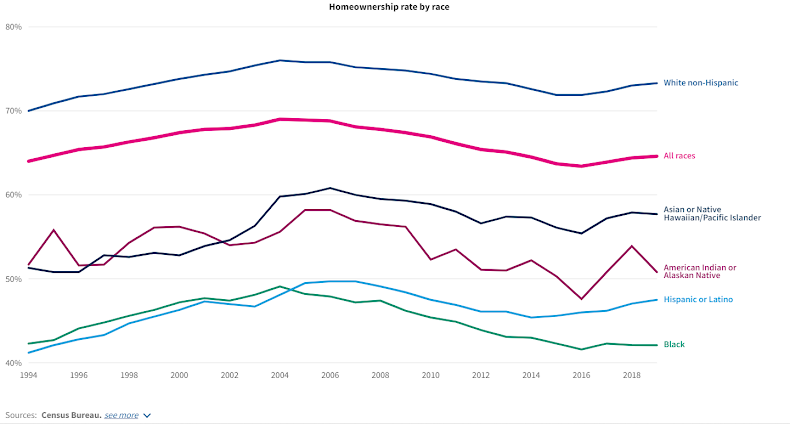
There were various grants and mechanisms to help the hardcore poor but in the end, the client had to have an acceptable credit score, reportable income sufficient to finance the majority of the sale price of the home, and some savings. When these people got into a house, they were ready for homeownership. Sadly, hardcore low-income people will never be able to buy a home the way things are today. When I was a housing counselor, I could encourage the single mother on welfare living in public housing, that if she was willing to make hard changes and put in the effort, homeownership was possible.  Today, I could not hold out that hope. The dream of homeownership would have to remain a dream. Most of the people I served in this category of the hardcore generation poor were African Americans. Unfortunately, the rate of homeownership among African Americans is lower now than in 1994.  All of the talk about "equity," and social justice, and the building of resentment does nothing to lift people out of poverty. All of the pious talk about "affordable housing," will put very few poor people into a home.


Unfortunately, not only for the generationally hardcore poor, is homeownership likely to remain a dream, but it is more and more likely to remain a dream for many middle-class people also.  Recently my daughter and her husband became homeowners.  I was able to help them.  For many people without parents who are able to substantially help them, they will never be able to realize the dream of homeownership. That is a sad fact of life.

Home prices and interest rates continue to skyrocket with no end in sight putting homeownership out of the reach of many working people. 

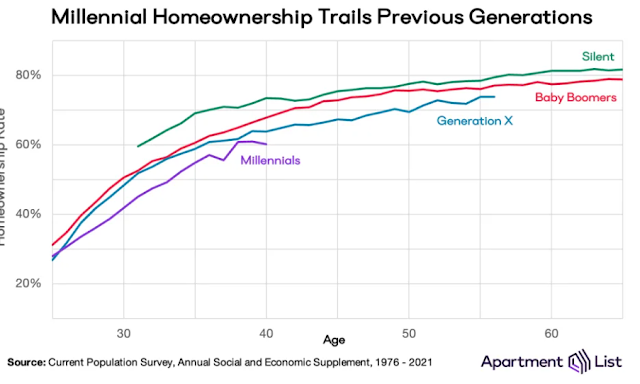
An organization called Apartment List which does research on housing issues and tracks trends in home and rental prices recently conducted a survey of people and found that many Millennials told them they are quickly coming to the conclusion that they may never be able to afford a home, and most who do want to be homeowners don’t have any money saved for a down payment. 

Here are some key findings from that report:

  • According to the most recent Census data, the Millennial homeownership rate stands at 48.6 percent, more than 20 percentage points lower than the rate for Gen X and almost 30 percentage points lower than Baby Boomers.
  • Millennial homeownership lags even after adjusting for age. Among older Millennials who have hit age 40, 60 percent own homes. At that same point in life, 64 percent of Gen Xers, 68 percent of Baby Boomers and 73 percent of Silents owned homes.
  • With each passing year – and accelerated by the pandemic – an increasing share of Millennial renters say they will never own a home. 22 percent of Millennial renters view themselves as “always renters” in 2021, and preliminary data from 2022 shows that share increasing.
  • As Millennials age, affordability becomes increasingly important to their housing choices. Other factors in the “rent or buy” decision (e.g., lifestyle flexibility) have become less important to Millennials as they age.
  • Down payment savings rates remain shockingly low for Millennials who want to buy homes. In 2021, nearly two-thirds say they have no savings whatsoever, and only 16 percent have saved more than $10,000. The average savings of just over $12,000 represents just a 4 percent down payment on a median-priced condo today.

 
This is discouraging. Homeownership is good for society as well as the individual. For most people, if they never own a home they will never accumulate wealth. Crime rates, fertility rates, out-of-wedlock birth rates, and other measures of a society's well-being are reflective of homeownership rates.  It stands to reason that homeownership leads to generational improvements. The next generation will have a better standard of living than the previous.  Never owning a home will most likely lead to the next generation being less well off than the previous. While I can state no study to support this, I suspect that homeowners feel more invested in their communities than renters. I suspect they are more grounded.  I suspect they have less resentment toward society and are less inclined to support wealth redistribution schemes. I don't know this, but I suspect homeowners will generally be more conservative, or at least less radical than if they had remained renters. 

Several things need to happen to reverse this trend toward lower homeownership. Governments at all levels need to stop doing the things that cause housing to become less and less affordable. We need to tinker with the tax code to encourage savings and homeownership. We need to stop focusing on "equity" and programs that make people think they are victims and focus on programs that provide opportunities for economic advancement.

You can find the full report from Apartment List at this link.

For more of my views regarding the issue of affordable housing, see the following:

Antiquated Zoning Laws Are Worsening the Housing Crisis

The dream of homeownership is becoming more elusive by the day

Stumble Upon Toolbar
My Zimbio
Top Stories

Saturday, December 07, 2019

Mayor Cooper Announces Approval of Most Recent Barnes Fund Grant Recipients. Affordable housing advocates not happy.

Metro press release, 12/3/2019- Mayor Cooper today announced that the Metro Housing Trust Fund Commission has approved recommendations from the Barnes Application Review Committee for a new round of grants to support the development and rehabilitation of 549 affordable housing units in Nashville. In response to fiscal pressures highlighted by the state comptroller, the Mayor’s Office has awarded a partial round of $5 million in Barnes Fund grants.

Mayor Cooper is hopeful that with potential budget savings and efficiencies, Metro can back an additional round of awards in the spring of 2020 using excess fund balance for this fiscal year. Taking current budget pressures into account, a primary objective of the Mayor’s Office is to avoid widespread personnel changes and interruption of vital city services.

“Even with our current budget difficulties, we are pleased to announce that the Barnes Fund will make grant awards due to their critical importance to housing affordability in our city,” said Mayor Cooper. “The Barnes Fund is a critical part of making sure that affordable housing is at the center of everything we do in Nashville. Providing housing stability for our children, taking stress off our local workforce, and creating opportunities for seniors to remain in their communities are all goals that help achieve a stronger Nashville for all of us.”

Under the Barnes Housing Fund requirements, eligible projects must create or preserve affordable housing opportunities in Nashville-Davidson County, Tennessee. Projects must be affordable to households with incomes at or below 60% area median income for rental projects and at or below 80% of the area median income adjusted for family size for homebuyer projects.

Organizations that will receive funds include:

  • Our Place, 
  • Affordable Housing Resources, 
  • Habitat for Humanity Nashville, 
  • Woodbine, 
  • Westminster, 
  • Be a Helping Hand, 
  • and Living Design Concepts. 
Since inception, the Barnes Fund has invested $37 million in affordable housing development and rehabilitation and has leveraged over $186 million of federal and private funding to construct more than 1,700 housing units.
#

Violated their trust:' developers denounce Mayor Cooper's cut to the Barnes Fund 

The Tennessean - … But on Tuesday, Cooper announced he is slashing nearly half of the city's annual funding it sends to the Barnes Fund for Affordable Housing, which offers city dollars to grant incentives to Nashville developers who pursue projects priced affordably. … Of the nearly $10 million the Metro Council — including Cooper while serving on council — approved for this year, Cooper said only $5 million will be awarded because of the "fiscal pressures" facing the city and highlighted by the state comptroller. …… While city leaders, stakeholders and affordable housing advocates say they understand the circumstances surrounding the budget Cooper inherited, many say trust has been broken and the mayor could have, and should have, made the decision with more input and transparency. ….

Cooper's announcement came as a blow to the Metro Housing Trust Fund Commission, which was only alerted of the funding cut just an hour ahead of its meeting Tuesday to approve this year's grant recipients. "It was a shock," Commissioner Kaki Friskics-Warren told The Tennessean. "It was demoralizing for our nonprofit artners and others who have spent hours of work into this."  (read more)

Stumble Upon Toolbar
My Zimbio
Top Stories

Tuesday, July 16, 2019

Mayoral Candidates stake out positions on affordable housing

Last night candidates for mayor took part in a forum sponsored by NOAH, Nashville Organized for Action and Hope. This is a  progressive coalition of interfaith and labor groups. About 500 people attended the event but unfortunately I was not able to attend. One of the topics of this forum was  affordable housing. In addition to this event, the mayoral candidates shared their views on affordable housing at a televized event on June 25th and each talked about affordable housing when interviewd by the Tennessean editorial board. Below in a nutshell is the opinion of the candidates on affordable housing:

David Briley
David Briley says affordable housing  is a "human right."  I am bothered by categorizing the things to which society may determine people are entitled as "rights."  Liberals do not know the difference or do not recognize a difference between liberties and entitlements. Categorically, freedom of speech and a right to paid maternity leave are different things. Right off the bat, Briley is losing me by calling affordable housing a "human right."

Briley has outlined an affordable housing initiative called Under One Roof 2029, which would spend $750 million over 10 years, primarily towards the redevelopment of aging public housing into mixed-income communities. This plan has come under a lot of criticism. Critics says it takes pieces of what is on the drawing board anyway and puts it in a new package. Also it calls for increasing funding to the Barnes Fund, the money to come from the operating budgets.  Budgets are approved each year and there are competing needs. This intent to fund the Barnes Fund at a higher level is no more than a good intention. One mayor or council cannot obligate the next.

$350 million of the money Briley proposed would come from issuing new general obligation bonds. This is at a time when Nashville has the highest debt obligation per person of any city in America. We need to be lowering our debt, not adding to it.

$250 million would come from voluntary investments in affordable housing by the private sector.  This is pulling money out of thin air. He could have made his plan a billion dollar plan by saying the private sector would make $500 in voluntary investments.

Briley's plan is smoke and mirrors based on wishful thinking.

John Cooper
At the NOHA event, Cooper pandered and said he advocates putting a NOHA representative on MDHA's board. While I generally have a negative view of NOHA, and while I would not want to specify than any one political group be entitled to a representative on the MDHA board, I would not oppose that their be a low-income person  from a "pocket of poverty" or low-income census track be on the board.  In my view, MDHA is too focused on building luxury condo's and one advocate for poor people on the board, would not hurt. That is not much of a solution to the problem of the declining availability of affordable housing however.

Cooper has a modest, practical affordable housing plan on his website. He advocates small changes that can make a difference. It is not a bold creative vision; he is not reinventing the wheel, but I like that.  It includes better management of what resources we already have, a new revolving fund for affordable housing, and greater leverage of federal and state housing funds for affordable housing.  

Carol Swain
Carol Swain has a plan she says is based on parcels of land owned by the city. She would make those excess parcels available for development of homes costing about $200,000. While I like this, those parcels are already being made available for development under an existing program. I am not sure, this is anything new. One thing she does advocate is to "use modular technology, new creative ideas to get the price down even further."  It is a shame Nashville stands in the way of the development of affordable housing by the private sector by effectively prohibiting the use of factory build housing in Nashville. I am pleased to see the advocacy of modular construction.

John Ray Clemmons
He says affordable housing is a "real crisis."  He would commit at least $50 million a year to the Barnes Fund using a dedicated revenue stream, but he does not identify that revenue stream. There is nothing magic about a dedicated revenue stream.  If the city, for instance, should take $50 million that now is paid in codes fees and direct that money to the Barnes Fund, that is $50 million that now goes into the city coffers to pay for education, police protection and everything else the city does.  That is not free money. That means the city would have to make $50 million in cuts to other services or raise taxes.

He would also create "income-source protection" for people with Section 8 housing vouchers, and a land bank for surplus public property. I am not sure how "income-source protection" works. So, I would have to know more to know what he is talking about.  For a primer on Land Banks, follow this link.  I tend to favor letting property be developed to its highest and best use but am not opposed to land banks playing a limited role in helping low income people become homeowners but it is no magic bullet that will solve the housing "crisis."


Rod's thoughts
First of all I do not think we have a housing "crisis." We have an "issue" or "problem."  For the person making the median income in Nashville, the median priced house is still affordable. We are in much better shape than many other cities in America where the median income person cannot afford the median priced house.

In one sense, this is what we asked for. When you attract people to move from elsewhere to Nashville and those people make a much higher income than most Nashvillians, they are going to drive up housing prices. A lot of what we are experiencing is simply supply and demand. That is not to say that for lower income people that they are not priced out of the market. What we are experiencing is an issue to be addressed but not a crisis.

I am disappointed that none of the candidates took the position that Nashville should stop taking actions that make the problem worse. Much of the fault for loss of affordable housing, is directly due to government policy. As an example of this, there is a new plan to redevelop Dickerson Pike. The Dickerson Road area has long been one of the cheapest parts of the city to live.  In addition to affordable apartment buildings along Dickerson, the neighborhoods adjacent to the thoroughfare have lots of modest affordable homes.  On Dickerson Road there are several old-fashion junky trailer parks.  On Dickerson Road itself there are businesses that serve the people who live in the vicinity. There are businesses such as laundromats, payday lenders, convenience stores, and discount tobacco stores, and used car lots.  Dickerson Road has always had a problem with hookers walking the street and the area has a lot of drug dealers.

Metro has a plan to improve this bad part of town. The plan envisions a dense collection of modern offices, shops and multifamily housing, widened streets and added transit hubs, greenways, crosswalks, sidewalks and bike lanes.  The city is going to beautify and upgrade one of the worst parts of the city.  The Tennessean says, "But the increased investment is expected to send property values soaring in one of the few areas where relatively affordable housing can still be found near downtown."  I am pleased to see this recognition of the effect of improving parts of the city.

We are talking about hundreds of units of housing are going to be lost.  Thousands of people will no longer be able to afford to live there.  Some of the people living in trailer parks rent by the week. Where are they going to go?   No one likes to have a seedy part of town, but when you beautify and upgrade a seedy part of town you are destroying the only place poor people can afford to live.  Every community can't look like Brentwood and still have affordable housing.

Less ambitious than a master plan such as is planned for Dickerson Road are city policies that little by little destroy affordable communities and thereby affordable housing.  These are policies that make busy corridors look nice. These are rules which say used car lots must have an attractive decorative fence in front of them, that say one can not have in close proximity businesses of the same or similar type such as used tire stores and auto repair businesses, and rules that say all dumpsters must be placed on a reinforced concrete pad behind the building, and rules that require a certain distance between pay day lenders.  These rules drive out the kind of business that serve low-income people.  They make unattractive parts of town more attractive and change the character of the community and make it attractive for people who make more money.  They turn low-income parts of town into middle-income parts of town.

Another way in which Nashville destroys affordable housing is by the policy of making large parts of the county single-family only.  Almost every Council meeting, there is a bill to down-zone a neighborhood from a zoning which allows duplexes to a zoning which does not.  Such legislation may change a zoning from R20 to RS20. I understand people wanting to preserve the character of their neighborhood.  I understand people wanting things to stay the same. However, this has an impact on future home prices.  This makes future affordable housing less likely and it encourages urban sprawl.  With higher density, there are fewer places to build houses and this causes the available places to be more expensive.  Also, with less available building spaces close in, it causes people to move further out.

Another way the city causes a loss of affordable housing is by driving up the cost of development and stifling the development of more affordable housing. Take the policy that requires a sidewalk in front of every house.  Sidewalks can add thousands of dollars to a the price of a house. This means developers will build more expensive homes rather than less expensive homes to absorb in the home price the cost of the sidewalks.  Also, I have talked to developers who say they have tried to build communities of affordable housing and instead of getting assistance from planning, they got obstacle after obstacle thrown in their way.  It is simply easier to build pricey homes rather than affordable homes.

Another way government destroys affordable housing, is my stringent codes enforcement.  I own a little rental house in Woodbine.  I only own one rental property.  It is the house I lived in  myself until I moved to my current home.  It is a two-bedroom one-bath house.  A few months ago I got a codes complaint and I had to deal with it. It is not the first time.  It was a headache and an annoyance.  I have a tenant who has different taste than I do and likes "yard art."  He also keeps a lot of stuff that he might can sell to make a little money.  The stuff was stored neatly in covered storage.  He also was parking a car on an unpaved or graveled area.

I only charge the tenant a modest price for rent.  I could put central heat and air in the house and dress it up just a little and rent it for about half again what I am getting, or I could sell the house.  I get about two postcards a week from someone wanting to buy that house. If I sold it they would tear it down, and build an expensive house on the lot. There would go a unit of affordable housing.

Quite frankly, I don't need the money I could get from selling the house or from upgrading and raising the rent.  My tenant is a Cuban refugee who really did come to America by a raft made of intertubes.  He has been here about twenty years or so but has a heavy accent and little education. He makes a living by selling scrap metal.  He would have a difficult time paying more rent.  I rent to him at a modest rent more out of a sense of doing a good deed than anything else.  When I get a codes letter, however, I am tempted by the postcard offers to buy my house.  I have talked to other landlords who get harassed by codes.  I know we have to have codes enforcement, but there is an effect.  When codes officials harass property owners they destroy affordable housing.

The other way Metro government contributes to the loss of affordable housing is by refusing to zone property for greater density if what is planned to be build on the property is affordable housing.  Worse yet, is the taking away of ones property rights in order to stop them from building affordable housing. This was attempted in Antioch. Ultimately, the person's property rights were not taken but the threat hung over the owners head for two years and the affordable property was never build.

Nashville could have more affordable housing if would embrace manufactured housing. There is a certain snobbish elitism that doesn't want "trailer trash" in Nashville and Nashville has had a long-standing attitude that we would keep "mobile homes" or "trailers" out of Nashville. A lot of the prejudice against manufactured housing is irrational. Manufactured housing could play a major role in insuring there was housing available at various price points.

The best way to make housing affordable is to increase incomes for those at the bottom of the income scale.  Rather than subsidizing poverty, in my view, we should strive to lift people out of poverty. You can't lift all people out of poverty, but we should have as a goal to have fewer poor people.

The loss and increasing lack of affordable housing is of concern, but much of the blame can be laid at the doorstep of the same people who bemoan the fact that we are losing affordable housing.  You can't have affordable housing if you don't want affordable neighborhoods.  You can't have affordable housing and have every neighborhood look like Brentwood. You can't have affordable housing, if you are going to ban greater density or fight having affordable housing in your neighborhood.

For source material and more information, follow these links: link, link, link, link, link.

Stumble Upon Toolbar
My Zimbio
Top Stories

Wednesday, March 27, 2019

Briley proposes massive additional debt for Nashville in order to build affordable housing.

Nashville's Mayor David Briley has proposed a plan that commits $500 million in public funds toward an affordable housing push over the next 10 years. As proposed, the money would come through general obligation bonds and would be spread out over the next decade. That is a lot of money.  Already Nashville is one of the most debt-ridden cities in America.  Forbes magazine says that when one includes unfunded metro retiree's health benefits, Nashville is the second most debt-ridden city in America. 


The  organization Truth in Accounting, says that of the largest 75 cities in America, ranked from least debt to most debt, Nashville ranks 62nd.  Among the 75 largest cities, there are only 13 cities where the citizens are burdened with more debt.

Briley's proposal would  provide $350 million to MDHA to help pay for 5,000 low and middle income homes, primarily through the redevelopment of Nashville's public housing. It is unclear if this is net new homes or replacing existing public housing.  Metro would also allocate $150 million to the Barnes Fund during the 10 years, which is a 50 percent increase over the current funding levels.

Currently MDHA is in the midst of redeveloping the Casey Homes project in East Nashville, but development is going slow.  Since 2014, when MDHA began the project, only 70 units have been constructed and MDHA has had to dip into reserve funding to finance the project. To read The Tennesseans article, follow this link.

No one can deny that housing is getting more expensive in Nashville and that many people could not afford the home they now own if they were trying to purchase it. New construction in Nashville tends to be high-end homes.  This is driven by market forces. When the city attracts lots of high paying jobs, that creates a demand for high priced homes.  This means that, that is what builders build and all homes appreciate in value and a lot of less expensive homes are purchased by developers and torn down and replaced by more expensive homes. Anyone who drives around Nashville can see it.  With more expensive housing and growing demand for housing, this means many of the people who work in Nashville can not afford to live here. The loss of affordable housing however, is not all the result of market forces.  Metro government deserves much of the blame. 

Three years ago now a developer tried to build an affordable housing development in Antioch, called
The Ridge at Antioch. The property was already zoned to allow this development, but the Council person from the district and an adjoining district tried to down zone the property. Down zoning is a taking of property. Property rights are more than holding title. If the government takes away the right to develop the property that you already possess, that is a taking of your property.  Eventually, the attempt was unsuccessful. The builder could not develop the property with this hanging over his head however, so for two years the project was delayed.  I don't think the property was ever developed.  The Council members fighting to stop this development argued they did not oppose housing development on the property but argued their part of town already had too much affordable housing.  Also, neighbors filed a law suit to stop the development but were unsuccessful. This was not "the projects."  It was an apartment complex that no one would have known was subsidized housing.  This "not in my back yard" attitude and willingness to trample property rights is one of the reasons for a shortage of affordable housing.
The Ridge at Antioch


That is the kind of thing one faces when the property is already zoned to permit development.  It is much worse when one needs a zone change to develop.  Often, developers need a rezoning to develop and not just a base zoning change but need a Planned Unit Development.  Most of the time when seeking to build an affordable development and seeking a zone change or PUD approval to do so, developers know not to even try to build affordable housing. The developer will approach a council man and be told up front, that there is no use pursuing the proposal. There is a lot of lip service paid to the need for affordable housing but no one wants it in their neighborhood.

I had a casual conversation with a large developer I met at a function recently. I asked him his take on the problem of affordable housing in Nashville. He told me that he had tried to build affordable housing but the city would not cooperate. He was going to build a condo development very near downtown where the units would be priced between $150,000 and $230,000.  He said the development would have open space, tennis courts and playgrounds and other amenities. He said rather than the city helping make it happen, the city threw up ever possible obstacle to making it possible.  He said with what one must go through to develop a property, it just makes more sense to build high priced home rather than affordable homes.

Another actions the city takes that drives up housing prices is the down zoning of whole neighborhoods from a zoning that permits two units per lot, such as R-20, to a zoning that permits only one unit per lot, such as RS-20. This happens almost every council meeting. If you lower the potential for greater density, you drive up housing prices. Less available building sights equals higher priced land.

The city also drives up housing prices by policies that beautify low income neighborhoods. I wish everyone could live on a beautiful street with a park-like setting, but neighborhoods with low income housing are going to look different than neighborhoods with expensive housing.  Rules that restrict the type of commercial services that can be on a thoroughfare such as restricting the number of  used car lots and used tire stores and requiring nice screening and disallowing payday lenders, changes the character of a neighborhood.  It makes the thoroughfare more attractive to higher income people and the affordable housing gets replaced by more expensive housing. 

The sidewalk policy also drives up housing prices. If someone builds a house on a street without sidewalks, they must build a sidewalk in front of their property even if it is a sidewalk that goes nowhere and is the only house on the block with a sidewalk. This drives up prices.

I am not opposed to the city promoting affordable housing, but the first thing the city needs to do is get out of the way and let people build it.  There needs to be a realization that developers are more likely to build affordable housing where the land is more affordable. Also, we need to recognize that neighborhood with affordable housing are going to look like affordable neighborhoods.

While affordable housing may be a lofty goal, Nashville is debt-ridden. We do not need to take on more debt. Now is the time to focus on paying down the debt, not taking on more.


Stumble Upon Toolbar
My Zimbio
Top Stories

Saturday, August 11, 2018

Bill 2016-219 to trample property rights and kill an affordable housing project deferred again.

The Ridge at Antioch
At last Tuesday night's council meeting bill Bill BL2016-219 on Third Reading was deferred yet again. This is the bill to trample private property rights and kill an affordable housing development in the process. This bill would cancel an approved Planned Unit Development and down zoning a persons property without his consent. This effort to pass this bill has been pending since June of 2016.  Karen Johnson is the sponsor. Councilman Bedne has handled the bill in Karen Johnson's absence.  There are several other council members listed as co-sponsors. The bill was disapproved by the Planning Commission and will require 27 votes to pass.

If this bill passes, the State of Tennessee has threatened to withhold future tax credits used to help finance affordable housing developments. I don't know why this development has not already occurred.  I can only guess that with the threat of this down zoning hanging over the head of the developer, that it has impacted the financing. I have called the law firm listed as the agent for The Ridge at Antioch hoping to get some insight but have not received a reply.

Should this bill pass and the owner wants to continue the fight, he may have a winnable lawsuit to pursue.  If a public interest law firm wants to join the suit, I will make a contribution to the cause. This rezoning would most likely be considered a "taking" of property.  The Fifth Amendment to the constitution says, "nor shall private property be taken for public use, without just compensation."  Government taking of property does not have to mean taking title.  To take away a right that one previously enjoyed may be a "taking" of property.  If you owned a lot you were planning to build a house on and the government rezoned the property to where nothing could be build on the property, you would still hold title but the right to use the property would have been taken.

There is a limit to how often a bill can be deferred. I do not know if this bill has reached that limit or not.  That this threat to downzone this property has been hanging over the owner's head for over two years and is still, is a disgrace.  Johnson and Bedne may win even it this bill never is passed. A lot of  factors are involved in arranging financing for a project, especially a project that is trying to build affordable housing. Simply keeping this threat hanging over the head of the owner may be sufficient to kill the development. Also, the market may change and the developer may be able to make more money by building upscale housing as opposed to building affordable housing. This is a shame.

For more on this story see this  link and this.

Stumble Upon Toolbar
My Zimbio
Top Stories

Monday, July 16, 2018

What's on the 7/17/18 Council agenda: Effort to trample property rights and kill planned affordable housing resurrects, and regs and taxes of scooters.

By Rod Williams - The most important item on this agenda is Bill BL2016-219  on Third Reading which is the bill to

The Ridge at Antioch
trample private property rights and kill an affordable housing development while doing so.  This bill would cancel an approved Planned Unit Development and down zoning a persons property without their consent. This effort to pass this bill has been pending since June of 2016  If was first pushed by Karen Johnson and is now being taken up by Councilman Bedne. 

If this bill passes the State of Tennessee has threatened to withhold future tax credits used to help finance affordable housing developments. I don't know why this development has not already occurred.  I can guess that with the threat of this hanging over the head of the developer, that it impacted the financing. Should this bill pass and the owner want to continue the fight, he probably has a winnable lawsuit to pursue.  This would most likely be considered a "taking" of property.  When government takes property the owner should be compensated and it should only be taken for a public purpose.  Government taking of property does not have to mean taking title.  To take away a right that one previously enjoyed may be a "taking" of property. This is a bill disapproved by the Planning Commission and will require 27 votes to pass. For more on this story see this  link and this.

The Metro Council will meet Tuesday, July 17, 2018 at 6:30 PM in the Council chamber at the Metro Courthouse. Here is a link to the Council agenda and the staff analysis for those who want to watch the Council meeting and follow along.  Below is a summary of what is on the agenda.

Elections and Confirmation: There are 6 mayoral appointments to Boards and Commission before the Council for confirmation. Usually, these are confirmed without controversy, discussion or dissension.

Public Comment Period:  This is new for Nashville.  Time is dedicated to allow members of the public who have registered in advance to speak upon matters related to the Metropolitan Nashville and Davidson County community. The only public comments we have had heretofore have been on zoning matters and once a year on the budget.  We have never had an open comment policy. This is common in smaller cities and I don't know how common it is in other cities the size of Nashville.  I suspect liberal activist will use this platform a lot.  I hope conservatives will also. Unfortunately, liberals seem to be much more engaged in advancing a big-government, liberal agenda than are conservatives in advancing a conservative agenda.  I also expect to hear from a lot of people talking about pot holes, and stray animal, and the quality of trash pickup. I hope this does not make Council meetings a lot longer.  

Resolutions: There is one resolution on pubic hearing exempting Jefferson Street Cafe from the minimum distance requirements for obtaining a beer permit and there are 25 other resolution on the agenda. Initially all resolutions except a resolution on public hearing are on the consent agenda. A resolution stays on the consent agenda if it passes unanimously the committees to which it is assigned. Resolutions which receive negative votes in committee are pulled off of consent. Also any councilman may have a resolution pulled off of consent. Those remaining on consent are lumped together and passed by a single vote. Resolutions on the consent agenda are usually not controversial and tend to be routine matters, such as accepting grants from the Federal or State Government, entering into inter-agency agreements over mundane things, appropriating money from the 4% fund, settling lawsuits, or approving signs overhanging the sidewalk. This agenda has a resolution approving a PILOT (payment in lieu of taxes) deal to build affordable housing, a resolution to expand a foreign trade zone and a resolution to fund the Big Band daces in Centennial Park. I don't expect any of these to be controversial. They will likely pass on consent. Unlike a bill which requires three votes of the Council to pass, a resolution only requires one vote of the Council. Here is a resolution of interest.
Resolution RS2018-1309 request that the investment committee of the Metropolitan Employee Benefit Board divest funds invested with entities engaged in the operation of private prisons. I oppose this. Private prisons have become a liberal target but they save cities and states money and are usually safer and better managed than government prisons. CoreCivic, formerly Corrections Corporation of America is a Nashville-based national private prison company. Memorializing resolutions express an opinion of the Council, are not signed by the mayor and have no force in law. However, since the Council is in a position to take stronger action if they wish, this may have real impact. The council could direct the investment committee to do this instead of asking. This carries more weight than when the Council opines on a national or state issue   This should be defeated, but I ddon't know that anyone will choose to take a stand on this.
Bills on First reading: There are only nine bills on first reading. First reading is a formality that gets bills on the agenda and they are not considered by committee until after they pass first reading. They are all lumped together and pass by a single vote except in rare circumstances. I don't read them until they get to second reading.

Bills on Second Reading: The only bills of interest are three bills that were previously on Second Reading and deferred to this meeting.
Bill BL2018-1200 would require that if hotels or roominghouses accept cash payment, they must also accept at least one other form of payment such as check or credit cards. I seldom carry cash and would find it inconvenient if I tried to do business with an entity that was cash-only, but why not let the market work this out?  Why must the government try to micromanage every aspect of commerce and our lives?

Substitute Bill BL2018-1202 proposed new rules for scooter prompted by the

arrival of Bird Scooter here in Nashville. It would require new fees including a fee of $35 per scooter. It seems to be the policy that everything must be taxed and regulated.  This does a lot in addition to a money grab, but if Bird can live with it and is not fighting it, then I would assume it is an OK bill. Bird and similar scooter companies are in lots of other cities. I hope we are not over regulating them. Something like Bird can be an important part of making our city more mobile and can take cars off the road. Some cities have welcomed scooters and merchants have installed scooter racks. I wish Nashville was less hostile to innovation and private enterprise.

Bill BL2018-1203  also deals with scooters, in-line skates, and roller skates by removing the requirement for wrist guards, elbow pads, and kneepads and updating audio device references. It redefines the word "scooter" to mean non-motorized scooters, so this section would not apply to the electric Bird scooters.They would be regulated by the regulations contained in 1202 above.
Bills on Third Reading: There are 33 bills on third and final reading. Most are zoning bills approved by the Planning Commission. There a few zoning bills that are disapproved by the Planning Commission in which cast those bills require 27 votes to pass. Council members can sometimes have a difficult time getting the 27 votes, especially if several council members are absent. I don't form opinions on the merits of most zoning bills. In addition to Bill BL2016-219 discussed at the top of this page, other bills on Third Reading of interest are these:
Bill BL2018-1099  is a disapproved zoning bill in Scot Davis' district.

Bill BL2018-1182,  a disapproved zoning bill in Karen Johnson's district.
To watch the Council meeting, you can go to the courthouse and watch the meeting in person or you can watch the broadcast live at Metro Nashville Network's Government TV on Nashville's Comcast Channel 3 and AT&T's U-verse 99 and it is streamed live at the Metro Nashville Network's livestream site and you can watch it live on Roku. You can catch the meeting the next day (or the day after the next) on the Metro YouTube channel. If can stand the suspense and just wait, I will post the video on this blog the day after or the day after that and provide commentary. 

Stumble Upon Toolbar
My Zimbio
Top Stories

Wednesday, January 24, 2018

Bill trampling property rights and stopping affordable housing deferred to July

by Rod Williams - Bill BL2016-219  the bill that tramples a person's property rights, partially taking property without compensation, and kills an affordable housing development is deferred until July 2018. The bill was on third and final reading Tuesday night and is a bill disapproved by the Planning Commission which means when it is finally acted upon it will take 28 votes of the Council to pass.  This bill has been in the works for a very long time, being introduced in April 2016.   
Unlike most zone changes which allow someone to do something with their property they were previously not allowed to do; this bill is a "down zoning," taking away a right someone now enjoys.  The owner is already vested in the project having designed the development and arranged financing.  I am pleased this was deferred but it is unfair to keep this hanging over the head of the owner.  Doing so should be illegal in my view.  While I do not know anything about the project other than what has been reported by other media and what is public record, I would assume that the fact that the down zoning is pending affects financing.  A delay is a also a major cost in a project like this.  

Despite the bill not passing, Councilman Karen Johnson has been successful in stopping the project. Her delaying the project may result in the planned affordable housing never being built since by the time the bill is finally defeated, assuming it is, the market may have changed and affordable housing may no longer be the best use for this property. Instead of the affordable housing, which Karen Johnson opposes, gentrification may have reached Antioch and upscale condo's may be built instead.

For more on this issue, see Contact your Council member. Stop the trampling of property rights and the killing of an affordable housing development.

When the video of the Council meeting is available I will post it and provide a summary and commentary. Please check back

Stumble Upon Toolbar
My Zimbio
Top Stories

Tuesday, January 02, 2018

Contact your Council member. Stop the trampling of property rights and the killling of an affordable housing development.

On Tuesday, January 2nd 2018 the Council will vote on  BILL NO. BL2016-219 on Third

proposed The Ridge at Antioch
and Final Reading.

This bill is the attempt to kill an affordable housing project and trample a person's private property rights by cancelling an approved Planned Unit Development and down zoning a person's property without their consent.  To take away a permitted use is a "taking."  Property rights are more than just holding legal title.  When property is taken it should only be for a public purpose and owners should be compensated for their loss.

This bill has been disapproved by the Planning Commission.  For more on this story see this link and this and thisThis bill has been in the works for a very long time.  To view the July 6, 2016 Public Hearing on the bill follow this link. It was deferred indefinitely following that public hearing. It was on the agenda on third reading on April18, 2017  and at that time it was deferred to this meeting, the second meeting in December. At that meeting it was deferred to the Jan.2nd 2018 meeting.  Being a dissapproved bill, this will take 28 votes to pass and there will be a roll call vote. I will record in this blog, how members of the Council voted.

Here are reasons members of the Council should vote against this bill"
  • This is a "taking" of property.  It is wrong to take someone's property without taking it for a public purpose and compensating the owner.  Owning property is more than simply holding title, it is a bundle of rights. This is taking away from the property owner the right to develop his property a right he currently enjoys. The owner is already vested in the development of the property, having already invested in development cost and arranged financing. 

  • We need affordable housing in Nashville. We cannot meet the need by building a handful of units as infill in established neighborhood.  The proposed development is for an apartment complex of over 200 units. This proposed affordable housing project should not be thought of as "the projects" or something similar. Unless someone told you, you would not even know this type housing had a subsidy. This planned development is a "tax credit" property. The people who will live there are people who work. The rent will not be based on an individuals ability to pay, but the rent will be "affordable" for a person of modest income. This is what is often called "workforce" housing. 

  • If this passes, Nashville is likely to be sued and will likely lose the law suit.
  •  The Tennessee Housing and Development Agency  has said that if this bill passes, they will withhold low income housing tax credits from Nashville and give them to other jurisdictions. This would be a blow to the future development of affordable housing in Nashville.
  • Traditionally Nashville has not rezoned someone's property without the owner requesting it. 
  • This is a disapproved bill. Generally, the council should follow the recommendation of the Planning Commission and respect the process.
Please contact your council member and the council members at large and ask them to vote against BILL NO. BL2016-219.   You can find the council members phone numbers and email addresses at this link. When you open the link, click on " Council Roster 2015-2019" for phone numbers.  

Stumble Upon Toolbar
My Zimbio
Top Stories

Thursday, December 28, 2017

The Tennessean reports on the evils of "gentrification."

Bill Hobbs's Profile Photo, Image may contain: 1 person
Bill Hobbs
By Bill Hobbs - Today's Nashville newspaper has a big story with the following headline: "Black share of population plummets in some Nashville neighborhoods." The story then goes on the detail what it clearly considers the evils of "gentrification," which it defines as white people moving into neighborhoods that used to be mostly black, a trend it warns "upended the social and cultural landscape" of those neighborhoods. Those awful white people, according to the newspaper, brought "tiny fluffy white dogs" and "rode bikes" instead of cars.

The first victim in the story is an African American woman the newspaper tries to portray as having been "pressured" and pushed out of the neighborhood by those white people with their tiny white dogs.

Her story: She bought a house in Edgehill in 1992 for $48,000. She lived in it for a quarter century. Then, her health becoming an issue and construction all around, she sold that house for $640,000 to a developer who tore it down to build a new, larger house. With her equity and $592,000 profit she has been able to help her family and church.

She wasn't a victim, of course. She was a beneficiary. She made a $592,000 profit. How good is that?
If she'd put that $48,000 in some sort of financial investment in 1992 and never added another cent and that investment had earned 10 percent a year over 25 years, compounded daily, it would have grown to $584,559, or about $55,000 less than it did invested in real estate. (And she would still have had to spend other money on a place to live for 25 years.)

She's not a victim. She's a winner. And she didn't have to sell and leave Edgehill - she chose to.
The whole newspaper story is laughable.

There was a time when liberal newspapers like The Tennessean stood against those who wanted to keep neighborhoods segregated by race by keeping people of a certain skin color out of those neighborhoods. Now, though, when the skin colors are reversed, the newspaper portrays the increasing racial diversity of a neighborhood as a bad thing. In it's eyes, gentrification is bad and the white people are the perps and the minorities are the victims.

Gentrification isn't evil. Gentrification isn't racial. Gentrification is when people who own property in a run-down neighborhood either fix it up, or sell it to someone who fixes it up. That's it. If Hispanic and other minority buyers purchase property in a run-down majority-white neighborhood and proceed to renovate the properties, that, too, is gentrification. But instead of casting it as a bad thing, the newspaper would be celebrating it. You don't think so? Consider all the stories the paper has done in recent years about the resurgence of Nashville's Antioch area and how, along the way, it is becoming a much more "diverse" area. The paper doesn't write about how "gentrification" is destroying "the social and cultural landscape" of Antioch. It writes about how "diversity" is reviving Antioch. Well, the neighborhoods in today's articles are becoming more diverse, too. Nobody lives in a neighborhood forever because - it turns out - nobody lives forever. Ask anyone today buying a house if when it came time to sell it in 25 years or so would they be happy if they got a 1,333 percent return on their investment.

This was reposted from a pubic Facebook post by Bill Hobbs. Bill Hobbs is a  fine art photographer and photojournalist  living in Nashville. 

Stumble Upon Toolbar
My Zimbio
Top Stories

Wednesday, November 08, 2017

What happened at the Council meeting of 11/7/2017: Soccer deal approved, Civil forfeiture approved, and a citizens Police review board advances.


The big news of the night is the approval of RESOLUTION RS2017-910, the $225 million bond issue for the $275 million soccer deal. To see the discussion go to timestamp 1:30:37 in the video. The vote in the Budget and Finance Committee was 10 for and 3 against and two not voting. 

While the deal was tweaked to placate some opponents, the major issues remaining creating opposition was the weak guarantee that left Metro holding the bag if the team lost money or if the team owners should lose their franchise, and the give away of ten acres of fairground property to the team owners. John Cooper makes a good argument against the giveaway of the ten acres of fairground property to the developer and criticizes previous decision that allowed the fairgrounds to fall into a state of disrepair. He calls the ten acre giveaway a "gentrification scheme" that benefits the team owners. I encourage viewers to watch his remarks.

After more than an hour of discussion the resolution is approved by a vote of 31 to 6.  Those voting against the resolution were john Cooper, Steve Groper, Holly Houzo, Larry Hagar, Mina Johnson, and Dave Rosenberg.

For those really interested in the deal details you may want to read the actual resolution and see the staff analysis. Also, the discussion that took place in the Budget and Finance committee is insightful and you can view that meeting at this link.  For more on the deal and the opposition see this link. For media reporting on the Council's vote on this issue see the following:
      Channel 4, WSM:  Metro Council approves financing plan for soccer stadium
      The Tennessean: Soccer Stadium a go.

This is  long meeting at over three and half hours long.  In addition to the contentious soccer issue this is public hearing night.  The chamber is packed with spectators. To access the agenda, the agenda staff analysis and my commentary on the agenda follow this link. You will get more out of the meeting if you know what's going on. Following the prayer, pledge, an insignificant message from the mayor, two presentations, and noncontroversial confirmation of mayoral appointments to boards and commission, the consideration of legislation business starts at timestamp 20:19.

Pubic Hearing. There are two resolution and 27 bills on Public hearing. These are zoning bills or bills related to zoning policy. These really bore me and I watch these segment at double speed. Unless one lives in the vicinity of the proposed rezoning one will probably find this boring. I don't even try to form an opinion on each and every zoning issue.  None of the bills on this public hearing are particularly contentious and most had no one speak either in favor or opposition. None are bills are disapproved by the Planning Commission so we do not have to see slide shows and Planning Commission presentation. Below are the bills of interest.

BILL BL2017-903 would ban decorative "rope lighting" on any building, sign, or property with non-residential zoning located adjacent to an arterial or collector street except those in the downtown area. The sponsor tried to pass something similar back in August (BILL NO. BL2017-704) but that bill would have applied to residential property also. This bill is not as bad as that bill, but I still do not see the necessity of this and remain opposed. Rope lighting is that lighting that you have probably seen that outlines a tree or structure. It is often used as Christmas decorations but sometimes is used year-round. Why one would want to ban this I have no ideal. I like it. I oppose this bill. It is approved by the Planning Commission. No one speaks on it and it is approved.

BILL BL2017-929  is a bill to rezone property in Bordeaux area. I find this of interest not due to the merits of the bill but find it instructive of the way people think about "affordable housing."    This bill rezones some agricultural zoned property to a zoning that would allow the construction of up to 40 multi-family residential units. One person speaking on the bill, while saying she does not want to discriminate, makes it clear she does not want section 8 housing in the community.  This is not that uncommon. Many people in what is now affordable communities want their community to be upgraded with more expensive homes. They want their affordable community to not remain affordable.  Many Council members and other public advocates of affordable housing have this same attitude.  They oppose "concentration of poverty." We saw this same sentiment at play in a long drawn out fight to stop an affordable housing development in Antioch.

While I don't doubt that advocates of affordable housing actual want to see the development of affordable housing, they do not want it build were economics would have it be build. Councilman Bedne says this, saying "we need city-wide affordable housing ... all over the city, and not just take advantage of economical affordable land." 

Advocates of  "affordable housing" want it mixed in with more expensive housing and want to see the building of upscale housing in neighborhoods that now have affordable housing.  Of course this will result in those areas being "gentrified," and the destruction of much of the remaining affordable housing stock. When that happens advocates of affordable housing will bemoan "gentrification."  I think we would do more to advance the cause of affordable housing if we worked within the framework of market forces. Affordable housing advocates often support policies that are detrimental to affordable housing. To have a significant amounts of affordable housing in Nashville we need neighborhoods with affordable housing. To see the discussion of the bill see timestamp 57:20.

BILL BL2017-937 is another bills that would address home-sharing or short term rental. It would establish a STRP Advisory Committee and it would allow existing permit holders to renew definitely, apply percentage caps to Not Owner-Occupied units within certain census tracts, and apply distance restrictions of 1,320 feet between Not Owner-Occupied units, among other changes. The Council has been working on the issue of short term rental property for a long time, at least a year. A comprehensive short term rental ordinance is in the works and is to be presented to the Council in January. This bill is deferred to December 5th.

BILL BL2017-938  would exempt religious institutions from current sidewalk requirements, provided the religious institution is within the General Services District and does not abut an existing or planned sidewalk. Currently if a developer does an infill development even on a street without sidewalks they must build sidewalk even if there are no other sidewalks on the street. This can greatly increase the cost of development and can result in less affordable housing. In my view the whole requirement that developers build sidewalks should be scraped except in rare circumstance. This bill is deferred to the first meeting in January.
There are 27 resolutions all of which are initially on the consent agenda. A resolution stays on the consent agenda if it passes  unanimously the committees to which it was assigned. Resolutions which receive negative votes in committee are pulled off of consent. Also any councilman may have a resolution pulled off of consent. Those remaining on consent are lumped together and passed by a single vote. Resolutions on the consent agenda are usually not controversial and tend to be routine matters, such as accepting grants from the Federal or State Government, entering into inter agency agreements over mundane things, appropriating money from the 4% fund, settling lawsuits, or approving signs overhanging the sidewalk. Unlike a bill which requires three votes of the Council to pass, a resolution only requires one vote of the Council. there are several resolution on this agenda which would complete the purchase and removal of certain previously identified flood-damaged properties.Below are the resolutions of interest.

RESOLUTION RS2017-910  is the soccer stadium resolution addressed at the top of this page. It is not on "consent."
RESOLUTION RS2017-920  concerns civil forfeiture. That is a program that is sometimes called "policing for profit." It allows law enforcement to take someones property upon arrest without due process and then the person who had their property taken must fight to prove they were not guilty of a crime in order to have their property returned. Most often the person who had their property taken are low income and cannot afford the legal fees necessary to fight for the return of their property.

This resolution would approve two agreements between the United States Department of Justice (DOJ), Drug Enforcement Administration (DEA) and the Metro Nashville Police Department. These agreements would govern the participation of DEA Nashville District Office Task force participants in the United States Department of Justice Equitable Sharing Program. In my view civil forfeiture is an evil practice in which metro should not participate. Both liberal and conservative civil liberty advocates included the ACLU and organization such as The Institute for Justice oppose civil forfeiture. This resolution was not on "consent."  Dave Rosenberg speaks against it. Unfortunately it is approved by a vote of 16 to 15 with four abstentions. To view the discussion see timestamp 2:35:10.

RESOLUTION RS2017-951 would accept a grant of $50K from the State to be matched by $50K from Metro to print new, larger recycling cart stickers and tags to increase curbside recycling and participation in Nashville. Unless I am missing something, this seems like a waste of money. It passes on the consent agenda.

RESOLUTION RS2017-962  recognizing November 20, 2017 as Transgender Day of Remembrance. This is a memorializing resolution which means it simply expresses the will of the Council and has no force in law. It passes on a machine vote of 31 in favor, one opposed, two abstentions and six not voting. 
Bills on First reading: There are 35 bills on first reading. First reading is a formality that gets bills on the agenda and they are not considered by committee until after they pass first reading.  Normally bills on First Reading are all lumped together and pass by a single vote. It is rare that a bill on First Reading is voted on separately. 

Councilman Scott Davis has BILL BL2017-951 acted upon separately.  This is a bill that would create a Community Oversight Board responsible for providing citizen oversight of the Police Department. He moves to pass the bill and defer to the first meeting in January for consideration on Second reading and he ask for a public hearing on the bill. At the Vice Mayor's suggestion the request for a public hearing is taken out of the motion with an understanding that that will be decided at a later date. Normally the Council does not have hearing on any bills but zoning resolutions and budget resolutions. Davis says that his motion would allow the task force working on the bill time to produce a really good bill.Councilman Russ Pulley moves that the bill instead be deferred on First Reading two meetings. Davis passionately argues his position. See timestamp 3:19:05 for Davis' emotional speech. Davis prevails.
  
Bills on Second Reading. There are 9 bills on Second Reading. These are the ones of interest.
BILL BL2017-939 would add additional obstacles to adopting the mayor's proposed transit plan. The state enabling legislation allowing for transit improvement known as the IMPROVE Act, provides that a  transit improvement program be adopted by ordinance or resolution by majority vote of the local government’s legislative body. This bills specifies that such a plan must must be approved by ordinance rather than a resolution. A resolution only requires one vote of the Council; a ordinance requires three votes. This is a good bill. It passes on a voice vote.

BILL BL2017-941 would establish a a Commercial Permit Parking Program. The council would have to approve the geographic areas in which this applied. In those areas commercial vehicles could only park on the street if they had a permit to do so.  As we grow, parking become more of a problem with people parking on streets taking parking places that deny those spaces to those who have businesses or residence on the street a place to park. These seems reasonable. At the request of the sponsor it is deferred to the second reading in December.
Bills on Third Reading. There are 9 bills on third reading. Most of them are zoning bills that have been approved by the Planning Commission. None of them are very interesting.

Stumble Upon Toolbar
My Zimbio
Top Stories

Tuesday, October 24, 2017

A victory for private property rights and affordable housing in Antioch

The Ridge at Antioch

A ruling from the State Court of Appeals  upholding a Davidson County Chancery Court ruling ends the long fight to deny a property owner his property rights and stop the construction of an affordable housing apartment complex in Antioch.  Property rights and affordable housing won.

Last year a developer proposed building a 96-unit apartment complex in Antioch. The development met the existing requirements and did not require a property zone change. Neighbors in Antioch did not want additional affordable housing in their community and fought the development. Councilman Karen Johnson introduced legislation to "down-zone" the property to a zoning that would not allow the construction of apartments.  A down zoning is a form of "taking." The owner retains title but the government takes away the development rights the owner previously enjoyed. At the public hearing to down-zone the property, neighbors favoring the down-zoning argued the development would "ghettoize" their community. Johnson did not have the votes to pass the bill which was disapproved by the Planning Commission and would have required 27 votes to pass on Third Reading, and she differed it indefinitely. (link)


Meanwhile, some Antioch residents filed suit to stop the development and lost in court, appealed and lost the appeal. The apartment complex knows as The Ridge at Antioch will be priced to be affordable to people who make 60% of the median Nashville area income, which for a family of three is $37,140. The financing of the project included $11 million in tax credits awarded by the Tennessee Housing and Development Agency. When the councilman tried to kill the project, THDA threatened to withhold future tax credit grants to Nashville if that occurred.

Having worked in the non-profit housing sector most of my career, I am well aware of these type tax credit properties.  They are not "the projects." The rent price is not based on an individual's ability to pay, but on what is "affordable" for a person of that income bracket.  While I do not know the actual rent these units will bring, affordable rent for a person making $37K would be $925 a month. Many people living in apartment developments of this type are not even aware they live in property restricted to people of modest income. There are a lot of single mothers with two children whose income does not exceed $37K and lots of young couples with one child just starting their careers whose income does not exceed $37,000.  One will not see old junker cars or any indication that a project of this type is priced to be affordable housing. The people living in these units are not generally people on welfare but are often young working people.

While a lot of lip service is paid to affordable housing, there are a lot of metro policies that discourage the development of affordable housing and a lot of hypocrisy around the issue.  Some of the Council's biggest advocates of  "affordable housing" supported Johnson's effort to kill this development.  While I am pleased this affordable housing project can move forward, I am more pleased that there was a victory for private property rights.  While I am not an opponent of planning and zoning and think that establishing land uses is proper function of government, it is morally wrong to take away one's property rights.  In this case it was especially reprehensible, because the developers and owners were already vested in the development. Plans had been drawn, financing arranged and the project was ready to move forward when the councilman and community tried to take away the property owners right to build. This was a good outcome.

To read The Tennessean story, follow this link.

Stumble Upon Toolbar
My Zimbio
Top Stories