Tuesday, March 18, 2025

Report ranks Tennessee fifth in road conditions, cost-effectiveness


By Kim Jarrett, The Center Square,  Mar 13, 2025 - Tennessee's highways, bridges and roads rank fifth overall among the 50 states in cost-effectiveness and conditions, according to a report released Thursday by the Reason Foundation.

The organization's Annual Highway Report dropped the state from its third-place ranking last year. Tennessee garnered the second spot in the category "other disbursements," which includes funding for law enforcement, safety, bonds, and interest payments.

The Volunteer State's next highest ranking was ninth for urban arterial pavement condition.

The organization found that 4.32% of the state's bridges were structurally deficient, which put Tennessee in the 11th spot. The national average among the states is 6.9%, according to the report.

The lowest rankings were for urban fatalities and other fatalities at 43rd and 42nd.

"In terms of improving in the road condition and performance categories, Tennessee should focus on reducing administrative disbursements and urbanized area congestion. The state ranks in the bottom half in both categories," said Baruch Feigenbaum, the lead author of the report and senior managing director of transportation policy at Reason Foundation. "Reducing urban and other fatality rates should also be a priority for the state, which ranks in the bottom 10 for both categories."

While the report places the state in the top 10 for road conditions, transportation spending is being scrutinized by lawmakers. A February report on the state's infrastructure needs, which includes transportation are increasing. 

"The total cost of transportation projects increased by $4 billion (11%), largely because of new projects ($3 billion) and cost increases in existing projects ($4 billion)," the report from the Tennessee Advisory Commission on Intergovernmental Relations said. "The increase was largely offset by $2 billion in completed projects, $441 million in cost decreases, and $166 million in canceled projects."

Democrats have been critical of Gov. Bill Lee and the General Assembly's handling of infrastructure funding.

"Today, Tennessee has a $78 billion dollar backlog of infrastructure projects – roads, bridges, schools, water systems – critical investments that we cannot afford," Rep. Johnny Ray Clemmons, D-Nashville, said in his prebuttal to Lee's State of the State. "Republican fiscal mismanagement is so bad that they argued the necessity of toll lanes on state roadways just to pay for road projects."

Lee included $1 billion in additional funds in his fiscal year 2026 budget for transportation projects. 

Stumble Upon Toolbar
My Zimbio
Top Stories

At Tonight's Council Meeting: Camera Surveillance Guidelines, Historical Zoning Commission

by Megan Podsiedlik, The Pamphleteer, March 18, 2025 -During this evening’s meeting, Nashvillians can expect to hear opposition for Councilmember Rollin Horton’s camera surveillance guidelines during the public comment period and should strap in for an extensive public hearing regarding Councilmember Emily Benedict’s historic zoning bill.

In December, the council voted down the Fusus contract that would have allowed Nashvillians to voluntarily integrate their security cameras into Metro Nashville Police Department’s network. Though Horton’s legislation wouldn’t officially establish an agreement between the tech company and MNPD, it’s expected to revive if his bill passes during tonight’s meeting.

As for Benedict’s bill, between the legislation’s rewrite and state pressure, the council seems primed to place the Historic Zoning Commission under the purview of Metro’s Planning Department. Before making their final decision, they will hear from several people for and against the change during third reading. The Coalition For Nashville Neighborhoods plans to show up to oppose the bill. Several developers and residents voiced their support during both special commission meetings held a few weeks ago. (link

Stumble Upon Toolbar
My Zimbio
Top Stories

Sunday, March 16, 2025

Could it be that the Democratic Party is Becoming Normal Again.

by Rod Williams, March 16, 2025 - I got a fundraising letter from the Davidson County Democratic Party this week asking me to make a monthly financial commitment to the Party. I am not tempted. 

As disgusted as I am with the Republican Party, I am not ready to become a Democrat. I still hold the same core values that I always have. I have not changed; the Republican Party has changed. I still believe in limited government, fiscal responsibility, the Constitution, a strong national defense and other things that Republicans used to believe in. I do not believe my core values align with those of the Democratic Party.

So, while I was not persuaded to sign up with the Dems, I am pleased with something in this letter. Well, not something that was in the letter but something that was not in the letter. This something makes me wonder if the Democratic Party is pulling back from some of its progressive virtue-signaling silliness. 

What was missing from this letter from Dakota Galban, Chair of the Davidson County Democratic Party was a signature tag. I am confused. Is he a "he," a "she," or a "them?"

Could it be that Democrats are becoming normal again?

Stumble Upon Toolbar
My Zimbio
Top Stories

Nashville Ranks a Dismal 32 Out of the Largest 75 Cities for Financial Health

by Rod Williams, March 16, 2025 - Truth in Accounting has released its ninth annual Financial State of the Cities report and found that 54 cities do not have enough money to pay their bills. Nashville is one of those and ranks number 32 from the top, the top of the list being the most financially healthy city. 

The financially healthiest cities, Truth in Accounting calls "Sunshine Cities," and those on the bottom of the least TIA calls "Sinkhole Cities." Here are the best and the worst:


Below is the segment that shows Nashville's ranking and the cities in adjacent financial standing.


Memphis is ranked 58th. Other Tennessee cities are not among the top 75 largest so are not included in the report. 

While cities are required to have balanced budgets, they often use accounting tricks to calculate the budgets, such as these:
 • Inflating revenue assumptions 
• Counting borrowed money as income 
• Understating the true costs of government by leaving pension and 
other retirement costs “off the books”
 • Delaying the payment of current bills until the start of the next 

It should be noted that this report only addresses the issue of financial health of the city, not how well managed a city is or quality of life factors, bond rating or tax levels. 

Below is the one-page report on Nashville:

To view the complete report, follow this link

Stumble Upon Toolbar
My Zimbio
Top Stories

Saturday, March 15, 2025

The Ukraine War in a Nutshell

By Dan McLaughlin, National Review, March 12, 2025 - .... 

What is Ukraine fighting for? 

Its survival as a sovereign state. Sure, there is a laundry list of other things important to the Ukrainians. They’d very much like all their land back. They’d like to join the EU, an economic window to the West. They’d like to join NATO, which would greatly increase their defensive security. But none of those things is essential, and as the record of the early peace negotiations between Ukraine and Russia in spring 2022 appears to illustrate, all of them were negotiable to Ukraine at the outset of the war. One thing was a deal-breaker, and should be a deal-breaker: any settlement must preserve not just Ukraine’s survival at the end of this war but also its capacity to deter or repel future Russian invasions aimed at extinguishing it.

What is Russia fighting for? 

No just cause. Of course, Vladimir Putin wants to reclaim as much of the old Soviet lands in Ukraine as he can, with particular attention to ethnically Russian enclaves and a secure route to Crimea and the Black Sea. It’s true that Ukraine’s borders and the distribution of its ethnic population are artificial products of the Soviet empire rather than organic historical developments, but it’s not as if Russia can complain that it had nothing to do with the many crimes committed against Ukraine by the Soviet Union. ... 

As for the idea that Putin is justified in going to war because he fears having a NATO member on his doorstep, he already has Estonia and Latvia on his border (and Poland and Turkey not far away), and this war has pushed Finland into NATO. ...  The notion that NATO presents an aggressive threat to Russian security of the sort posed by an expansionist tyrant is fanciful.

Why do Americans care? 

.... we care because an international order in which states do not invade one another for territory or conquest — and, if they try, pay a price imposed by a large segment of the world’s economic and military powers — is in America’s interests to preserve. So is an international order in which democratic states (even those with systems far less liberal and democratic than our own) know that the United States and its allies have their back if these states find themselves on the receiving end of aggression by tyrants and terrorists. Our capacity to rally allies for any number of causes is enhanced when we uphold this principle, not because it is a moral principle but because it is a rule of common interests in the same way that every member of a community benefits from the punishment of crimes and the maintenance of public order. This is the kind of neighborhood in which we prosper.

How should this end? 

.... We should want lasting peace, not a prelude to more war. (read the much longer article)

Stumble Upon Toolbar
My Zimbio
Top Stories

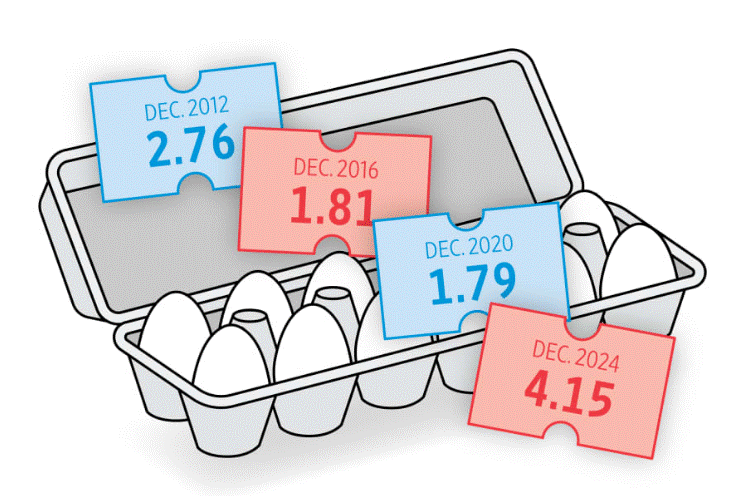
Egg Watch: Week Seven of the Trump Administration and Egg Prices Rise Again!


Price of Eggs March 13, 2005

Price of Eggs Jan. 25, 2025

Price of Eggs, Feb. 17, 2025


by Rod Williams, March 15, 2025 - President Trump has been in office seven weeks and look at the price of eggs! 

In August 2024, Donald Trump held a press conference surrounded by packaged foods, milk and eggs, and said: “When I win, I will immediately bring prices down, starting on Day One.” 

He didn't start bringing prices down on day one. He has been in office almost seven weeks and prices of eggs continue to rise. 

To be fair, a president has very little to do with the price of eggs. Also, often there is lag time between an adoption of any economic policy and the effect of that policy. Often presidents get the blame or the credit for policies enacted by their predecessor.   Also, the bird flu has resulted in the need to kill a bunch of chickens, and that is hardly Trump's fault. Nevertheless, the price of eggs was a major concern of people and the believe that Trump would lower the price of eggs was a reason many people voted for him. Trump acted as if he could control the price of eggs. He said he would do it. Let us hold him to that.

It will not be surprising if at some points egg prices do drop. Due to bird flu, some flocks had to be killed. As that recedes into the background and new chicks began producing, prices should drop. However, Trump will not deserve the credit for that no more than the previous administration deserved the blame for high egg prices. Of course, while egg producers recover from the effect of the bird flu other events occur. One can't hold the other factors constant.  Due to Trump's mishandling of the economy, I expect egg prices and grocery prices in general to go higher. Firing a bunch of agriculture health inspectors, deporting farm laborers, and imposing tariffs will all contribute to higher prices. 

The above pic is from the Audi's here in Nashville and are grade A large eggs. Eggs will cost more at Publix's or Kroger's. Also, it you buy brown eggs, or cage free, or free range, or happy eggs, expect to pay more. 

Stumble Upon Toolbar
My Zimbio
Top Stories

Thursday, March 13, 2025

Trump, defying his Own Logic, does not Want Canadians to Take our Stuff and Gives us their Money.

by Rod Williams, March 13, 2025- Trump has tightened restrictions on Canadians visiting America. Canadians staying in America for over 30 days must now register with the federal government and all Canadians over 14 years old must now be fingerprinted. Canadians were exempt from these rules. This will discourage Canadians from coming to American and spending money. 

This defies logic. Defying logic is nothing new for Trump, but this defies his own internal logic. When a visitor comes to Nashville and spends money, this is the equivalent of a US company selling a good in Canada. We get a Canadian's money, and they get some of our stuff. We sell them an experience, entertainment, lodging, and food and beverages, and gas for their car and probably a pair of cowboy boots and a cowboy hat. 

There are a lot of Canadians who spend their winters in Florida. It is estimated that 1 million Canadian 'snowbirds' travel to America annually. These snowbirds escape harsh Canadian winters and enjoy sunny Florida. They get out sun and beaches and food and lodging and we get their money.  That is an export. This helps our balance of trade with Canada.  Does Trump not know this, or is he so petty and immature that he just wants to inconvenient Canadians because Canada has fought back in the trade war he started?

Stumble Upon Toolbar
My Zimbio
Top Stories

Get Your Free Copy of “Trickle Down” Theory and “Tax Cuts for the Rich”


Stumble Upon Toolbar
My Zimbio
Top Stories

Harwood Salons: Has Market Liberalism Failed?


The debate over economic freedom has never been more urgent. As protectionism and industrial policy gain traction, what lessons can we learn from history - and how can we chart a better path forward?

Join us on Wednesday, March 19, at 6:00 p.m. for an engaging discussion with Dr. Samuel Gregg, AIER's Friedrich Hayek Chair in Economics and Economic History. He'll explore what has worked, what hasn't, and how we can revive the case for free markets in today's policy landscape.

This is a great opportunity for you to connect with like-minded individuals in your community and gain key insights on the future of economic freedom.

Spots are filling up fast — register now to secure yours!

Registration required. REGISTER HERE

Harwood Salons - Nashville is made possible through the generosity of supporters like you. We encourage you to become a member or make a donation to support the American Institute for Economic Research and ensure the continuation of these important events. All donations are tax-deductible and directly contribute to sustaining Harwood Salons - Nashville.


Stumble Upon Toolbar
My Zimbio
Top Stories

David Frum on Donald Trump’s Betrayal of Ukraine


David Frum is editor of The Atlantic and was a speech writer for President George W Bush. 

Stumble Upon Toolbar
My Zimbio
Top Stories

Wednesday, March 12, 2025

Recommended Readings on Free Trade Versus Protectionism


Everything You Need to Know About Open Markets, Comparative Advantage, and Globalization

by Williamson M. Evers, Independent Institute, January 24, 2025 -

Introduction

Economists, going back to Adam Smith and David Ricardo, are virtually unanimous that free trade benefits consumers and the overall economy. But there exist special interests who would gain in the short run from protectionist barriers. And there is a large segment of the public that doesn’t understand the arguments for free trade. Not surprisingly, there are politicians who are all too willing to gain votes by catering to protectionist interests.

People, farms, firms, and factories in America should be able to trade freely with people, farms, firms, and factories across international boundaries. You should, for example, be able to buy shoes made in Ethiopia. Economist William Niskanen stresses the moral case for free trade: Individuals have the right “to make consensual arrangements across national borders.” Without governmental interference, such voluntary interaction is harmonious and mutually beneficial. People don’t trade unless they believe they will be better off afterwards.

Much international trade can be explained by comparative advantage. Economist Donald J. Boudreaux explains that “the chief nontrivial insight” found in the idea of comparative advantage is that an economic concern’s “technical ability to produce a product” is, by itself, “irrelevant” for resolving whether “that entity should produce that product itself” or “acquire that product by first producing something else and then trading that something else” for the desired product.

Trade barriers are put in place by politicians and bureaucrats who use the machinery of government to disrupt voluntary trade and grant privileges to special interests at the expense of consumers and the general public. Jobs that are protected from the gales of competition are jobs in stagnant industries that are under no pressure to improve and innovate. Free trade provides the best deals for consumers and encourages the economy to grow.

These politicians and bureaucrats—who could be aligned with either Democrats or Republicans—cloak their bestowing of special privilege in the rhetoric of public benefit. They are sometimes successful because they are concentrating on getting their privileges, while much of the public’s attention is elsewhere.

What are some of the frequent rhetorical stratagems of the advocates of protectionist privilege?

They say that new-born industries need hot-house protection. They claim that their country needs to be strong or dominate in allegedly key industries. They claim to have special insight into what the national interest requires—and it turns out to require protecting these special interests. As James Bovard puts it, so-called “fair trade” means “subjugating” the wishes of consumers to those of government officials and the special interests they are helping.

They say that high tariffs will bring in an abundance of tax revenues—forgetting that a Laffer Curve exists for tariffs. As economic historian F. W. Taussig pointed out in 1888, if a government raises tariffs, thereby building up protected domestic businesses, then products of these domestic businesses will replace imports, and revenues from tariffs on those imports will fall.

Advocates of protection claim they worry about the “balance of trade.” Milton Friedman, Nobel Laureate in economics, clarified that a “favorable balance of trade” actually means “exporting more than we import,” sending “abroad goods of greater total value than the goods we get from abroad.” He asks, “In your private household,” wouldn’t you prefer “to pay less for more” rather than the other way around, yet that is what would be called an ‘unfavorable balance of payments.”

Yet despite rhetorical ploys like “balance of trade” and despite the special interests putting considerable time and money into obtaining privileges, we have enjoyed epochs of relative free trade.

Why have these free trade periods come about? It is because civically-active people have held—call it what you will—ideals, philosophies, or ideologies that support freedom of trade and acted on behalf of those ideals. (read more)


Stumble Upon Toolbar
My Zimbio
Top Stories

Bill to rename Nashville airport for Pres. Trump back in TN legislature

Bill to rename Nashville airport for Pres. Trump back in TN legislature

Stumble Upon Toolbar
My Zimbio
Top Stories