By Scott Lincicome, The Atlantic, Aug. 23, 2024- Last week in North Carolina, Kamala Harris called for a new federal law to ban “price gouging on food.” Such a law might be popular, but it would have, at best, no impact on grocery prices and might even make the problem worse. That’s especially unfortunate because it distracts from all the federal policy changes that actually could reduce food prices.
The evidence that price gouging was responsible for the post-pandemic spike in food prices is somewhere between thin and nonexistent. A recent report from the New York Federal Reserve found that retail food inflation was mainly driven by “much higher food commodity prices and large increases in wages for grocery store workers,” while profits at grocers and food manufacturers “haven’t been important.” ....
... Even if excessive corporate profits had been the cause of higher food costs, a price-gouging ban would do nothing to relieve Americans’ current burdens for the simple reason that food prices long ago stopped rising. .... In reality, the grocery business has always had notoriously thin profit margins. ... the industry’s average net profit margins were just 1.18 percent in January 2024—ranking 80th of the 96 industries surveyed and lower than the margins the food industry recorded in all but one of the past six years .... As economics textbooks and centuries of experience teach us, limiting the amount that companies can charge is more likely to reduce supply by discouraging investment and production: a recipe for both shortages and higher, not lower, prices in the long term. ...
In addition to tariffs, regulatory protectionism—against imported products such as tuna, catfish, and biofuel inputs—causes more consumer pain for little health, safety, or environmental gain. ... Propping up the domestic food sector is a long-standing American tradition. (read it all)
By Jon Styf | The Center Square, Aug 16, 2024 -Beacon Center has filed a lawsuit, on behalf of the Association of Christian Schools International, to fight a new U.S. Department of Labor overtime rule that would require anyone making less than $58,000 per year as an hourly, non-exempt employee.
The previous rule had that threshold at $35,568. The new rule is scheduled to go into effect Jan. 1 and includes a stipulation to increase the salary threshold every three years.
The increase came in two parts, with an increase to a threshold of $43,888 on July 1 and the increase to $58,000 on Jan. 1. Several challenges were reportedly filed before the July 1 implementation across the country as well, according to Employment Law Watch from attorneys Reed Smith LLP.
"This new rule is not only unlawful but will also have many unintended consequences,” Beacon Vice President of Legal Affairs Wen Fa said in a statement. “It threatens the livelihoods of small business owners and employees alike. Our client represents thousands of schools in the United States, and this rule will hinder their mission to provide a quality education to the students they serve."
The new rule would require 4.3 million salaried workers to be reclassified nationwide and become eligible for overtime.
The ACSI is a non-profit that has 2,500 member schools nationwide and 97 in Tennessee, where Beacon Center is based.
The ACSI schools say they are heavily impacted as the rule change will happen in the middle of the school year and financial year.
"The timing of this new rule couldn't be worse,” Fa said. “Many schools have already budgeted for the upcoming school year and are ill-equipped to deal with the 2024 rule's drastic changes. We look forward to standing with organizations and businesses in Tennessee and across the country challenging this unfair and blatantly illegal rule."
The Beacon Center lawsuit argues the new rule is similar to a 2016 overtime rule that was thrown out because its increase of the salary-level threshold made “overtime status depend predominately on a minimum salary level, thereby supplanting an analysis of an employee’s job duties.”
It also argues that the automatic threshold increase every three years violates the Administrative Procedure Act’s notice and comment requirement. In the past, threshold increases have gone through a public notice period that allows for objections.
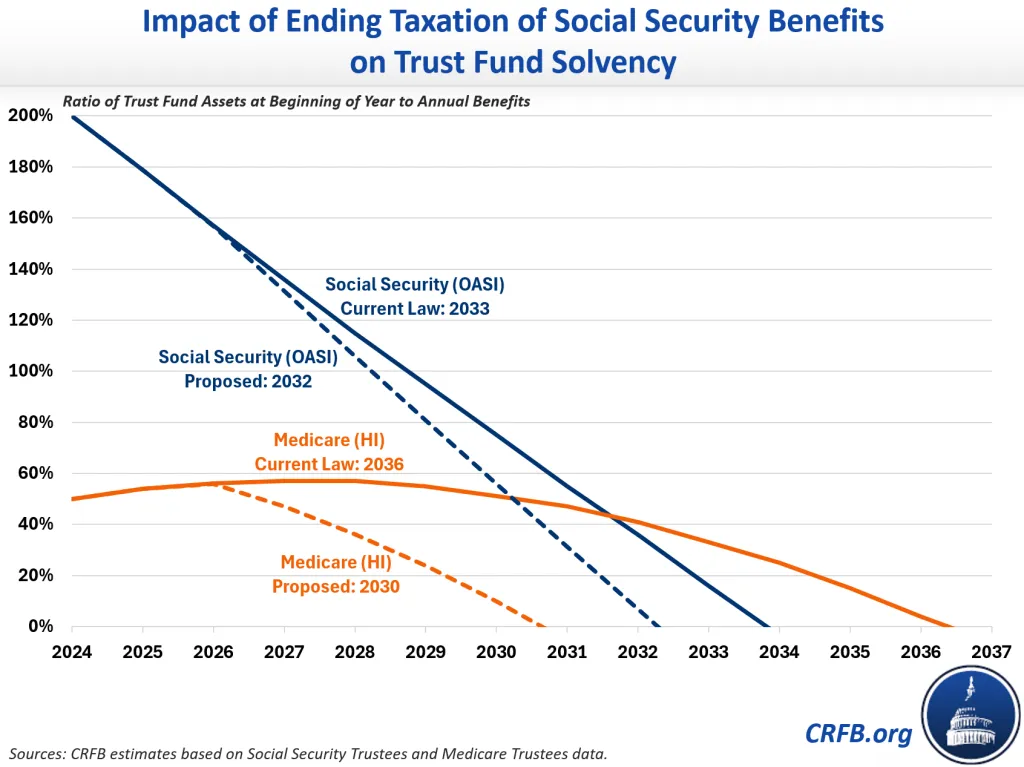
Committee for a Responsible Federal Budget, published July 31, 2024 -Earlier today, former President Donald Trump suggested eliminating the partial income taxation of Social Security benefits, which currently helps fund the Social Security and Medicare Hospital Insurance (HI) trust funds. Without a replacement source of revenue, we estimate repealing taxation of benefits for seniors would:
Increase deficits by $1.6 trillion to $1.8 trillion through 2035
Increase Social Security’s 75-year shortfall by 25 percent – or 0.9percent of payroll
Nearly triple the Medicare HI 75-year shortfall, increasing it by 0.6 percent of payroll
Advance the insolvency date of Social Security’s retirement trust fund by over one year
Advance the insolvency date of the Medicare HI trust fund by six years
US Budget Watch 2024 is a project of the nonpartisan Committee for a Responsible Federal Budget designed to educate the public on the fiscal impact of presidential candidates’ proposals and platforms. Throughout the election, we will issue policy explainers, fact checks, budget scores, and other analyses. We do not support or oppose any candidate for public office.
In a post on Truth Social today, President Trump declared that “SENIORS SHOULD NOT PAY TAX ON SOCIAL SECURITY!”
President Trump is likely referring to the fact that some Social Security benefits are currently taxed as ordinary income and have been since 1984.
Under current law, seniors that earn less than $25,000 per year ($32,000 for married couples) of “combined income” – that is adjusted gross income plus certain adjustments and half of their Social Security benefits – pay no taxes on Social Security retirement benefits. Above that amount, 50 percent of Social Security benefits are subject to income tax, with the revenue going toward the Social Security retirement trust fund. For seniors earning combined income above $34,000 per year ($44,000 for married couples), an additional 35 percent of benefits are taxable, with this revenue going toward the Medicare HI trust fund.
Although taxation of benefits has been a relatively modest source of revenue over the past 40 years, revenue collection is growing over time because Social Security benefits are getting larger and the thresholds for exempting benefits from taxation are not indexed to inflation. This year, for example, taxation of benefits is projected to raise about $94 billion.
Based on data from the Social Security and Medicare Trustees, we estimate that eliminating taxation of Social Security benefits for seniors would cut taxes and thus reduce revenues by about $1.8 trillion between Fiscal Year (FY) 2026 and 2035. This includes $1.05 trillion less in revenue collection for Social Security and $750 billion less revenue for Medicare. Based on data from the Congressional Budget Office (CBO), the total reduction in revenue would be $1.6 trillion, with $950 billion less revenue for Social Security and $650 billion less for Medicare. In these estimates, we assume benefits for non-seniors – including those benefiting from the Social Security Disability Insurance (SSDI) program – continue to be taxed.
Effects of Ending Taxation of Social Security Benefits
Ten-Year Revenue Impact (CBO)
Ten-Year Revenue Impact (Trustees)
Effect on 75-Year Actuarial Balance
New Insolvency Date
Social Security Revenue
-$950 billion
-$1.05 trillion
-0.9% of payroll
2032 (-1 year)
Medicare HI Revenue
-$650 billion
-$750 billion
-0.6% of payroll
2030 (-6 years)
Total
-$1.6 trillion
-$1.8 trillion
N/A*
N/A
Note: Ten-year budget window is from FY 2026 through FY 2035. *Percentages of payroll are relative to the Social Security and Medicare tax bases, and thus are not additive. Sources: CRFB estimates based on Congressional Budget Office, Social Security Trustees, and Medicare Trustees data.
This revenue reduction would grow over the long run, significantly widening Social Security’s and Medicare’s 75-year actuarial imbalances. Based on Trustees’ data, we estimate the Social Security Old-Age and Survivors’ Insurance (OASI) trust fund imbalance would grow by roughly 25 percent – or about 0.9 percent of payroll – from 3.6 percent of taxable payroll to 4.5 percent. Meanwhile, the Medicare HI trust fund imbalance would nearly triple – increasing by 0.6 percent of payroll – from 0.35 percent of payroll to nearly 1.0 percent. This assumes the lost revenue isn’t replaced with revenue from other sources.
As a result of these changes, Social Security’s retirement trust fund would become insolvent more than one year earlier – in early 2032 instead of late 2033. Medicare’s insolvency date would advance by six years – from 2036 to 2030.
Upon insolvency, the law requires spending to be cut to match revenue. The 21 percent cut to Social Security benefits projected under current law would expand to 25 percent under this proposal. After-tax benefits would not meaningfully change – though reductions would be larger for lower income seniors and smaller for higher income seniors.
Importantly, consequences would differ if taxation of benefits were replaced with another source of revenue or offset with changes to benefits.
Washinton Post: Why Democrats are so quiet about climate change right now. ...If they call for curbing fossil fuel production to fight global warming, they risk alienating voters in Pennsylvania, a pivotal swing state where natural gas powers the economy. But if they tout record U.S. oil production that has helped lower energy costs, they risk angering young voters, a crucial constituency for Democrats.
Transcript: Good evening. I bring greetings from the great state of Georgia. So let's get the hard part out of the way. I am a Republican.
But tonight I stand here as an American, an American that cares more about the future of this country than the future of Donald Trump. My journey started to this podium years ago when
I realized Donald Trump was willing to lie, cheat and steal to try to overturn the 2020 election.
I realized Trump was a direct threat to democracy and his actions disqualified him from ever, ever, ever stepping foot into the oval office again. ... So I'm going to focus my attention on the millions of Republicans and independents that are at home that are sick and tired of making excuses for Donald Trump. If Republicans are being intellectually honest with ourselves, our party is not civil or conservative, it's chaotic and crazy. And the only thing left to do is dump Trump.
These days, our party acts more like a cult, a cult worshiping a felon thug.
Look, you don't have to agree with every policy position of Kamala Harris. I don't, ... Let me be clear to my Republican friends at home watching. If you vote for Kamala Harris. Kamala Harris in 2024 you're not a democrat,you're a patriot.
In our family, my wife Brooke and I are raising three boys and we have a family motto and it says doing the right thing will never be the wrong thing.
During the just the lowest of lows when we had armed officers outside our house, protecting us from
other republicans (Donald Trump had targeted us.) my son came downstairs and he handed me this coaster that I'd given him years before at a father. .. And he said, hey, dad doing the right thing will never be the wrong thing. ...(read more)
Transcript: Good evening. I have a confession to make. I'm a lifelong Republican. So I feel a little out of place tonight, but I feel more at home here than in today's Republican party.
The grand old party has been kidnapped by extremists and devolved into a cult. Trump doesn't know the first thing about public service. Like a child. He acts purely out of self-interest.(Read more)
by Abigail Devereaux, Independent Institute, Aug.16, 2024- Doctor shortages are becoming endemic in Kansas, including an estimated 50 percent fewer primary care physicians than needed, according to the U.S. Department of Health and Human Services.
The American Immigration Council says that unique health care worker job postings increased by 20.8 percent in the state between 2017 and 2021, although the population increased by less than 1 percent over the same period.
Kansas isn’t alone. Most states in the country are experiencing similar shortages. ... Requiring foreign doctors to both pass the U.S. Medical Licensing Exam and endure a second residency isn’t necessary to ensure quality and patient safety. After passing the test, foreign doctors could be issued a temporary license under the supervision of a state-licensed doctor for one to two years before applying for an unrestricted license
Tennessee requires two years of employment in a hospital with a residency program accredited by the Accreditation Council for Graduate Medical Education, though international medical graduates can work as physicians instead of residents. Its new rule came into effect on July 1 and has had significant ripple effects. ... Kansas and other states facing doctor shortages should follow Tennessee and remove the requirement that foreign doctors repeat their residencies, instead allowing them to apply for unrestricted licenses. (read more)
by WH Bernstein, reposted from Facebook, 8/22/2024- On my mind: Tax cuts.
An eminent friend and sensible man has asked me about Trump's tax cuts and wouldn't they pay for themselves or something.
Not all tax cuts are created equal. The beauty of Reagan's philosophy was that he actually understood how this worked. If you cut the tax on, say, alcohol, manufacturers will tend to cut prices or use the extra money to upgrade equipment, improve salaries etc. But the amount of extra economic activity generated will not make up for the loss of revenue to the government. Similarly, if you increase the childcare credit, which both Harris and JD Vance are proposing, people will have a little more money but their extra spending will not offset the revenue loss.
Tax cuts work when the tax is on some kind of production. Thus, capital gains tax cuts produce more revenue (and have done so every time) because the lower rates encourage people to sell existing assets and reinvest the money in other places. Even Obama understood this (see video in comments). Similarly, cuts in marginal tax rates encourage people to work extra, because they get to keep more of the income from that extra work.
Imagine an architect charging $100,000 for a commission that can do 14 jobs a year. If on the last two jobs he's only going to make $40,000 because his marginal tax rate is 60% then he'll likely just skip it. Lower the marginal rate to 40% and might do those jobs. And the construction, blueprints, transportation, etc. etc. that his work generates will mean more money being made in the economy which means more tax revenue.
Cutting something like Social Security taxes encourages no one to work or produce more. "Putting money in people's hands" is the fallacious argument made, but we have lots of experience with this and the actual outcome is no more economic activity results.
The Trumpistas have forgotten (willfully in some cases) this distinction. Turmp's proposals to reduce some taxes are as idiotic as what the Democrats propose, mere pandering to groups he hopes will vote for him.
Bill Bernstein, formerly of Nashville where he was owner of Eastside Gun Shop, now lives in Brunswick, Georgia. He is a scholar with a BA degree from Vanderbilt University and degrees in Classics from Corpus Christi College, Oxford, UNC-Chapel Hill, and University of Pennsylvania.
As the author of A Disgruntled Republican I often post items which I think may be of interest to the conservative, Republican, libertarian or the greater community. Posting of a press release or an announcement of an event does not necessarily indicate an endorsement. Rod




 Posts
Posts


