This is a positive development and I hope the bill passes.Sherry Jones, D-Nashville, sponsor of HB1385. "It would apply to only the most severely debilitated people ... children suffering a hundred (epileptic) ...
Saturday, January 04, 2014
Rep. Sherry Jones proposes medical marijuana bill
Friday, January 03, 2014
Middle Tennessee Republican Women. Save these dates...
|
|||||
|
|
|
|||


Alexander: Ending Wind Subsidy a Good Way to Celebrate New Year, Reduce Federal Debt and Save Tennesseans $52 Million
Says subsidy allows wind developers to give away
electricity and still make a profit, which could undercut the continued
operation of 25 percent of our nuclear plants
“The massive taxpayer subsidy to windmill
developers expired Jan. 1. A good way to celebrate the New Year would be
to not renew it and to reduce the federal debt by $60 billion, an
amount about equal to the spending in the recent budget agreement.” –
Lamar Alexander

He said the wind production tax credit, which expired Jan.1, provided a subsidy “so generous that wind developers can give away electricity and still make a profit, while undercutting cheaper and more reliable power from coal and nuclear plants. This ‘negative pricing’ rewards expensive, unreliable power like wind and punishes cheap, reliable power from nuclear and coal plants.” Alexander cited a study by the Center for Strategic and International Studies, which said that continuing the subsidy could make nuclear plants so uncompetitive that 25 percent of them could close by 2020.
Alexander offered four reasons to allow the wind subsidy to expire:
1. Money saved could reduce the federal debt:
“The massive taxpayer subsidy to windmill developers expired Jan. 1. A good way to celebrate the New Year would be to not renew it and to reduce the federal debt by $60 billion, an amount about equal to the spending in the recent budget agreement,” Alexander said. “For the next 10 years, extending the tax credit one year at a time could cost $60 billion or more, based on the most recent data from The Joint Committee on Taxation, about enough to pay for the $63 billion Congress spent in the recently passed budget agreement.”
2. At more than 20 years old, the subsidy was long outdated and unnecessary:
“The subsidy was put in place in 1992 to jumpstart a technology, and according to the Obama administration’s former energy secretary, the technology has matured,” Alexander said. Former Energy Secretary Stephen Chu testified in 2011 that wind energy is a “mature technology.”
3. The subsidy treated Tennessee and many states unfairly:
“A recent study shows wasteful wind subsidies left Tennesseans who pay federal taxes at a $52 million loss in 2012 – meaning we get very little of the benefit because the wind doesn’t blow enough in the southeastern United States, and yet our federal tax dollars go to subsidize Big Wind in other states,” Alexander said. According to the study by the Institute for Energy Research, 30 states paid more to the federal government for wind subsidies than wind producers in their states received. Tennessee’s net loss was $52 million.
4. Windmills are a scar on the landscape and use massive amounts of land for the power they produce:
“At least in our part of the country, windmills are a huge scar on the landscape – you can see their flashing lights for 20 miles,” Alexander said. “You would have to stretch wind turbines the entire length of the Appalachian Trail, from Maine to Georgia, to equal the power produced by eight nuclear plants on one square mile each – and you would still need the nuclear plants or some other form of power generation for when the wind doesn’t blow.” Based on data from the National Renewable Energy Lab, if wind power were to attempt to provide the 20 percent of the United States’ electricity that about 100 nuclear reactors currently do, it would take 150,000 two-megawatt wind turbines stretching the entire length of the earth’s equator.
State Representative Charles Curtiss Resigns From Seat
State Representative Charles Curtiss Resigns From Seat
Does that make this another seat the Republicans can pick up?
Dear Senators Corker and Alexander: Stand firm, do not vote to extend unemployment benefits.
Dear Senators Corker and Alexander,
This is an open letter, asking you to vote against extending unemployment benefits.
An article in today's Washington Post said both of you were senators to watch as Republicans that might join Democrats and support an extension of unemployment benefits. Please say it is not so.
According to the Post story, there are already three Republicans ready to join Democrats in supporting the extension. They are Senator Heller from Nevada, Senator Susan Collins of Maine and Alaska's Lisa Murkowski. If all 55 Democrats vote for the extension and the three named Senators above vote with the Democrats then they only need two more. The post listed nine potential senators who might vote with the Democrats. You two were among those nine.
I know that there are a lot of people hurting and I know there will be hardships if people lose there unemployment. Nationwide, 1.3 million ran out of jobless benefits on Dec. 28, and more will follow. However, I do not see how we can afford to indefinite keep people on unemployment. Our country is going broke. Also, unemployment benefits leads to unemployed people. Unemployed people will be more picky about the job they will accept if they are receiving unemployment payments. A lot of people will not look for jobs that paid less than what they were making at their old job until they face the expiration of unemployment benefits.
Many mothers of small children welcome staying home with their children and do not rush to return to work if receiving unemployment compensation. Also, many companies won’t even look at the resumés of the long-term unemployed, so to a certain extent the government is making it harder for the unemployed to find a job due to keeping them out of the job market. Also, we are on the edge of the baby boom retirement wave. How many people would go ahead and apply for social security if they were not receiving unemployment? I don't know, but I would assume it is not an insignificant number. If those people were out of the job market, the unemployment rate would be lower.
Senators Corker and Alexander, I have voted for each of you and financially supported your campaigns and I have defended each of you to my tea party brethren who deem you insufficiently conservative. Please do not vote for extending unemployment benefits. If you do, I would have a hard time defending that vote. Don't prove me wrong for having been a faithful supporter of yours.
Sincerely,
Rod Williams
This is an open letter, asking you to vote against extending unemployment benefits.
An article in today's Washington Post said both of you were senators to watch as Republicans that might join Democrats and support an extension of unemployment benefits. Please say it is not so.
According to the Post story, there are already three Republicans ready to join Democrats in supporting the extension. They are Senator Heller from Nevada, Senator Susan Collins of Maine and Alaska's Lisa Murkowski. If all 55 Democrats vote for the extension and the three named Senators above vote with the Democrats then they only need two more. The post listed nine potential senators who might vote with the Democrats. You two were among those nine.
I know that there are a lot of people hurting and I know there will be hardships if people lose there unemployment. Nationwide, 1.3 million ran out of jobless benefits on Dec. 28, and more will follow. However, I do not see how we can afford to indefinite keep people on unemployment. Our country is going broke. Also, unemployment benefits leads to unemployed people. Unemployed people will be more picky about the job they will accept if they are receiving unemployment payments. A lot of people will not look for jobs that paid less than what they were making at their old job until they face the expiration of unemployment benefits.
Many mothers of small children welcome staying home with their children and do not rush to return to work if receiving unemployment compensation. Also, many companies won’t even look at the resumés of the long-term unemployed, so to a certain extent the government is making it harder for the unemployed to find a job due to keeping them out of the job market. Also, we are on the edge of the baby boom retirement wave. How many people would go ahead and apply for social security if they were not receiving unemployment? I don't know, but I would assume it is not an insignificant number. If those people were out of the job market, the unemployment rate would be lower.
Senators Corker and Alexander, I have voted for each of you and financially supported your campaigns and I have defended each of you to my tea party brethren who deem you insufficiently conservative. Please do not vote for extending unemployment benefits. If you do, I would have a hard time defending that vote. Don't prove me wrong for having been a faithful supporter of yours.
Sincerely,
Rod Williams
Sara Kyle says she will not run for Governor
Governor Bill Haslam has announced his run for a second term. After exploring a potential run for governor, Memphis Democrat Sara Kyle
has announced that she won't make a bid for the office. (Full Story)
Thursday, January 02, 2014
William F. Buckley Jr on Maijuana legalization
In recognition of the legalization of recreational marijuana use in Colorado, I wanted to revisit the arguments in favor of legalization by conservative icon and one of the people I most admire, William F. Buckley, Jr. . Buckley was a long time advocate of legalization when most conservatives adamantly opposed legalization. Buckley also admitted to smoking marijuana, sailing his boat outside the territorial water of the U.S in order to do so legally.
Buckley once said, "Even if one takes every reefer madness allegation of the prohibitionists at face value, marijuana prohibition has done far more harm to far more people than marijuana ever could."
Buckley also said, "The amount of money and of legal energy being given to prosecute hundreds of thousands of Americans who are caught with a few ounces of marijuana in their jeans simply makes no sense - the kindest way to put it. A sterner way to put it is that it is an outrage, an imposition on basic civil liberties and on the reasonable expenditure of social energy."
In 2004, Buckley advocated the complete legalization of marijuana. If I were in Colorado, I would smoke one for WFB.
Buckley once said, "Even if one takes every reefer madness allegation of the prohibitionists at face value, marijuana prohibition has done far more harm to far more people than marijuana ever could."
Buckley also said, "The amount of money and of legal energy being given to prosecute hundreds of thousands of Americans who are caught with a few ounces of marijuana in their jeans simply makes no sense - the kindest way to put it. A sterner way to put it is that it is an outrage, an imposition on basic civil liberties and on the reasonable expenditure of social energy."
In 2004, Buckley advocated the complete legalization of marijuana. If I were in Colorado, I would smoke one for WFB.
Alexander: Obamacare Creating More Substitute Teachers for Tennessee Schools
Says at least 11 Tennessee school districts are forced to limit jobs or hours worked because of higher health insurance costs
“Individuals, families and businesses aren’t the
only ones facing financial challenges because of Obamacare – Tennessee
schools are also being hit hard by higher health insurance costs that
are forcing districts to cut jobs or hours. Obamacare has forced schools
to save costs by creating more part-time employees, from substitute
teachers to coaches to custodial and administrative staff.”– Lamar
Alexander
MARYVILLE, Jan. 2 – U.S. Senator Lamar Alexander (R-Tenn.), a former
U.S. Secretary of Education, today said that as school starts back up
in 2014, Obamacare is forcing cuts in hours for employees, such as
substitute teachers, in at least 11 Tennessee school districts “and
likely many more,” harming students’ education in the process.“Individuals, families and businesses aren’t the only ones facing financial challenges because of Obamacare – Tennessee schools are also being hit hard by higher health insurance costs that are forcing districts to cut jobs or hours,” Alexander, the senior Republican on the Senate education committee, said. “Obamacare has forced schools to save costs with more part-time employees, from substitute teachers to coaches to custodial and administrative staff.”
A major driver of school districts’ problems, Alexander said, is an Obamacare mandate requiring employers to provide more expensive health insurance to anyone working 30 hours or more per week. As a result, many districts are being forced to employ more part-time workers, and to keep their hours low, to save on costs.
Alexander said, “Schools should be free to make decisions based on what will help students learn what they need to know, not on how to cope with Obamacare’s burdensome and expensive mandates.”
School districts reporting fiscal challenges because of Obamacare include: Carter County, Clarksville, Franklin Special School District, Johnson City, Maury County, Oneida Special School District, Rutherford County, Scott County, Stewart County, Washington County and Wilson County.
Maury County Schools, south of Nashville, for example, is limiting its substitute teachers to no more than 28 hours per week. One school board member told the local news: “Students struggle enough having one substitute teacher, but now we’re going to have to possibly split the substitute time between two substitute teachers. It just makes it hard on the students to learn.”
The Metro Council meeting agenda for January 7, 2014 is now available.
The Metro Council meeting agenda for January 7, 2014 is now available. If you will wait I will read it for you and tell you if there is anything important on the agenda, but if you want to read it now, here it is: Council Agenda.
Nashville Chickens coming home to roost.
Two years ago this month, the Council passed a resolution to legalize the keeping of backyard chickens. There are limits on how many you may have based on your lot size and there are other restrictions and those who keep chickens must pay a registration fee. At the time it passed, some suburban district were amended out of the bill. Exempted from the bill were council districts 12, 20, 28, 29, 30, 31, 32, and 33. Now, there is an attempt to remove those exempted districts and make the law apply county-wide.
Metro Councilman Fabian Bedne who represents District 31, wants to keep his district's exemption from the bill and keep it illegal to keep chickens in his district. Here is an email letter he wrote to his constituents.
Metro Councilman Fabian Bedne who represents District 31, wants to keep his district's exemption from the bill and keep it illegal to keep chickens in his district. Here is an email letter he wrote to his constituents.
Greetings,
I wanted you to be aware that there is a Legislation coming to the Metro Council public hearing this January 7th regarding chickens. In the past I was able to exclude our District from the Law but this Legislation seeks to remove that exclusion. The sponsor argues that the law should be the same for the whole City, however that ignores the fact that Nashville is very different in Urban and Suburban areas (we already have farms with lots of farm animals).
I am very happy for people in urban areas to be able to have farm animals if they want to, raising chickens adds to a sustainable way of life. For our district it creates a problem of potentially attracting wild life (such as coyotes) closer to the homes. This sounds made up for people in the core but for us is reality.
I hope you will consider attending the Public Hearing at 6:30 pm January 7th. Thanks
ORDINANCE NO. BL2013-629
An Ordinance amending Sections 8.12.020 and 17.16.250 pertaining to the keeping of chickens on residential property to remove the sunset provision and remove the prohibition of chickens in certain Council districts (Proposal No. 2014Z-001TX-001).
BE IT ENACTED BY THE COUNCIL OF THE METROPOLITAN GOVERNMENT OF NASHVILLE AND DAVIDSON COUNTY:
Section 1. That Section 8.12.020 of the Metropolitan Code is hereby amended by deleting subsection M. in its entirety.
Section 2. That Title 17 of the Metropolitan Code, Zoning Regulations, is hereby amended by deleting subsection B.1. in its entirety, and renumbering the remaining subsections accordingly.
Section 3. That this Ordinance shall take effect from and after its passage, the welfare of The Metropolitan Government of Nashville and Davidson County requiring it.
Sponsored by: Karen Bennett, Anthony Davis, Megan Barry, Peter Westerholm
Tuesday, December 31, 2013
Happy Marxist, Pseudo-African, make-up, Kwanzaa holiday wishes
In case you missed it, Mayor Karl Dean on December 20th extended holiday greetings to the Metro Council in an official message from the Mayor. Below is the text:
Not only is Karl Dean and the RNC wishing people Happy Kwanzaa, but so are late night TV talk show host and department stores and Hallmark has a line of Kwanzaa greeting cards. The Tennessean, today featured laudatory story "Kwanzaa wraps up on note of faith."
Kwanzaa is a made up holiday. It was created in 1966 by a radical American Black nationalists who was either a stooge of the FBI or an FBI informer. In the sixties, the founder headed a group called "United Slaves" which positioned themselves as more radical than the Black Panthers.
The principles of Kawanzaa are not anything worth celebrating. The first principle is Umoja (Unity). That is not unity among all people however but unity in the family, community, and race. The second principle is Kujichagulia (Self-Determination). It calls for the right to define ourselves, name ourselves, create for ourselves, and speak for ourselves. Keep in mind this is for Black people to do. It is not a call for cooperation with others or to be accepting or cooperative with others; this is a call for radical Black power. It doesn't get better. It calls for "collective economics," perhaps the last thing the Black community needs. The Black community needs a good dose of capitalism not more socialism.
I know Christmas is made up also. It evolved over time and customs and traditions and elements were added one on the other. However the message of Christmas is a positive message and anything that evolves over time, to my way of thinking, has more legitimacy than something someone just set down one day and made up.
To learn more about the made up holiday of Kwanzaa see this Wikipedia link and see this story by Ann Coulter: KWANZAA: THE HOLIDAY BROUGHT TO YOU BY THE FBI.
I wish you a blessed and happy holiday season. This has been a challenging year for many of you as you’ve worked on your re-election or election campaigns. I hope you take the opportunity to enjoy this time of year, the slower pace that comes with it, and to catch up with friends and loved ones.Isn't that nice? I could forgive Mayor Dean for the "Happy Kwanza" wishes. He is a Democrat and a liberal and I don't expect much better. However, the Republican National Committee went one further. This is from the Republican National Committee:
There is much work for us to do in the new year. I look forward to working with all of you to keep our city moving in the right direction. Merry Christmas, Happy Hanukah, Happy Kwanza, and Happy New Year!
Sincerely, Karl F. Dean
Mayor
From December 26 through January 1, many families will take time to celebrate African culture and history. Kwanzaa is a wonderful opportunity for all of us to honor the importance of family and community, and it reminds us of the great diversity in America. Happy Kwanzaa!There is no excuse! Republicans know better. Worse than that, it got 3054 "likes." It did not get a "like" from me. It almost make me not want to contribute to the RNC. I know as Republicans we need to reach out to African Americans, but pandering and acting like bone-head liberals is not the way to do it. Even intelligent Blacks make fun of Kwanzaa.
Not only is Karl Dean and the RNC wishing people Happy Kwanzaa, but so are late night TV talk show host and department stores and Hallmark has a line of Kwanzaa greeting cards. The Tennessean, today featured laudatory story "Kwanzaa wraps up on note of faith."
Kwanzaa is a made up holiday. It was created in 1966 by a radical American Black nationalists who was either a stooge of the FBI or an FBI informer. In the sixties, the founder headed a group called "United Slaves" which positioned themselves as more radical than the Black Panthers.
The principles of Kawanzaa are not anything worth celebrating. The first principle is Umoja (Unity). That is not unity among all people however but unity in the family, community, and race. The second principle is Kujichagulia (Self-Determination). It calls for the right to define ourselves, name ourselves, create for ourselves, and speak for ourselves. Keep in mind this is for Black people to do. It is not a call for cooperation with others or to be accepting or cooperative with others; this is a call for radical Black power. It doesn't get better. It calls for "collective economics," perhaps the last thing the Black community needs. The Black community needs a good dose of capitalism not more socialism.
I know Christmas is made up also. It evolved over time and customs and traditions and elements were added one on the other. However the message of Christmas is a positive message and anything that evolves over time, to my way of thinking, has more legitimacy than something someone just set down one day and made up.
To learn more about the made up holiday of Kwanzaa see this Wikipedia link and see this story by Ann Coulter: KWANZAA: THE HOLIDAY BROUGHT TO YOU BY THE FBI.
Marsha Blackburn's year in review
From Marsha Blackburn:
Friends-

January- I joined my colleagues in passing out of the House the “No Budget, No Pay Act” because if Congress can’t perform one of the most basic functions of government, then we don’t deserve to receive a paycheck. It was the first victory secured by House conservatives to get us back on a path to restoring regular order. I also joined with a coalition of 29 conservative organizations urging the end of taxpayer funding for abortions through the Title X grant program.
February- President Obama came to Congress for the 2012 State of the Union address and I once again called for spending cuts. We do not have a revenue problem. Washington has a spending problem. I joined with House Republicans in passing the “Require a PLAN Act” to call for a balanced budget. By approving the “Require a PLAN Act,” we reaffirmed our commitment to getting our nation on a path to fiscal health. In February, I was named the leading conservative female voice in the House and the 3rd most conservative member overall.
March- I learned Homeland Security Secretary Napolitano was spending $50 million on new Transportation Security Administration uniforms days before sequestration went into effect. Later in the year, I worked with the House Appropriations Committee to cut the TSA uniform account by $18 million. I wish we could have cut the full $50 million, but even in this divided government, I’ll keep looking to cut more in 2014. I supported the 2014 Fiscal Year Budget Resolution and reminded the Senate that we can’t continue to spend money we don’t have on programs the American people don’t need or necessarily want. I voted for one of dozens of jobs bills passed in the House, still remaining in the Senate, that would have helped put people back to work.
April- It was an honor to lead the House delegation to former Prime Minister of the United Kingdom Baroness Margaret Thatcher’s funeral. Her deep and abiding friendship with America altered the course of history and I am grateful for her example and legacy. I introduced the SECURE IT Act of 2013 as we cannot afford to sit idly by as malicious hacker groups, and the states that sponsor them like China and North Korea, devise more sophisticated and effective ways to attack our citizens, businesses, and government institutions.
May- Congressman Griffin and I joined together to demand the Federal Communications Commission answer questions about the Lifeline program, commonly known as the “Obama phone” program. This effort was part of a focus on making government more efficient. I voted to fully repeal President Obama’s signature health care law. The law was unpopular when Democrats rammed it through Congress without a single Republican vote three years ago and the burdens Obamacare places on hard-working American families grow with each passing day. I co-sponsored the Northern Route Approval Act because it’s been five years since the initial Keystone XL Pipeline application was filed with the State Department and more American energy means more American jobs. Joining with Congressman Fincher and Stutzman, we co-sponsored House Resolution 206 calling on the House to review public policies that led to illegal abortion practices such as those of Dr. Kermit Gosnell. Gosnell debunked the myth that abortion in America is safe, legal, and rare. Oversight and enforcement are desperately needed so we can help stop these Gosnell abortion horror stories from continuing.
June- Continuing the fight to rein in the Transportation Security Administration, I secured a provision that cut funding for Officer uniforms by 20%. Working with leaders from Fort Campbell, I secured provisions in the National Defense Authorization Act to provide important resources for our military. I went to the Floor and urged passage of the Pain-Capable Unborn Child Protection Act. With over 60% of American’s supporting a ban on abortions in the second trimester and over 80% supporting the ban in the third trimester, our humanity compels us to end this violent and abhorrent practice.
July- With fellow members of the Energy and Commerce Committee, we launched an investigation into the delay of the Obamacare Employee Mandate. I co-sponsored the Saving America’s Workers Act that would have reinstated the 40 hour work week slashed under Obamacare and would have allowed small business owners to run their businesses as they always have. I fought back against burdensome regulations being imposed on American ceiling fan manufactures by the Department of Energy. I voted again to give hard-working taxpayers relief from Obamacare by voting to delay Obamacare mandates for all Americans. I introduced legislation to delay Obamacare and all its taxes for one year.
August- I’ve spent my career in Congress fighting to stop government abuse and to empower the American people. That’s why I supported the Stop Government Abuse Act. I voted for legislation that would prohibit the Internal Revenue Service from implementing or enforcing any provisions in Obamacare. And I voted to rein in regulatory overreach at the Environmental Protection Agency.
September- I opposed military action in Syria because I will not vote to put the lives of our troops at risk without a clearly defined mission, an execution strategy and an exit strategy. I fought to protect American taxpayers from Obamacare fraud. I joined with my colleagues on the Republican Study Committee in introducing legislation to replace Obamacare, the American Health Care Reform Act. My colleagues and I voted again to defund Obamacare and keep the government running. Leading the fight, I sponsored HR 2809 to delay all Obamacare provisions and taxes for one year. I joined with my colleagues and continued to come to the table with proposals that would have kept the government open.
October- During the shutdown, I fought to restore funds for the Tennessee National Guard and Reservists, as well as voting to pass legislation such as the Nutrition Assistance for Low-Income Women and Children Act, the Head Start for Low-Income Children Act, and the Impact Aid for Local Schools Act. The House passed several bills putting people before politics as we should not allow cold hearts and petty politics to overtake our obligation to come together, as one nation under God, to serve people with the respect and care they deserve and require. I introduced legislation that would have ensured Military Tuition Assistance Programs would continue to be funded. I voted against raising the debt ceiling.
November- As Vice Chairman of the Energy and Commerce Committee, despite her “non” answers, I continued to investigate Health and Human Services Secretary Sebelius. I fought for solutions to promoting access to affordable health care such as the Keep Your Health Plan Act.
December- Based on two bills, H.R 1960 and S.1197, the National Defense Authorization Act for Fiscal Year 2014 is a bipartisan agreement on America’s national security goals, resources, and policies. I secured an NDAA provision, a restoration of the Army and Air Force flying hours, to provide important resources to the Fort Campbell and broader military community. One of my last votes of the year was in support of the Budget Agreement to rein in waste, fraud and abuse by ending the permanent extension of unemployment benefits and putting a stop to government payments for prisoners and the deceased. Most importantly for our men and women in our military, the budget agreement allowed Congress and the Pentagon to return to regular order so we can better manage the cuts facing our military so that they will not damage our national security or vital installations like Fort Campbell. In addition, this bill ensured that our seniors will be able to continue to have access to their physicians and the care they deserve.
Friends-

What a
year it has been! I’ve had the joy and pleasure of seeing many of you
while crisscrossing the Tennessee 7th Congressional District, others
came to visit in DC, and many of you visit often through social media.
Serving the District is a great honor for me and this year was no
exception. This year has certainly been packed with news and
unforgettable moments. As you’re getting ready for 2014, I wanted to
take a few minutes and highlight the past year as well as take a quick
look forward to the year to come.
January- I joined my colleagues in passing out of the House the “No Budget, No Pay Act” because if Congress can’t perform one of the most basic functions of government, then we don’t deserve to receive a paycheck. It was the first victory secured by House conservatives to get us back on a path to restoring regular order. I also joined with a coalition of 29 conservative organizations urging the end of taxpayer funding for abortions through the Title X grant program.
February- President Obama came to Congress for the 2012 State of the Union address and I once again called for spending cuts. We do not have a revenue problem. Washington has a spending problem. I joined with House Republicans in passing the “Require a PLAN Act” to call for a balanced budget. By approving the “Require a PLAN Act,” we reaffirmed our commitment to getting our nation on a path to fiscal health. In February, I was named the leading conservative female voice in the House and the 3rd most conservative member overall.
March- I learned Homeland Security Secretary Napolitano was spending $50 million on new Transportation Security Administration uniforms days before sequestration went into effect. Later in the year, I worked with the House Appropriations Committee to cut the TSA uniform account by $18 million. I wish we could have cut the full $50 million, but even in this divided government, I’ll keep looking to cut more in 2014. I supported the 2014 Fiscal Year Budget Resolution and reminded the Senate that we can’t continue to spend money we don’t have on programs the American people don’t need or necessarily want. I voted for one of dozens of jobs bills passed in the House, still remaining in the Senate, that would have helped put people back to work.
April- It was an honor to lead the House delegation to former Prime Minister of the United Kingdom Baroness Margaret Thatcher’s funeral. Her deep and abiding friendship with America altered the course of history and I am grateful for her example and legacy. I introduced the SECURE IT Act of 2013 as we cannot afford to sit idly by as malicious hacker groups, and the states that sponsor them like China and North Korea, devise more sophisticated and effective ways to attack our citizens, businesses, and government institutions.
May- Congressman Griffin and I joined together to demand the Federal Communications Commission answer questions about the Lifeline program, commonly known as the “Obama phone” program. This effort was part of a focus on making government more efficient. I voted to fully repeal President Obama’s signature health care law. The law was unpopular when Democrats rammed it through Congress without a single Republican vote three years ago and the burdens Obamacare places on hard-working American families grow with each passing day. I co-sponsored the Northern Route Approval Act because it’s been five years since the initial Keystone XL Pipeline application was filed with the State Department and more American energy means more American jobs. Joining with Congressman Fincher and Stutzman, we co-sponsored House Resolution 206 calling on the House to review public policies that led to illegal abortion practices such as those of Dr. Kermit Gosnell. Gosnell debunked the myth that abortion in America is safe, legal, and rare. Oversight and enforcement are desperately needed so we can help stop these Gosnell abortion horror stories from continuing.
June- Continuing the fight to rein in the Transportation Security Administration, I secured a provision that cut funding for Officer uniforms by 20%. Working with leaders from Fort Campbell, I secured provisions in the National Defense Authorization Act to provide important resources for our military. I went to the Floor and urged passage of the Pain-Capable Unborn Child Protection Act. With over 60% of American’s supporting a ban on abortions in the second trimester and over 80% supporting the ban in the third trimester, our humanity compels us to end this violent and abhorrent practice.
July- With fellow members of the Energy and Commerce Committee, we launched an investigation into the delay of the Obamacare Employee Mandate. I co-sponsored the Saving America’s Workers Act that would have reinstated the 40 hour work week slashed under Obamacare and would have allowed small business owners to run their businesses as they always have. I fought back against burdensome regulations being imposed on American ceiling fan manufactures by the Department of Energy. I voted again to give hard-working taxpayers relief from Obamacare by voting to delay Obamacare mandates for all Americans. I introduced legislation to delay Obamacare and all its taxes for one year.
August- I’ve spent my career in Congress fighting to stop government abuse and to empower the American people. That’s why I supported the Stop Government Abuse Act. I voted for legislation that would prohibit the Internal Revenue Service from implementing or enforcing any provisions in Obamacare. And I voted to rein in regulatory overreach at the Environmental Protection Agency.
September- I opposed military action in Syria because I will not vote to put the lives of our troops at risk without a clearly defined mission, an execution strategy and an exit strategy. I fought to protect American taxpayers from Obamacare fraud. I joined with my colleagues on the Republican Study Committee in introducing legislation to replace Obamacare, the American Health Care Reform Act. My colleagues and I voted again to defund Obamacare and keep the government running. Leading the fight, I sponsored HR 2809 to delay all Obamacare provisions and taxes for one year. I joined with my colleagues and continued to come to the table with proposals that would have kept the government open.
October- During the shutdown, I fought to restore funds for the Tennessee National Guard and Reservists, as well as voting to pass legislation such as the Nutrition Assistance for Low-Income Women and Children Act, the Head Start for Low-Income Children Act, and the Impact Aid for Local Schools Act. The House passed several bills putting people before politics as we should not allow cold hearts and petty politics to overtake our obligation to come together, as one nation under God, to serve people with the respect and care they deserve and require. I introduced legislation that would have ensured Military Tuition Assistance Programs would continue to be funded. I voted against raising the debt ceiling.
November- As Vice Chairman of the Energy and Commerce Committee, despite her “non” answers, I continued to investigate Health and Human Services Secretary Sebelius. I fought for solutions to promoting access to affordable health care such as the Keep Your Health Plan Act.
December- Based on two bills, H.R 1960 and S.1197, the National Defense Authorization Act for Fiscal Year 2014 is a bipartisan agreement on America’s national security goals, resources, and policies. I secured an NDAA provision, a restoration of the Army and Air Force flying hours, to provide important resources to the Fort Campbell and broader military community. One of my last votes of the year was in support of the Budget Agreement to rein in waste, fraud and abuse by ending the permanent extension of unemployment benefits and putting a stop to government payments for prisoners and the deceased. Most importantly for our men and women in our military, the budget agreement allowed Congress and the Pentagon to return to regular order so we can better manage the cuts facing our military so that they will not damage our national security or vital installations like Fort Campbell. In addition, this bill ensured that our seniors will be able to continue to have access to their physicians and the care they deserve.
As you
can see, it has indeed been a very long year. When I head back to the
2nd Session of the 113th Congress, I’ve got cutting on my mind. Now that
we have a Budget and are back to regular order for the first time since
2008, I can begin to cut into the Budget and assure you President Obama
will no longer be able to re-program money from one agency to another.
My colleagues and I are going to keep the pressure on Secretary Sebelius
for answers regarding the failed implementation of Obamacare. As well,
you have my word I won’t let up the fight for faith, hope, freedom, free
people, and free markets.
I’m looking forward to 2014. I hope you and your family have a wonderful new year-
Marsha
I’m looking forward to 2014. I hope you and your family have a wonderful new year-
Marsha
Don't Drive Drunk, but if you do, here are some tips.
Happy New Year!
 Tonight there will be more drunk drivers on the road than any other night of the year. Unfortunately there will be a lot of inexperienced drunk drivers on the road. A lot of people will have their judgement impaired and think they are perfectly capable of driving but they will be drunk.
Don't drive drunk. Don’t do it. Drunk driving kills people. Getting arrested can be costly and humiliating. It can ruin your life. You can go to jail and loose your license. Call a cab. Although, good luck getting a cab in Nashville. Since Nashville has had a long-time policy of restricting the supply of all kinds of vehicles for hire, we do not have sufficient transportation-for-hire to meet the demand. However, it would impossible to have enough taxis, black cars, Ubers, Lyfts, Sidecars or limousines to transport all of the people who should not be driving on New Years eve.
 Have a designated
driver. Pick the designated driver before you start drinking. Have a friend drive you. If at a friends house, stay the night. Use Sober Ride. Sober ride is a service of the Sheriff's office. Sober ride pick up points are (1) 2nd and Church, (2) Demonbruen near the roundabout, and (3) east Nashville at Five Points. Sober ride operates from 10PM to 2AM.
Have a designated
driver. Pick the designated driver before you start drinking. Have a friend drive you. If at a friends house, stay the night. Use Sober Ride. Sober ride is a service of the Sheriff's office. Sober ride pick up points are (1) 2nd and Church, (2) Demonbruen near the roundabout, and (3) east Nashville at Five Points. Sober ride operates from 10PM to 2AM.
Having said all of that however, I know that there are going to be thousands of people who will be driving tonight that will not think they are too drunk to drive but will have had a sufficient amount of adult beverage that they could register drunk even though they don’t think you are drunk.
I am offering this guide to help you improve your drunk driving skills.
(1) Know that you don’t have to be “drunk” to register DUI. You do not have to be sloppy, falling down drunk to register as DUI. If you think you should not drive then by all means don’t. See the above. Often you will not know if you are drunk or not, so unless you know exactly how much you have had to drink and weather or not that would constitute drunk driving, then assume you are technically drunk. You do not have to appear intoxicated or have any of the symptoms that we think of as “drunk” to have a Blood Alcohol Content that legally makes you guilty of Driving Under the Influence. If you drink and you drive you have probably driven “drunk.”
(2) Track your consumption and don’t have “one for the road.” That is what often happens. If for New Years you are having dinner with friends and you have a pre-dinner cocktail and wine with dinner and after dinner liquore with coffee, and a champagne toast at midnight, you might register drunk. Try to keep your alcohol consumption to a level that falls below the BAC limit.

On occasion I like to go to Lower Broadway to listen to live music and party. If I have 8, 12-ounce beers in a four-hour period I should have a BAC of about .068, however if I have 9 beers in four hours that means I have a BAC of .085 and am legally drunk. “One for the road” could put me over the limit. Actually, I seldom have eight in a four hour period, but it has happened.
A female can drink less than a male and a slender person can drink less than a heavy person. For a 115 pound female, three glasses of wine in two hours is drunk. Don’t try to keep up with the other people in your party. Know your limit. Skip a round. Drink slower. Some people assume that wine is less inebriating than tequila shots. That is not so. A 12-ounce beer, 5 ounces of wine, or 1 ounces of 100 proof distilled spirits have the same impact on an individual's BAC level.
Here is a calculator that will give you guidance on how much alcohol you can consume and an estimate of BAC. Please be aware that this is only a guide. If you are drinking on an empty stomach, your BAC may be higher than indicated in the calculator.
(3) Plan your trip. Point your car in the direction of home. Avoid places where the police might see you. When I go to the honkytonk strip on lower Broadway to party, I never park on Broadway. I live on the south side of town, so I park a block or two south of Broadway on one of the one-way streets heading south. The less exposed you are to the police the less chance you have of getting caught.
(4) Be aware that you are impaired. If you didn’t keep track of how much you drank then assume you are may have had enough to register drunk and use your best drunk-driving skills. "Thinking" skills, like perceiving and evaluating risks, or processing information are not easily visible to outside observers, but they are the first skills to be adversely affected by alcohol. Be aware of this.
(5) Stop the Party. You are having a good time. You are joking and singing and laughing. You hate
 to end the party, but if there is any chance that you are
driving with an elevated BAC, then stop the party. Say, “OK folks, we
need to straighten up. I need your help in getting us home.” Don’t sing
or engage in distracting conversation. Turn off the radio. Don’t talk on
the cell phone. Give driving your undivided attention. Don’t let anyone
in the car have an open container. You may be perfectly capable of
driving, but if a drunk passenger is yelling "Happy New Year" out the
window, the police may stop the car and give you a drunk driving test.
to end the party, but if there is any chance that you are
driving with an elevated BAC, then stop the party. Say, “OK folks, we
need to straighten up. I need your help in getting us home.” Don’t sing
or engage in distracting conversation. Turn off the radio. Don’t talk on
the cell phone. Give driving your undivided attention. Don’t let anyone
in the car have an open container. You may be perfectly capable of
driving, but if a drunk passenger is yelling "Happy New Year" out the
window, the police may stop the car and give you a drunk driving test.
(6) Check the checklist. Have a mental checklist. You don’t want to get stopped because you failed to use your turn signal. I was once stopped by the police on lower Broadway and forced to take a Breathalyzer. I knew I had only had two beers in a two-hour period so I was not concerned. The reason they stopped is that I had not tuned on my headlights as I pulled out into the street. The downtown area is well lit and this was just an oversight. The police are looking for excuses to stop you; don’t give them one. Seat belts? Check. Adjust the mirror? Check. Turn off the radio? Check. Turn on the headlights? Check.
(7) Consecrate; pay attention. Be aware of your driving. Don’t relax. Keep both hands on the wheel. Don’t be distracted. Don't answer the phone. If you feel you must answer the phone, safely pull off the road. Don't even engage in conversation. Make sure you do not weave. Are you staying within the lines? Drive just below the speed limit. Don’t tailgate. Pay attention to the car in front of you. If they put on their brakes, notice it. If you are approaching an intersection with a traffic light, pay close attention. Plan that traffic light stop. Don’t run a yellow light.
(8) Use your co-pilot. Ask the person in the passengers seat to help you drive. Ask them to tell you if you weave or tailgate or go too fast.

(9) If you get stopped. Unless you are certain that you have had less than the number of drinks it would take to raise your BAC level to the .08 level, then common wisdom holds that it is a good idea to refuse the breathalyzer test. It generally is more difficult to convict a driver of drunk driving if no chemical tests are taken.
I have never been arrested for drunk driving but I admit I have been guilty of it. I guess I have been lucky. As a young adult I was more often guilty of it than I have been as an older adult. Nevertheless, from time to time, I still have probably technically met the blood alcohol level for being drunk. Stay safe. Happy New Year.

Don't drive drunk. Don’t do it. Drunk driving kills people. Getting arrested can be costly and humiliating. It can ruin your life. You can go to jail and loose your license. Call a cab. Although, good luck getting a cab in Nashville. Since Nashville has had a long-time policy of restricting the supply of all kinds of vehicles for hire, we do not have sufficient transportation-for-hire to meet the demand. However, it would impossible to have enough taxis, black cars, Ubers, Lyfts, Sidecars or limousines to transport all of the people who should not be driving on New Years eve.

Having said all of that however, I know that there are going to be thousands of people who will be driving tonight that will not think they are too drunk to drive but will have had a sufficient amount of adult beverage that they could register drunk even though they don’t think you are drunk.
I am offering this guide to help you improve your drunk driving skills.
(1) Know that you don’t have to be “drunk” to register DUI. You do not have to be sloppy, falling down drunk to register as DUI. If you think you should not drive then by all means don’t. See the above. Often you will not know if you are drunk or not, so unless you know exactly how much you have had to drink and weather or not that would constitute drunk driving, then assume you are technically drunk. You do not have to appear intoxicated or have any of the symptoms that we think of as “drunk” to have a Blood Alcohol Content that legally makes you guilty of Driving Under the Influence. If you drink and you drive you have probably driven “drunk.”
(2) Track your consumption and don’t have “one for the road.” That is what often happens. If for New Years you are having dinner with friends and you have a pre-dinner cocktail and wine with dinner and after dinner liquore with coffee, and a champagne toast at midnight, you might register drunk. Try to keep your alcohol consumption to a level that falls below the BAC limit.
On occasion I like to go to Lower Broadway to listen to live music and party. If I have 8, 12-ounce beers in a four-hour period I should have a BAC of about .068, however if I have 9 beers in four hours that means I have a BAC of .085 and am legally drunk. “One for the road” could put me over the limit. Actually, I seldom have eight in a four hour period, but it has happened.
A female can drink less than a male and a slender person can drink less than a heavy person. For a 115 pound female, three glasses of wine in two hours is drunk. Don’t try to keep up with the other people in your party. Know your limit. Skip a round. Drink slower. Some people assume that wine is less inebriating than tequila shots. That is not so. A 12-ounce beer, 5 ounces of wine, or 1 ounces of 100 proof distilled spirits have the same impact on an individual's BAC level.
Here is a calculator that will give you guidance on how much alcohol you can consume and an estimate of BAC. Please be aware that this is only a guide. If you are drinking on an empty stomach, your BAC may be higher than indicated in the calculator.
(3) Plan your trip. Point your car in the direction of home. Avoid places where the police might see you. When I go to the honkytonk strip on lower Broadway to party, I never park on Broadway. I live on the south side of town, so I park a block or two south of Broadway on one of the one-way streets heading south. The less exposed you are to the police the less chance you have of getting caught.
(4) Be aware that you are impaired. If you didn’t keep track of how much you drank then assume you are may have had enough to register drunk and use your best drunk-driving skills. "Thinking" skills, like perceiving and evaluating risks, or processing information are not easily visible to outside observers, but they are the first skills to be adversely affected by alcohol. Be aware of this.
(5) Stop the Party. You are having a good time. You are joking and singing and laughing. You hate

(6) Check the checklist. Have a mental checklist. You don’t want to get stopped because you failed to use your turn signal. I was once stopped by the police on lower Broadway and forced to take a Breathalyzer. I knew I had only had two beers in a two-hour period so I was not concerned. The reason they stopped is that I had not tuned on my headlights as I pulled out into the street. The downtown area is well lit and this was just an oversight. The police are looking for excuses to stop you; don’t give them one. Seat belts? Check. Adjust the mirror? Check. Turn off the radio? Check. Turn on the headlights? Check.
(7) Consecrate; pay attention. Be aware of your driving. Don’t relax. Keep both hands on the wheel. Don’t be distracted. Don't answer the phone. If you feel you must answer the phone, safely pull off the road. Don't even engage in conversation. Make sure you do not weave. Are you staying within the lines? Drive just below the speed limit. Don’t tailgate. Pay attention to the car in front of you. If they put on their brakes, notice it. If you are approaching an intersection with a traffic light, pay close attention. Plan that traffic light stop. Don’t run a yellow light.
(8) Use your co-pilot. Ask the person in the passengers seat to help you drive. Ask them to tell you if you weave or tailgate or go too fast.
(9) If you get stopped. Unless you are certain that you have had less than the number of drinks it would take to raise your BAC level to the .08 level, then common wisdom holds that it is a good idea to refuse the breathalyzer test. It generally is more difficult to convict a driver of drunk driving if no chemical tests are taken.
I have never been arrested for drunk driving but I admit I have been guilty of it. I guess I have been lucky. As a young adult I was more often guilty of it than I have been as an older adult. Nevertheless, from time to time, I still have probably technically met the blood alcohol level for being drunk. Stay safe. Happy New Year.
Monday, December 30, 2013
State Senator Mae Beavers wants to block police from cell phone tracking
A recent study by USA Today and Gannett found that found 1 in 4 state and local police agencies are using new technologies to tap into cell phone data. At this point, we've not been able to determine that any agencies in Knoxville, Knox County, or Nashville are doing this, but a state lawmaker wants to make sure they don't.
The investigation found at least 25 police agencies use tower dumps, a way for them to get thousands of phone records from cell phone towers near crime scenes.
Police have also used a Stingray, a portable device that fools cell phones into thinking it is a real cell tower.
Both methods help police gather cell phone data without a search warrant and without people ever knowing. Tennessee State Senator Mae Beavers is trying to change that. She announced Monday she will introduce a bill next session that, if passed, will require local and state police to get a search warrant before collecting data. (read more)
The investigation found at least 25 police agencies use tower dumps, a way for them to get thousands of phone records from cell phone towers near crime scenes.
Police have also used a Stingray, a portable device that fools cell phones into thinking it is a real cell tower.
Both methods help police gather cell phone data without a search warrant and without people ever knowing. Tennessee State Senator Mae Beavers is trying to change that. She announced Monday she will introduce a bill next session that, if passed, will require local and state police to get a search warrant before collecting data. (read more)
Sunday, December 29, 2013
Is Universal Pre-K the answer?
Reposted with permission from TN Edu-Independent:
Locally and nationally, "universal" Pre-K continues to make news. Memphis voters recently defeated (in a low voter turnout) a sales tax hike to pay for more Pre-K. President Obama has brought attention to the need for high quality early learning and is pushing universal Pre-K and full day Kindergarten. San Antonio, has in a way, gone big (not gone home) for Pre-K.
San Antonio expects to pay their Pre-K teachers $64,500, rising to $80,000 by 2021, and each student served is expected to cost $15,000. The program expects to serve, after a few years of ramping up enrollment, 3,700 students per year (SA has many more 4 year olds per year, but the program will target low-income 4 year olds).
(You may have noted that the expected salary for Pre-K teachers in San Antonio is much higher than what many MNPS K-12 teachers currently earn, and that a Nashville K-12 student averages about $12,000 per year).
Should Nashville, or Tennessee follow San Antonio's lead? Is expanded Pre-K, in the form of "universal" Pre-K (Pre-K for every 4 year old), the right policy solution? It's currently popular to be for it politically, but is it the right policy solution?
Not so funny side note on that - I met with a particular TN state representative 2 years ago (my rep) and was trying to push him to bring much greater attention to early learning at the state level. He had no interest. Lo and behold, I just saw the same rep in the news "boldy" coming out for more Pre-K, attacking the other party. He just got some headline time, but disappointing that he only cares now for political reasons.
Anyways, I've long been an advocate for much greater attention and much better "age 0-5" public policy that helps young children develop and grow for their full potential. We know that the "achievement gap" is pronounced the first day of Kindergarten. Not only that, but other research makes it clear that early brain development and experiences in the first 5 years of life can really shape individuals in profound ways that will last them throughout their K-12 careers and into adulthood as citizens. A few brief graphics capture this:


Education neuroscience research makes it really clear that the brain and young body are growing at an incredible rate during the early years (90% of your brain grows during age 0-5). It makes absolute total sense that we have much more effective programs and focus on ensuring high quality early childhood development for every child.
But I'm not so sure "universal Pre-K" is the way to make that happen. Here are some of my concerns and mixed feelings, specific to Tennessee and Nashville's case:
We need much greater attention on the issue as a community. Our public policies need to reflect smart and sound investments in our youngest when their bodies and brains are most vulnerable. Age 0-5 is an incredible window of opportunity for every developing child. That biological fact is not going to change.
But "Universal Pre-K" might not be the best policy solution to accomplish such an important priority.
Locally and nationally, "universal" Pre-K continues to make news. Memphis voters recently defeated (in a low voter turnout) a sales tax hike to pay for more Pre-K. President Obama has brought attention to the need for high quality early learning and is pushing universal Pre-K and full day Kindergarten. San Antonio, has in a way, gone big (not gone home) for Pre-K.
San Antonio expects to pay their Pre-K teachers $64,500, rising to $80,000 by 2021, and each student served is expected to cost $15,000. The program expects to serve, after a few years of ramping up enrollment, 3,700 students per year (SA has many more 4 year olds per year, but the program will target low-income 4 year olds).
(You may have noted that the expected salary for Pre-K teachers in San Antonio is much higher than what many MNPS K-12 teachers currently earn, and that a Nashville K-12 student averages about $12,000 per year).
Should Nashville, or Tennessee follow San Antonio's lead? Is expanded Pre-K, in the form of "universal" Pre-K (Pre-K for every 4 year old), the right policy solution? It's currently popular to be for it politically, but is it the right policy solution?
Not so funny side note on that - I met with a particular TN state representative 2 years ago (my rep) and was trying to push him to bring much greater attention to early learning at the state level. He had no interest. Lo and behold, I just saw the same rep in the news "boldy" coming out for more Pre-K, attacking the other party. He just got some headline time, but disappointing that he only cares now for political reasons.
Anyways, I've long been an advocate for much greater attention and much better "age 0-5" public policy that helps young children develop and grow for their full potential. We know that the "achievement gap" is pronounced the first day of Kindergarten. Not only that, but other research makes it clear that early brain development and experiences in the first 5 years of life can really shape individuals in profound ways that will last them throughout their K-12 careers and into adulthood as citizens. A few brief graphics capture this:

Great graphic from Memphis:
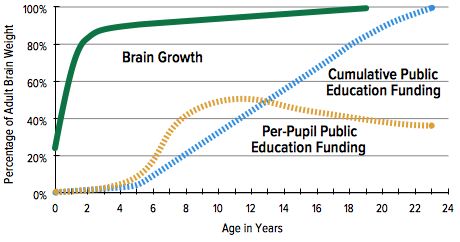
Education neuroscience research makes it really clear that the brain and young body are growing at an incredible rate during the early years (90% of your brain grows during age 0-5). It makes absolute total sense that we have much more effective programs and focus on ensuring high quality early childhood development for every child.
But I'm not so sure "universal Pre-K" is the way to make that happen. Here are some of my concerns and mixed feelings, specific to Tennessee and Nashville's case:
- "Gold
standard" studies of Pre-K show cognitive increases fade out, generally
by 3rd grade. The large Head Start study has shown that, and
unfortunately, the Vanderbilt Pre-K study has shown that recently as
well. This is a MUST READ on the topic: "New Evidence Raises Doubts on Obama's Preschool for All."
- Professor Dale Farran, lead researcher on the Vanderbilt study, has some very good points in this piece, emphasizing that some of the non-cognitive
gains that come out of Pre-K are quite important for both school and
life. I completely agree, but I don't think we know conclusively if
non-cognitive skill gains we see in Pre-K or Head Start are a direct
result of the programming or other factors - such as the child growing
and maturing around that age. It's also very hard to create public
policy for an expected return 20 years from now. We don't know
concretely enough (the previous long term studies on early childhood
programs have been small).
- Institutionalizing
Pre-K in the school system does not sound appealing to me if we're
looking for high quality outcomes for kids over time. There are many
reasons I feel this way, but structurally, once it is locked in the
school system, there's not much incentive for the system to keep up it's
quality.
- Less may be more.
Educating a diverse
student body of 81,000 students in grades K-12 is hard enough, and the
challenges are large enough, that we don't need to also expect MNPS to
knock it out of the park as a high quality early childhood provider.
What I'm most concerned with is quality. I want quality K-12, I want
quality early childhood programs - and I'm concerned that if MNPS tries
to take on "universal" Pre-K, some attention will drop from the
educational programming quality in K-12. Both might suffer.
- If
Pre-K is going to be expanded in Nashville - I'd rather see the school
system follow the state model that allows non-profit providers and
community organizations to provide Pre-K classrooms. I think MNPS would
be more effective as a "program manager" and funder, and not an operator
of Pre-K. MNPS as a gatekeeper of quality if you will, vetting
applicants and monitoring quality outcomes, and shifting funding when a
community provider isn't meeting a high
quality standard, sounds much more appealing and promising than MNPS as
a provider of more Pre-K.
- The
district faces a pretty substantial issue of facilities when it comes
to providing universal Pre-K, or simply more Pre-K seats, for that
matter. In the high need areas of Nashville where Pre-K would be most
useful - many of the elementary schools in those areas are already
pretty overcrowded with their K-5 student populations. Hence, MNPS
often places Pre-K classrooms across the city where there ends up being
available space - not necessarily where the demand is greatest, or where
the impact can be the greatest (and not many parents want their 4 year
old riding the yellow school bus for 30 minutes or more each day).
- Not
only that, but when Pre-K classrooms are put in elementary schools, one
of the "quality" concerns that goes along with that is that the
elementary school principal is tasked with managing the
Pre-K program. Nothing against elementary school principals - but they
are often focused on TCAP pressures for their 3-5 grades, evaluating
teachers in grades 3-5, and often don't have an extensive background in
what high-quality early learning looks like or know how to deliver high
quality PD to the early learning teachers. I think this was some of the
thinking in San Antonio - they are building 4 Pre-K demonstration
centers (Pre-K) only that will educate 2,000 PreKers. The other portion
of the enrollment will be filled by non-profit and partner school
district providers.
- When
MNPS hires Pre-K teachers - they pay them on the MNPS teacher step and
ladder pay scale. It is a much higher wage, higher than what the labor
market for early childhood teachers currently pays, and while great
teachers are worth every penny - MNPS adding more Pre-K will mean they
will draw some of the best early childhood teachers from private and
non-profit
providers in the city. The same thing happened when the state
voluntary Pre-K program started up and MNPS adopted more Pre-K
classrooms. Is it good policy to migrate those teachers into the school
system from the private or non-profit sector? Is the sum of the whole
less? (if teachers move to MNPS, that means those teachers aren't in
private or non-profit settings, offering their professional expertise
and development to other developing ECE teachers)
- There are big opportunity costs to investing scarce public dollars into Pre-K,
whether it be "universal" or halfway there to "universal." For
example, with the big concern of the "fadeout" problem - where cognitive
gains have shown to be lost from Head Start or TN Pre-K programs - if
the district or the state is itching to spend x million dollars more on
early childhood - what about putting that money towards ensuring a more
robust K-3 educational quality for all
students?
More reading specialists in grades K-3? Creating a firm foundation of early literacy for all students is extremely critical. MNPS could pay for 1,000 more Pre-K seats or 200 reading specialists deployed throughout the district. Or what about putting that money towards even more effective expenditures at an earlier age? Nurse-family partnership programs, especially for infants and toddlers in low-income settings, have shown really solid benefits to the child and family.
We need much greater attention on the issue as a community. Our public policies need to reflect smart and sound investments in our youngest when their bodies and brains are most vulnerable. Age 0-5 is an incredible window of opportunity for every developing child. That biological fact is not going to change.
But "Universal Pre-K" might not be the best policy solution to accomplish such an important priority.